• There seems to be an uptick in Political comments in recent months. Those of us who are long time members of the site know that Political and Religious content has been banned for years. Nothing has changed. Please leave all political and religious comments out of the forums.

    If you recently joined the forums you were not presented with this restriction in the terms of service. This was due to a conversion error when we went from vBulletin to Xenforo. We have updated our terms of service to reflect these corrections.

    Please note any post refering to a politician will be considered political even if it is intended to be humor. Our experience is these topics have a way of dividing the forums and causing deep resentment among members. It is a poison to the community. We appreciate compliance with the rules.

    The Staff of SOH

  • Please see the most recent updates in the "Where did the .com name go?" thread. Posts number 16 and 17.

    Post 16 Update

    Post 17 Warning

**The OFFICIAL All Sims Air Tour Thread**

Tuesday 13th. Jan (Report filed on 14th.)
Part 1 (KAAO) → (KTUL) Part 2 (KTUL) → (KFTW) → (KDTN)
FS9/2004

Part 1
The weather was too good, and the opportunity unique. So we grabbed both, and as they used to say in Monty Python; “Now for something completely different”:
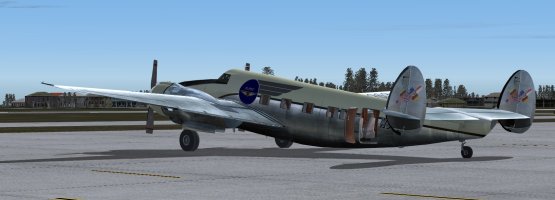
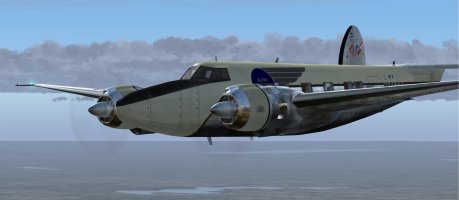
1 Hughes.jpg

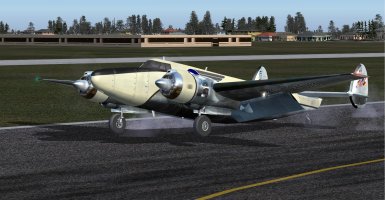
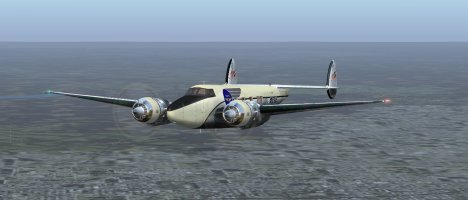
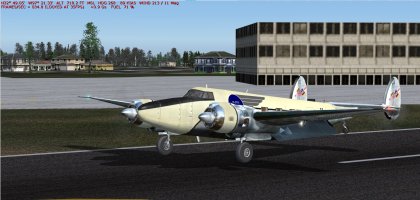
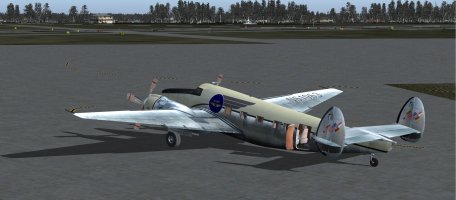
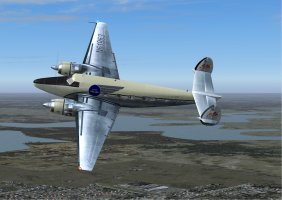
Belonging to the FS Flight Club International it was for hire complete with experienced co-pilot to mentor and oversee whoever was going to pilot (can you blame them?).
Yes, I know, it first flew in 1963 but its hart and soul hark back to the Lodestars and Venturas it was developed from. A thing of beauty and power but commercial indifference (only 22 built).
Clearly good ol’ Dee Howard had not heard Bob Dylan singing The Times They are A-Changing.
It was pressurised and did have a luxurious interior, but a tail dragger, with two 18 cylinder radials in 1963?
Still from such eccentricity this beast was born; “thank you Dee!”.
Suzanne the only experienced enough pilot to take command (with the help of the clubs’ co pilot.).
Tanks full, no worries about payload for these legs, whatever was in her make-up case. We powered up:
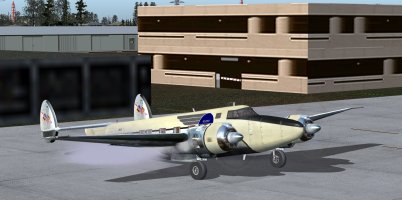
2 HOWARD POWER UP.jpg

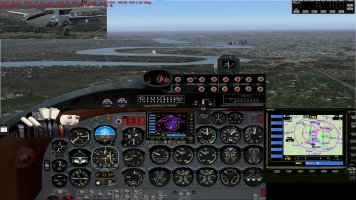
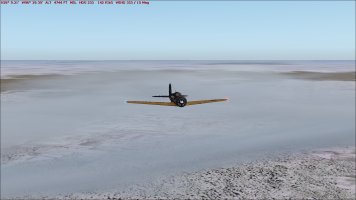
Ground handling abysmal, all done with differential braking. But take-off easy with one click of flaps and a touch of up trim. Probably both superfluous on runways over 4000’. Each engine developing some 2500 hp.
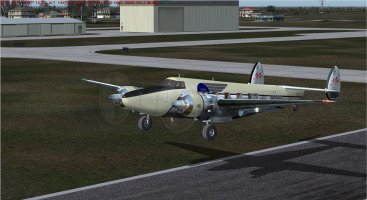
3 howard up.jpg

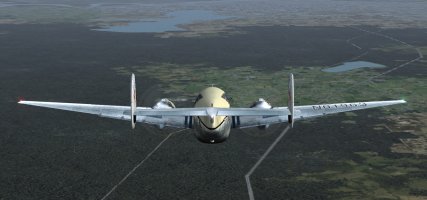
Capable of climbing like an executive jet, Suzie kept it at 1500’ / min. for safety as we climbed and turned onto a 140 heading for Tulsa. McConnell AFB below our right wing.
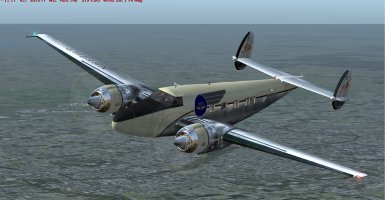
3 hugh turn 140 f Tulsa.jpg

Before you could say “thirty-six cylinders” we were descending for Tulsa (KTUL). Wind was westerly so we opted for rwy 26. As you can imagine everything happens fast with this baby, slowing from around 300kts to a 220kts descent then a manoeuvring speed around 160kts. We overshot the approach so had to adjust, with an approach around 120kts and final around 110Kts. Not enough time to fly and take pictures, sorry.
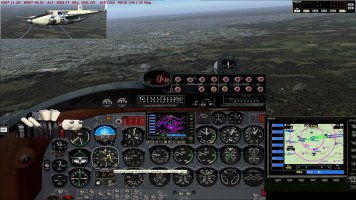
5 hugh final tulsa.jpg

The touch and go; a rather one wheel affair but I still count that as a touch :oops:.
6 Hugh t and g tulsa.jpg

Leaving Tulsa on a 210 heading for (KFTW) Fort Worth.
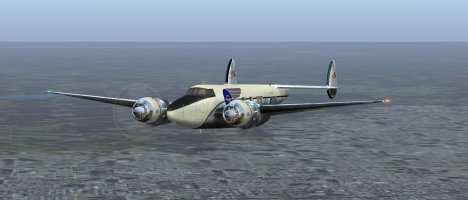
7 hugh leaving tuls.jpg

Next part of the journey in part 2
 
Tuesday 13th. Jan (Report filed on 14th.)
Part 1 (KAAO) → (KTUL) Part 2 (KTUL) → (KFTW) → (KDTN)
FS9/2004

Part 2
We left Tulsa turning onto a heading of 210 for (KFTW) Fort Worth and Texas:
7 hugh leaving tuls.jpg

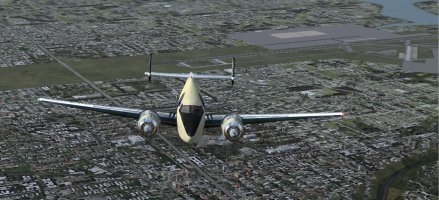
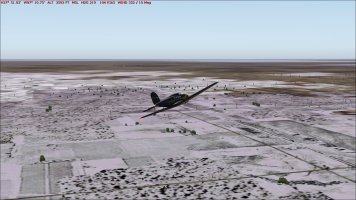
We were soon up to 8500’ our chosen cruising altitude and on one of the longest legs of the tour able to see what the Howard 500 could do. Restraint required as our co-pilot was not happy if we took her over 300 kts. The nominal top speed at sea level some 350 kts. The journey fast but uneventful. We were soon over lake Texoma and into Texas. The radio was playing up again stuck on the Tulsa frequency. So entering probably the busiest airspace since Chicago with no ATC. We descended to 3000’ approaching (KFTW) Fort Worth, the wind 236 at 17 kts so we went for rwy 27.
A better touch and go this time:
9 High t a g KFTW.jpg

Suzie made a rather sharp climbing 180 turn to bring us onto a heading of 100 degrees for (KDTN) Shreveport Downtown:
9 turning f KDTN.jpg

Dallas ATC must be cursing us; here crossing Fort Worth Intl. With radio silence:
10 over Dallas.jpg

Soon away from Dallas and heading east for the Arkansas border and Shreveport:
11 to shrev.jpg

Steep descent for (KDTN) , those massive slab flaps acting as air brakes.
12 descend shreve.jpg

Although not the ideal rwy for the wind we decide to test the autopilot on the rwy 14 ILS.
It did not go well; the autopilot tried to dive the aircraft into the ground. Suzanne responded quickly flicking the autopilot approach switch off and with the help of the 5000hp. available recovered to the approach path and took us in manually:
13V kdtn fINAL.jpg

Down and disembarking in (KDTN) Shreveport. What an adventure that was!
14 all off KDTN.jpg
 
I flew Leg 18 from Atlanta to Greenville y'day, and used an aircraft at totally the opposite end of the size range to the Ensign, a DH 80 Puss Moth, which has only three seats on a good day, and the pilot's in one of them. As luck would have it I've flown in the rear seat of a Puss Moth while filming (8mm, not video, as it was in 1974....) a test train that I worked on in the 70s. The train was considerably faster than the Puss Moth was!

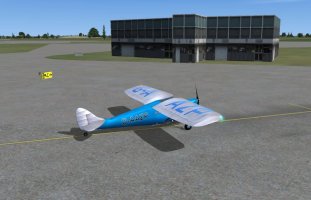
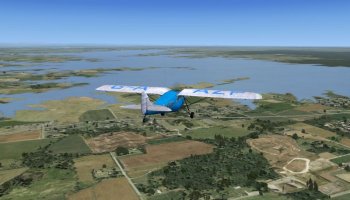
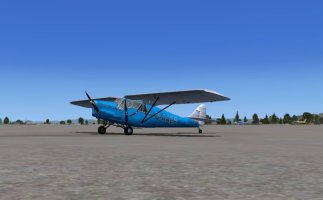
Here's G-AAZP on the ramp at Atlanta, next to the only building that FSX placed there.....

Leg 18-a.jpg

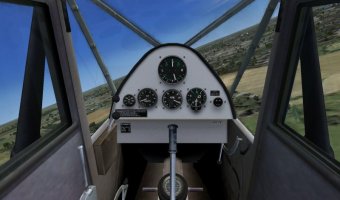
The model has a lovely, albeit minimal, panel, which works really well in both 3D and 2D forms.

Leg 18-b.jpg

She steered very nicely on the ground and I was soon airborne and on my way north east again. For a change the weather was pretty much CAVU, and was I ever glad not to be flying through that clag again! I cruised at 2500 ft to make the best of the superb visibility from the cabin, but I kept the windows closed on this occasion, unlike when I was filming the train as they were full open then and I was half outside them, at 75 kts! :oops:

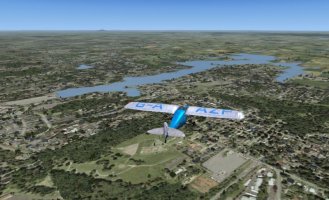
The first notable landmark was this rather nice lake that had me wishing the Puss Moth had floats. It was called Lake Spivey btw.

Leg 18-c.jpg

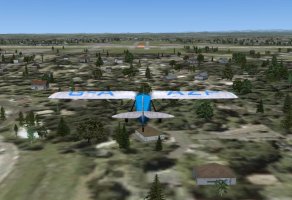
Mostly the local scenery was pretty flat, which was OK by me as I didn't have to worry about bumping into anything, and I was able to spot the numerous airfields that cover the entire USA, but this one was a real zinger! It's entitled the 'Gordon E Bellah International Airport' (4GE2) would you believe? And it only has grass runways!! How can it be 'International' for crying out loud?

Leg 18-d.jpg

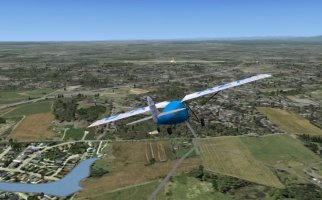
Approaching the Georgia-South Carolina state border was rather obvious as in this area the border is the Savannah River, and I was going to cross it as it spread into Lake Hartwell, which is MASSIVE!

Leg 18-e.jpg

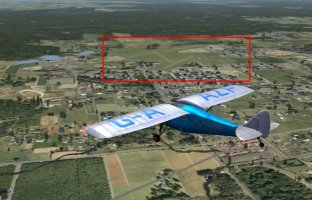
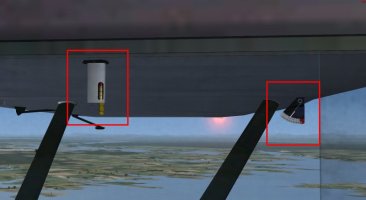
Having mentioned the Puss Moth's excellent panel, I feel I should also say that some of the 'instrumentation' isn't actually on the panel itself. The fuel gauges hang out underneath the wing tanks, and you need to look sideways to check on them. That's the port one inside the LH red rectangle in this pic. And the item in the RH rectangle is the stand-by airspeed indicator! Yes, really, and if you zoom in to it you can read it too! It's just a small rectangular blade that's pushed up a curved scale by the air flowing past it, as basic as they come!

Leg 18-f.jpg

Turning onto the approach for Greenville meant heading way out east and coming back as I had a westerly wind here, but it was a nice simple STAR anyway.

Leg 18-h.jpg

Slowing the Puss Moth was 'different' as it doesn't have any flaps, and like most DH designs it's a very low drag airframe, but with the aid of a large lever and some complex linkages the main landing gear struts, which have quite a large chord, twist through 90 degrees to help slow you down! And they actually do twist in the FSX models too, a wonderful bit of work. You can just about see the difference in the two pics, one above with the struts in the low-drag position, and the one below in the high-drag position.

Leg 18-i.jpg

The landing went OK, and I was soon parked up on yet another structure-less airfield, and with only two other aircraft in sight.

Leg 18-j.jpg

Quite a slow flight of course, the Puss Moth is a 1930s GA aeroplane of course, but I still averaged 101 kts thanks to a hefty tailwind most of the way, and I used a paltry 13 galls of fuel. Very environmental. :)
 
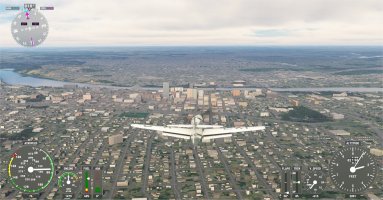
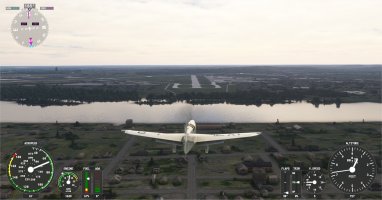
Leg 13: Fort Worth Meacham International (KFTW) to Shreveport Downtown (KDTN)

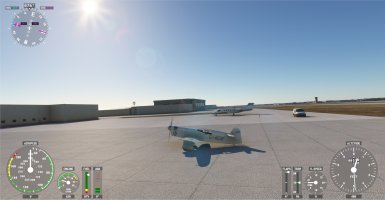
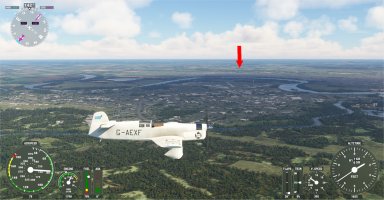
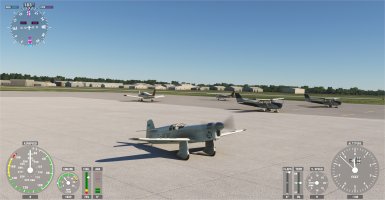
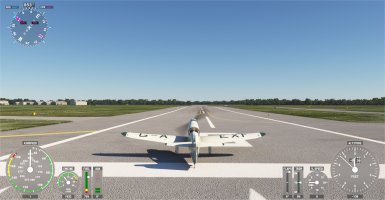
Flying the Percival Mew Gull in MSFS 2020. Using Active Sky FS for weather and Little Navmap for navigation. Using FSLTL for AI traffic.

01 sunny day.jpg
Engine started on a sunny day in Texas. 87% fuel on board.

02 takeoff 35 small.jpg
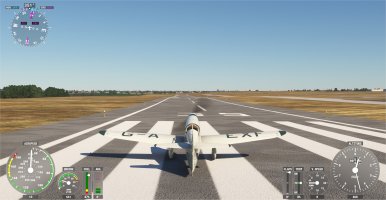
Lined up for takeoff on runway 35. Runway 35 was the shorter runway for smaller aircraft. The tower suggested that I leave runway 34 for the big boys to use. Interesting that the runways are not laid out exactly parallel.

03 runway heading 35.jpg
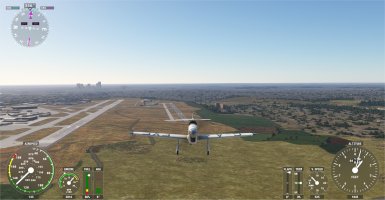
On the way on runway heading. The tower asked me to stay on runway heading for a bit to get clear of the airport vicinity before making my right turn to get on course. Turning too soon would interfere with the runway 34 traffic.

04 Dallas on left.jpg
Passing Dallas on the left.

05 half way there.jpg
Half way there. More clouds ahead but still good weather.

06 cruising at 2500.jpg
Cruising at 2,500 feet. The direct course to Shreveport is 91 degrees, but I am staying on an average course of 87 or 88 most of the way. There has been a steady crosswind of 20 to 25 knots from my left during the flight. And light turbulence most of the way as well.

07 airport ahead.jpg
Airport in sight ahead.

08 downwind for 32.jpg
Wind is out of the North so on a downwind leg for runway 32.

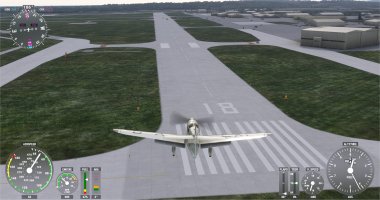
09 short final for 32.jpg
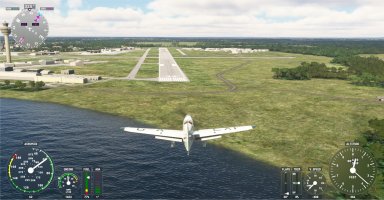
Short final for runway 32. Just after I snapped this picture I used Active-Pause in MSFS 2020. My wife asked me a question and we talked for a few minutes. When I turned back to the simulator and un-paused I must have been still distracted by my lovely wife, because I immediately pushed the throttle up to full instead of cutting back to idle as was my original intention. When the Mew Gull surged forward, I immediately figured out what was wrong and corrected. Lucky for me that runway 32 is over 5000 feet long. Needless to say my touchdown spot was the furthest down the runway of this Air Tour so far. No damage to the Mew Gull or the landing gear though.

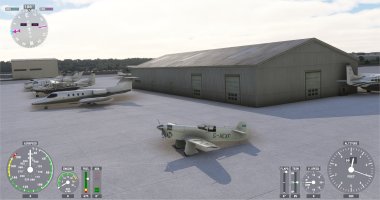
10 parked at KDTN.jpg
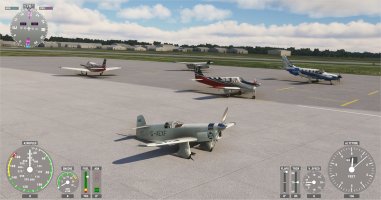
Parked on the General Aviation ramp with plenty of company. 76% fuel on board.

Next stop is Adams Field (KLIT)
 
Clear skies, intermittent snow, and 15deg F ...cold as a taxman's heart. Map says it is 180 miles to Wichita, any linemen out today are teasing the brass monkeys.

kmkc.jpg

As flat and featureless as flying over the ocean, a third of the way along
flat.jpg

KEMP, Emporia Municipal Airport, opened in 1944, it hosts around 30,000 operations a year. 60 miles to go.
kemp.jpg

Obscured by clouds
weather.jpg

And there is KAAO, Colonel James Jabara Airport, named for the WWII and Korean fighter pilot who was the first American jet ace; 15 victories in Korea gave him the title of "triple ace" and he was ranked as the second-highest-scoring U.S. ace of the Korean War. He and his daughter were killed in an auto accident in Florida in 1966, they are buried together at Arlington.
kaao.jpg

kaao_2.jpg

186 miles in 66 min.
kaao_3.jpg
 
Last edited:
14th. January (Report filed on 15th.)
(KDTN) Shreveport → (KLIT) Adams, Little Rock
FS9/2004

Time to leave for Little Rock and Adams airport (KLIT).
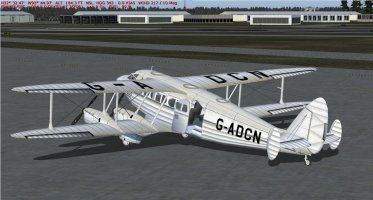
We decided on something older and slower but not less interesting:
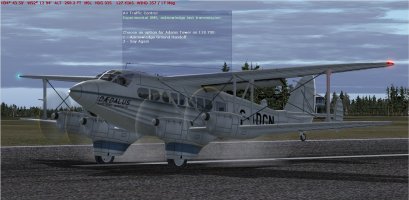
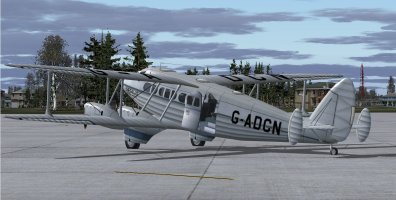
De Havilland.jpg

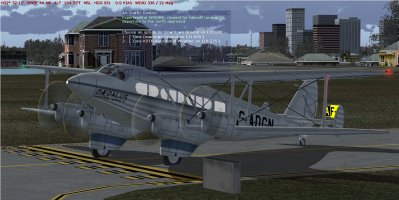
Designed as an enlarged De Havilland Dragon it was meant to fulfil an Australian air mail requirement, she was named the De Havilland DH-86 Express
This turned out to be the worst leg so far…
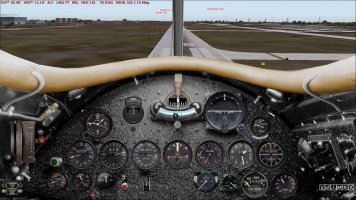
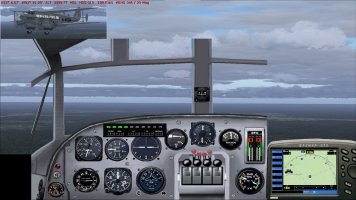
We climbed on board and were faced with a poor panel:
Panel.jpg

Yet fitted with a modern autopilot but no radio. The throttles just dummies, alarm bells did not ring, possibly because the model is so nice to look at.
Fuelled and plenty of room for us (it was designed to carry 10 to 12 people).
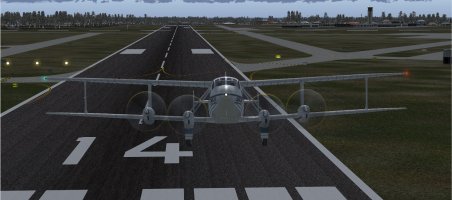
A northerly wind blowing 16 to 28 kts so we taxied to hold at rwy 32. Ground handling just about OK.
2 wait clear rwy 320.jpg
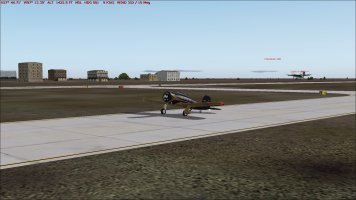
Take off OK; the 4 Gipsy six engines doing their duty:
3 airborne.jpg

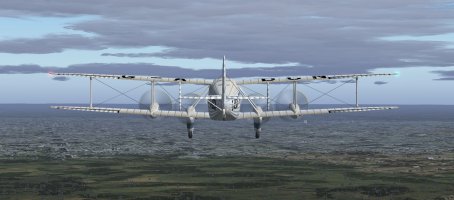
We levelled out at 3000’ clipping along at 185 kts with a near 20 kts headwind. It just seemed too good to be true. Nothing much to do about it now, I’d do some research on the real thing after landing.
4 cruise.jpg

The modern autopilot worked well (even if unrealistic) so we headed on, soon approaching Little Rock:
5 approach lit r.jpg

The hidden radio worked well; we were directed to 4R. The wind was still a strong northerly so rwy 36 would have been easier. Sometimes (often?) FS9 ATC is best ignored. The approach and landing difficult:
6 landing.jpg

Using the hidden radio I was directed to parking at the opposite end of this large airport, after more than three miles of taxiing we parked and powered down.
7 powered down.jpg

Research from Wikipedia revealed its max speed was 145 kts and cruise 125 kts.
By all accounts it was a not very successful air plane in real life:

“Seriously lacking in directional stability, the D.H.86s were frequently in trouble.”

“The D.H.86 had been rushed from design concept to test flight in a record four months to meet the deadlines set by the Australian airmail contracts, and a lot of attention to detail had been ignored. It was a big aircraft for its power, and as a result very lightly built. There was poor response to control movements in certain speed ranges, the wings were inclined to twist badly if the ailerons were used coarsely and, most seriously, the vertical tail surface was of inadequate area. The result was an aircraft that, although quite safe under normal conditions, could rapidly get out of control under certain flight regimes.”

So to conclude: nice model but poor panel and unrealistic performance. We will probably fly something smaller next time for a change (take a feather from Bosspecops book.)

The real thing:
Real thing.jpg
 
Warming up at KAAO, another cold clear day with occasional snow.
kaao.jpg

The view never changes (if anyone knows why I have those darker textures beneath the plane, please wise me up; it's been like this for years, through different textures and different terrain settings)
view-never-changes.jpg

An interim stop at KBVO, Bartlesville OK, home of Philips Petroleum; 102 miles from KAAO.
kbvo.jpg

I've had their airplane since December, they want it back.
down.jpg

They've offered me a loaner. But what.
 
hmmm ...does it have a pot-bellied stove for heat?
x.jpg

kbvo_fokker.jpg

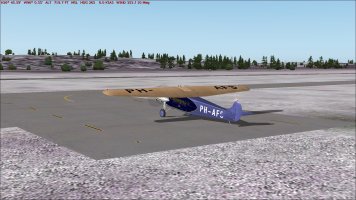
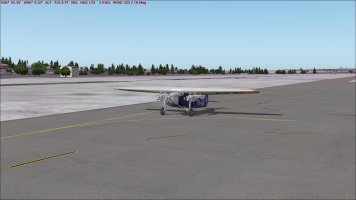
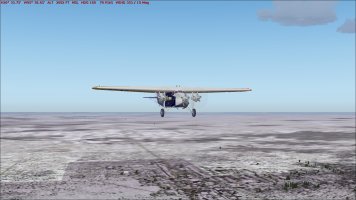
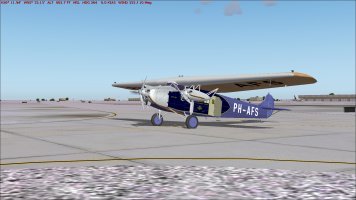
Fokker F.VII, a mainstay of many airlines in the late twenties-early thirties; it remained in service with Imperial Airways til the early forties ...ten years after its "best if used by" date. This is a KLM aircraft, ca 1930. Oh well, it will get me to Tulsa. I hope.

Taxi to the runway, ground handling is atrocious.
taxi.jpg

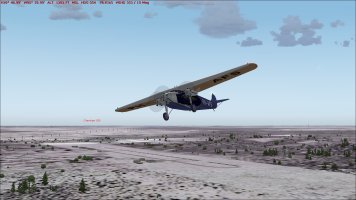
And we're off; in the air it is stable and easy to fly, though rather sluggish.
off-to-tulsa.jpg

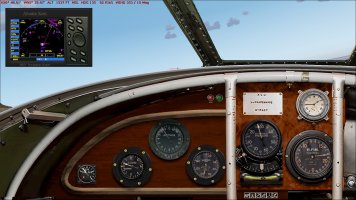
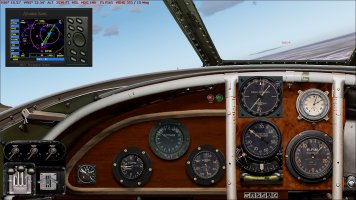
The office is almost ...Victorian. (At least two F.VIIs are still flying, both have completely modern cockpits.)
office.jpg

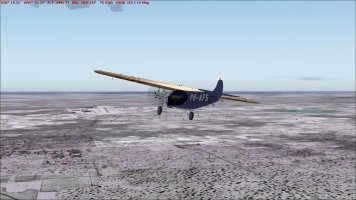
Terrain is still monotonously flat. Cruising at 2500ft, 80kt; the Orion could fly circles around this crate. (Once flew this from London to Rome, at least there was scenery along the way.)
flat.jpg

Almost there
almost.jpg

almost2.jpg

Done, from Bartlesville 45 miles in 30 minutes. Total from KAAO, 147 miles in 1hr 24 minutes.
ktul.jpg
Now, who do I have to sleep with to get a faster plane.
 
Last edited:
JGF, really nice panels on both your planes, did they come with the planes or have you built them yourself? And if you did are they shareable?
Oh, and by the way, I think you got the last statement the wrong way round, you're more likely to get your plane if you promise NOT to sleep with whome it may concern. ;):LOL:
 

15th. Jan (Report filed on 16th. Jan)

(KLIT) Little Rock → (KMEM) Memphis Intl.
FS9/2004

It is one of the shortest legs, so we all agreed; something slow and relaxing as we head for the remarkable musical heritage of Memphis.
We headed out to the pretty little thing on the apron, Suzanne and Callum singing the chorus: “Walking In Memphis”


I try not to mix my metaphors, was it a feather out of Bosspecops hat, or a leaf out of his book?
No matter, that is where the inspiration came from. Thank you:
1 jack.jpg
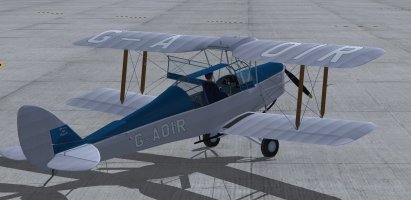
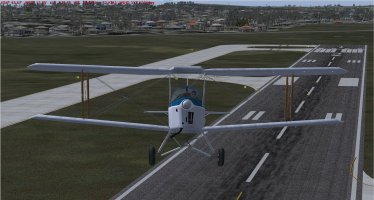
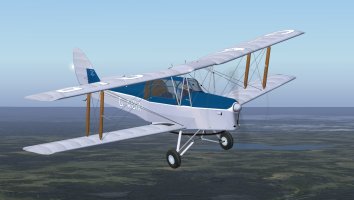
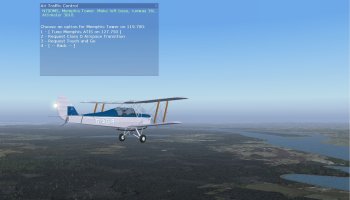
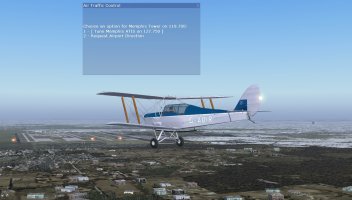
The De Havilland DH-82A (Mod) known as the Jackaroo

How it came to pass:

“In the early post-war years a shortage of US dollar exchange contributed to a British Government decision to ban the import of light aeroplanes from America. Surrounded by ex-RAF Tiger Moths, Squadron Leader J.E. Doran Webb of the Wiltshire School of Flying at Thruxton Aerodrome commissioned Ron Prizeman, Chief Engineer of Baynes Aircraft Interiors at Heston, to design a four-seat cabin aircraft based on the DH.82A Tiger Moth. The result was the Thruxton Jackaroo, certificated as a DH.82A (Mod)”

Four seats in an enclosed cabin and a heater mounted on one of the most fun trainers to fly; what’s not to like?
We squeezed our 535 Lbs of pay load in and yet still able to fill to 99% capacity (135 Lbs or 22gallons of fuel). The panel was minimalist but fitted with a small modern radio and GPS.
Cleared for take off rwy 4L I gave her full power, she has no flaps and was loaded to near maximum so took some time before the tail lifted and eventually the main gear became unstuck from the tarmac and we climbed gently. The chorus had changed to: “We’re going to Graceland, Graceland Tennessee.”


4 jack take off.jpg

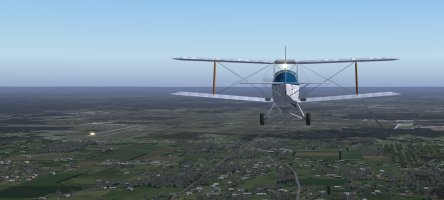
The weather report had indicated northerlies 4kts up to 2600’ and 22 Kts above, so we levelled off at 1500’ following the roads and a railway line all heading due East. Cruise was 2300 RPM giving a ground speed of around 86 Kts. Here passing Carlisle Municipal:
7 Jack Carlisle airport.jpg

“I bet the Rocket 88 could go faster” Suzanne shouted (It was a noisy cabin).
“The what?” Callum and I asked
“The Oldsmobile Rocket 88. Considered the first rock and roll song. 1951 Jackie Brenston and his Delta Cats. Part of the early Memphis blues movement”


“Every day is a school day” as they say.
The landscape flat as a pancake. We pointed out any features worth noting.
“We’re over the White river, or is it a Bayou?”
“Roy Orbison or Emmy Lou Harris?”

Finally a slight change of direction as we approached the Big Muddy
8 jack to memph.jpg

As we approached the big river we received clearance for rwy36L at Memphis Intl.
10 jack clear rwy 36L.jpg

Over the river and approaching the only hill for miles, was it an FS9 oddity or does it exist in the real world?
11 jack hill.jpg

On base leg for rwy 36L, lights visible off our left wing, as is the wind speed indicator (same as on Bosspecops craft) fitted to the wing spar.
12 Jack memph.jpg

Turning onto final, with patches of snow visible.
13 final 36L.jpg

Down safely cruising in at 58 kts.
14 touch down.jpg

Now for an almost four mile taxi. Had I known where we would be directed for parking I would have landed a mile and half further down the 9300’ runway. That tail skid probably worn away to nothing.

Finally parked, we unloaded us and belongings and took a taxi to Graceland.
15 Jack down off.jpg
 
really nice panels on both your planes, did they come with the planes or have you built them yourself

Thanks! Both are my own creations, from photos found online. In an earlier post someone mentioned a nicely modeled aircraft with a "poor" panel; it was an identical situation, years ago, that got me started making panels. When I got my first wide screen monitor I started making wide screen versions, redoing many of my earlier ones, and creating new ones for default aircraft. In some cases I stitch together parts of several photos, resizing and correcting perspective, occasionally use parts of original panels, whatever works.

A few more will make appearances as our tour continues.

I've not uploaded many publicly for "permissions" reasons; Flightsim told me I couldn't upload unless i had written permission from the creator(s) of every gauge used, except MS defaults ...my gauge folder contains around 8000 gauges dating back to FS98 days, I've no idea the source of 90% of them, and even if I did what are the chances of contacting all those people today and getting a response. In a few cases, mostly military aircraft, I knowingly used payware gauges, but I obviously purchased those aircraft and only use those gauges personally.

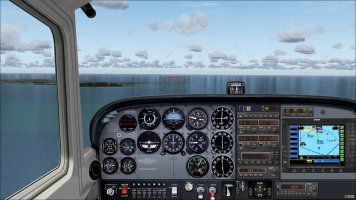
Default C172 widescreen
c172_wide_pnl_sm.jpg

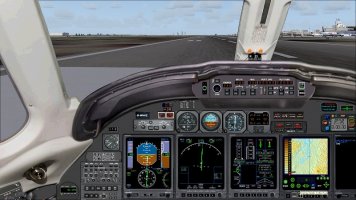
Citation X wide
citation_pnl.jpg

P-38
p38j_pnl_sm.jpg

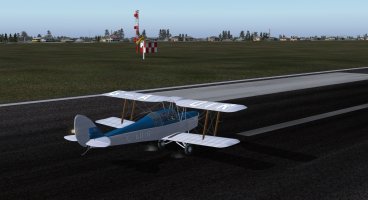
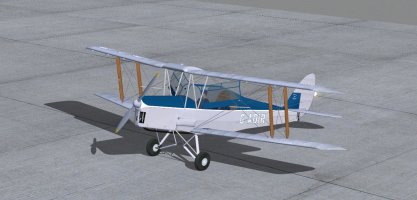
One of my first, for a Bristol 170, never found decent references for a wide screen version
b170_sm.jpg
 
Leg 14: Shreveport Downtown (KDTN) to Adams Field (KLIT)

Flying the Percival Mew Gull in MSFS 2020. Using Active Sky FS for weather and Little Navmap for navigation. Using FSLTL for AI traffic.

01 engine started ready to go.jpg
Engine started on a sunny day. 76% fuel on board.

02 takeoff on 05.jpg
Finally a short taxi to the runway from the ramp. Lined up for takeoff on runway 05.

03 on the way.jpg
Up in the air and on the way.

04 only 2 spots to land.jpg
If this very reliable engine quit, I can only see two good emergency landing spots below. Once when I was on a RW check ride doing an emergency landing drill, I had a perfect field picked out until I got close enough to see a tractor sitting in the middle of the field. Quickly chose another nearby field to head for and passed the drill as a result.

05 town of Magnolia below.jpg
Flying over the town of Magnolia.

06 airport in sight.jpg
Airport in sight ahead.

07 downwing over Little Rock.jpg
Over the city of Little Rock. On the downwind leg for runway 18.

08 long final for 18.jpg
Long final over the river for runway 18.

09 almost down on 18.jpg
Almost down on 18. Safe and easy landing.

10 parked at KLIT.jpg
Parked at Adams Field (KLIT). Lots of aircraft lined up here. 67% fuel on board.

Next relatively short flight is to Memphis International (KMEM).
 
An apology.

This was an instructive case of how one has to be careful when doing research on line.
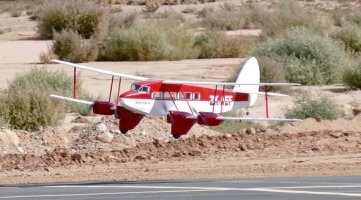
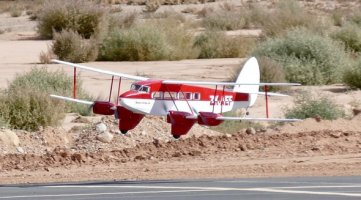
In my Shreveport to Little Rock leg I used the De Havilland DH-86 Express and posted a picture of the plane stating it was the real thing:
Real thing.jpg

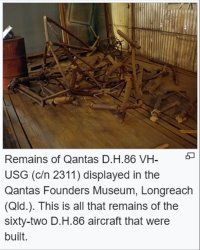
It was a real thing, but on further examination the plane looked quite small compared to the background bushes and earth clods and boulders. When I came across this on Wikipedia I smelt a rat:
Left overs 2.jpg

The picture was of (a very nice) radio controlled model.
I also hope that is not the prize and best exhibit at the Qantas Founders Museum. :eek::LOL::ROFLMAO:
 
So true, finding pics of almost any vintage aircraft on the Net these days almost always results in 80% of the pics being of models! :(

Not that I have anything against models mind you, building them is my main hobby, but when you're looking for reference pics it gets to be a nuisance.
 
Back
Top