
Mikoyan Gurevich Mig-3 late version 6 IAP
The late Spanish Civil war experience showed the Soviet fighter aircraft to be inferior to the German Bf 109 which convinced Stalin that the Soviet Air Force needed to develop more modern fighter aircraft. The Mig-1 was one of several types rushed through design and into service in 1939 /1940. Major teething problems were encountered and the type went through several design changes resulting in the Mig-3. The Mig-3 was widely in service when the German invasion began. The late version incorporated a longer nose to accommodate space for more ammunition. Designed as a high altitude interceptor, the Mig-3 was forced to fight at low altitudes and even in ground attacks where it was unsuited and its performance was inferior to German types. Nevertheless it was available in large numbers and continued in service well into 1943.
Credits
Captain Kurt: Aircraft model, and Rs-82 rockets and rack
UncleTgt: Paint schemes and air files
Shessi: Pilot figure
Kelticheart: Prop blurred texture
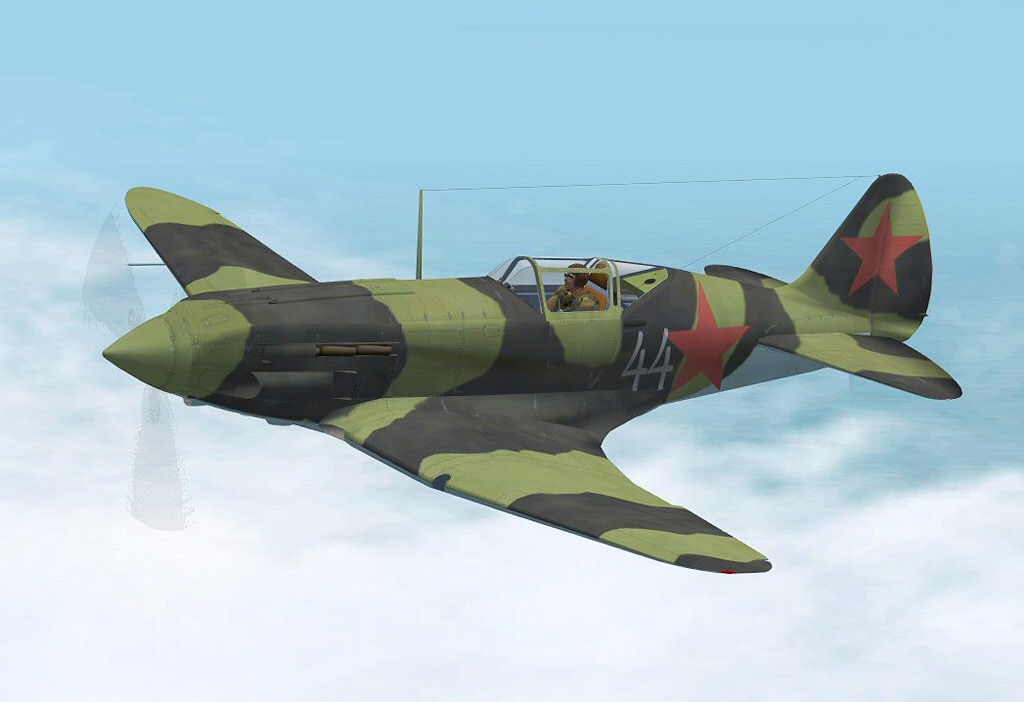
The late Spanish Civil war experience showed the Soviet fighter aircraft to be inferior to the German Bf 109 which convinced Stalin that the Soviet Air Force needed to develop more modern fighter aircraft. The Mig-1 was one of several types rushed through design and into service in 1939 /1940. Major teething problems were encountered and the type went through several design changes resulting in the Mig-3. The Mig-3 was widely in service when the German invasion began. The late version incorporated a longer nose to accommodate space for more ammunition. Designed as a high altitude interceptor, the Mig-3 was forced to fight at low altitudes and even in ground attacks where it was unsuited and its performance was inferior to German types. Nevertheless it was available in large numbers and continued in service well into 1943.
Credits
Captain Kurt: Aircraft model, and Rs-82 rockets and rack
UncleTgt: Paint schemes and air files
Shessi: Pilot figure
Kelticheart: Prop blurred texture


