• There seems to be an uptick in Political comments in recent months. Those of us who are long time members of the site know that Political and Religious content has been banned for years. Nothing has changed. Please leave all political and religious comments out of the forums.

    If you recently joined the forums you were not presented with this restriction in the terms of service. This was due to a conversion error when we went from vBulletin to Xenforo. We have updated our terms of service to reflect these corrections.

    Please note any post refering to a politician will be considered political even if it is intended to be humor. Our experience is these topics have a way of dividing the forums and causing deep resentment among members. It is a poison to the community. We appreciate compliance with the rules.

    The Staff of SOH

  • Please see the most recent updates in the "Where did the .com name go?" thread. Posts number 16 and 17.

    Post 16 Update

    Post 17 Warning

welllllllllllllllllllllllllllllllllllllll......... ....

warchild

Charter Member
Only have one for you tonight.. Was finishing up some fuel adjustments and doing a test flight from KRDM to KSFO to judge the fuel usage, and stepped out of the plane for a little walk ( stretch my eyeballs for a bit and let them relax on something besides lighted dials) when i saw this. Hope you folks like it..
Thanks to Pauls good eyesight, we have the stall/spin characteristics back, but it comes at a price. as nice and easy as we tried to make this plane, you'll need to use aileron and rudder trim. not much, but a smidgeon, and the plane will drift so make sure of where your going because there is no autopilot. Theres not even an adi.
Also, the pilot has been rescaled. he's lookin real good now.. i mean REALLY ( Thanks Dean :D :D :D )good :D.. I'll be shipping the Beta 2 version of the FDE to Paul and Dean tomorrow for shredding, but frankly, i think we got it right.. finally ::lol::..
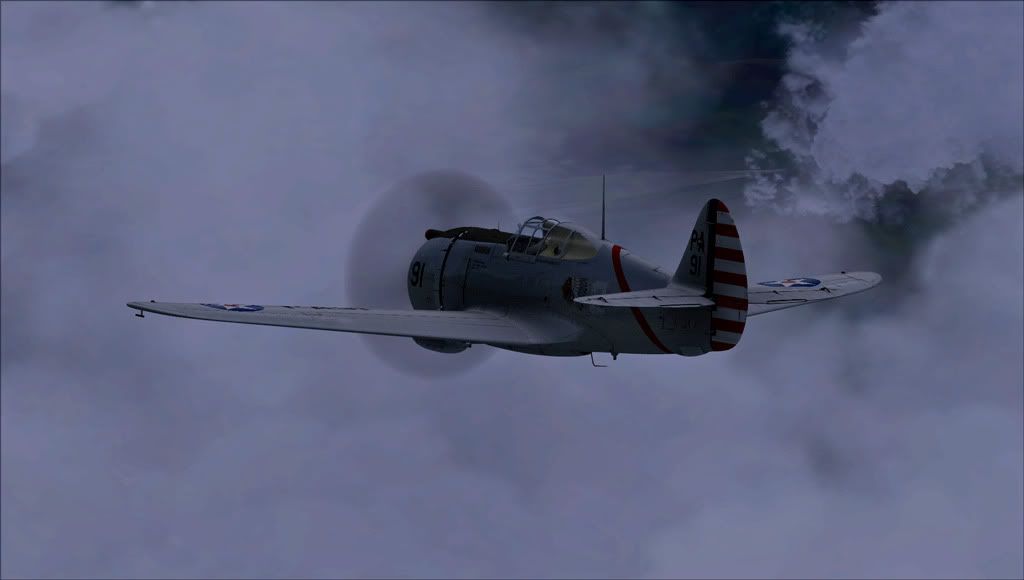
2010-4-23_20-44-25-966-copy.jpg


PS.. forgot to mention, and i'll have to add it to the manual ( or dean will ). To get the range, your gonna have to fly her for real.. Use a bit of a right rudder on takeoff roll and watch out for the yaw on takeoff. it isnt bad, but it can surprise you.. One you climb to cruise altitude, adjust your propeller for 55% pitch, and your mixture to auto lean, then adjust your throttle for 250 knots and trim all three axis'
Pam
 
Hi Fliger...
The P-36 has a very unique way of setting automatic prop pitch. you simply put the prop pitch lever for a certain pitch angle and it goes into automatic pitch. In the actual airplane its 73% ( i believe ), but for the test flight where i was able to get a full 835 miles i set it to 55%.

The tailwheel is similar in that it is steerable up to 35 degrees, but beyond 35 degrees, it disconects itself from the rudder and spins freely.

one quirk of the French version that did not get modeled ( and you'll be glad it didnt ) is that the French throttle operates in reverse of the American throttles..

Like i mentioned to another gentleman, it seems almost like the designer saw Friz Lang's Metropolis and fell in love with automation...
 
Pam, I was wondering if you had found and incorporated the power settings for the P-36, with Manifold Pressure/RPM, for take off, cruise, landing, etc.? I ask, because Manifold Pressure and RPM is what one should go by to get proper airspeeds, temps, and fuel burn, instead of approximating a throttle or prop-lever-position percentage.
 
I've got manifold pressure, but they are still working on the rpm gauge.. The setting i quoted however were taken from the French Manual as its the only frame of reference i have.. with the settings i gave above, we're running about 33 pounds of manifold pressure and at 80% throttle that "should" be about 2200 RPM ( but dnt quote me on that :) ).
 
So, I'm curious.. Does seeing inside my head and the work that i do help you guys in any way?? Knowing i'm not a god and sometimes make mistakes?? Seeing my thought processes??
 
Ok, I'll admit it, Fliger-Tom's question was also mine, but I just didn't ask. I thought most US WW-II fighters were controlled with PRM and manifold pressure, whereby you set the desired RPM with the prop lever, and the plane “knows” what pitch to set the prop to maintain that RPM. I know some planes (more modern ones..?) do have pitch controls, where you set the pitch, not the RPM, even though the goal, and end result, is the same. I would be surprised if the P-36 operated that way, but I don't know, one way or the other. It doesn't help knuckleheads like me understand any better when people refer to the prop lever as both “pitch control” and “RPM control” depending on the context of the discussion. As a result, this has always been a confusing issue to me. Either way, I have never heard the prop control settings stated in terms of percentage. But I may be a dunderhead, so nobody should go by that! :icon_lol:

Pam, I for one am not worried to see “how you think”, even if it is different from me. Heck, especially if it's different from me! Different perspectives are good, and in the end help understanding of things. And I'm not worried in the slightest about the flight model for the upcoming Curtis pursuit ship!
 
Hi paul.. Thanks for the reply.. i think part of the reason its so confusing between pitch control and rpm control is that they are seperate.. If you study a picture of the throttle body ( or wait till the plane is released ) youll see three levers. the topmost lever is the throttle (RPM ), the one next to it is the mixture control, and the one on the side is the prop pitch.. The Prop itself is a Curtiss Electric Constant speed prop. This means that irregardles of what the engine is doing, the prop is always turning at the exact same rate. Prop pitch then, is what actually determines the amount of bite the propeller has into the air, and therefore, the speed you travel.. BUT, if you dont have the torque behind the prop, it gets bogged down ( i think ) and starts to act on the engine causing you to lose speed. So the engine has to have enough torque being generated to the prop. however, raise the torque too high, and you use more fuel, which cuts down on your range, as does having the pitch of the prop too high because of the strain it puts on the engine. therefore, all three elements have to be balanced out. the torque, the mixture and the pitch of the prop..
not sure if i made any sense there, but i hope i did..
Pam

Ahh.. a last bit of curiosity here.. Th US is the only nation during world war two, which didnt fly the p-36. It was at pearl harbor, and it shot down the first two zeros of the war, but it was soon superceded by the p-40.
 
Pam, you have a lengthy PM. I hope that makes it more clear.

In general "Contant speed" in "Constant speed propeller" means that the number of rpm is constant..... air density and manifold pressure define drag and power. The pitch is automatically reduced or increased to keep the desired rpm.

But I guess it will all become more clear when you read my PM in which I try to explain the electrical Curtiss-Wright system.

Cheers,
Huub
 
Ahh.. a last bit of curiosity here.. Th US is the only nation during world war two, which didnt fly the p-36. It was at pearl harbor, and it shot down the first two zeros of the war, but it was soon superceded by the p-40.

so the us didnt fly it in ww2 .. yet it was at pearl?? :icon_lol:

wasnt it p40b/c's at pearl??
 
so the us didnt fly it in ww2 .. yet it was at pearl?? :icon_lol:

wasnt it p40b/c's at pearl??

There were 39 P-36s stationed at Pearl Habour, from which 5 succeeded to take off. They were credited to shoot down 2 Zero's.

Cheers,
Huub
 
ah never knew that, learn summing new every day :)

The first Zero was shot down by Ltn Philip Rasmussen from 15th Pursuit group. The P-36 in the National US Air Force museum is painted (well actually it is more polished aluminium) in the colours he flew with.

Don't believe movies like "Pearl Harbour", which are purely entertainment ;).

Cheers,
Huub
 
We've got the age-old, constant speed prop confusion going on..

Engine RPM and prop RPM are mechanically linked. One cannot change without the other changing too. The difference here, is that there is gear-reduction for the R-1830 engine.. but for the sake of discussing how the prop works.. the prop is bolted straight onto the crankshaft (just always running at a 2:3 ratio).

ANYway.. the throttle controls manifold pressure, not engine RPM. The constant speed prop's job is to see to it that RPM stays constant .. no matter what you do with the throttle.

The blade pitch will continuously change to whatever it takes to maintan the selected RPM (selected by the prop control).

The pilot never selects a blade pitch. The blade pitch is always being adjusted by the constant speed prop.. trying to "bite" as needed to keep the RPMs as selected.

Example: If you're cruising along at a given manifold-pressure, and RPM... and then you advance the throttle.. engine (and prop) RPM will stay the same, because the constant speed prop increases blade-pitch in order to keep them the same.

Now.. I've never researched this aircraft's setup specifically.. but the P-36 is listed as having a constant-speed prop.. so I'm sure this applies..

Just keep in mind:

Throttle adjusts manifold pressure...
Prop-control adjust RPM ...
Blade-pitch is a function of manifold pressure and airspeed...
And mixture is self-explanatory...
 
About P-36's at Pearl Harbor, there is the great story of Phil Rasmussen, who jumped into a P-36 and got airborne, while still wearing his pajamas - something that has been replicated in a P-36 display at the Air Force Museum. One of the Zeros shot down that day, was to his credit.

http://www.flickr.com/photos/afmuseum/4077483711/sizes/o/

The Curtiss-Electric props are rather interesting. In the cockpit, you have both a manual prop-lever (the knobs are always marked with a P, so that is what I refer to them as), and a four-position RPM toggle switch - auto-off-inc./dec. With the switch left in auto, the RPM will be constant, until you manually make changes via the prop lever (just like any other American warbird with a prop lever). With the prop lever left alone, you can also change the RPM through the toggle switch, with inc./dec. selections. This is the same setup used on P-40's, P-47's, P-51's, P-38's, and others fitted with Curtiss-Electic props.

The general procedure in an aircraft like this, is when decreasing power, you bring the Manifold Pressure back to where you want it, and then bring the RPM back to the equivalent setting (such as 35-in MP, and 2500 RPM in the P-40, for climb). There is always that optimum RPM number for any Manifold Pressure you set. When you increase power, you first bring the RPM up, and then Manifold Pressure to match, the opposite of decreasing power.
 
There were P-36s in the Philippines and Java at the outbreak of the Pacific War as well. Not sure how much action they saw.
 
Back
Top