
-
Please see the most recent updates in the "Where did the .com name go?" thread. Posts number 16 and 17.
You are using an out of date browser. It may not display this or other websites correctly.
You should upgrade or use an alternative browser.
You should upgrade or use an alternative browser.
The Ongoing Mystery Aircraft Thread Part Deux.
- Thread starter Ferry_vO
- Start date

Hello boys and girls!
I hope I'm allowed to offer following comments on the Ricci "no name" after carefully reading the 1933 issue of "L'Ala d'Italia" within the link so kindly supplied by our competent friend Giru.
What is illustrated on thread #14247 by Cthornburg, #14255 by Giru and #14260 by Moses is the same aircraft actually not an Aircraft but it appears more like an ante-literam "hydrofoil". Her conventional name was I.A.S Idroplano antisommergibile (anti-uboat hydroplane), had a hull with five steps (what the french call "redan") and could reach the phenomenal speed of 60 km/h.
No precise date is given of her date of Birth however it seems it was just before the armstice (therefore around 1917/1918).Concerning the weaponry the text states that she was fitted with a "cannoncino" (literally "small gun") [how she could fight u-boats with a cannoncino is for me a mystery!].
That's all boys and girls and thanks for your patience...
Cheers
BG
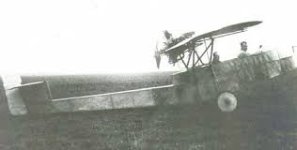
May I use a bit more of your patience and a bit more broadband of the forum. The pic on Moses thread #14236 belongs according to "L'Ala d'Italia" located in the same a.m. link to a" (quote) two seater land based biplane fitted with a curious Landing gear shaped like a reversed T. The engine fitted is a 60HP Combi (unquote)". Needless to say if Moses could supply a full pic of this creature it would be much appreciated.
BTW I was forgetting this again nameless Aircraft participated in an exhibition called "Coppa del Mare" obviously located near Naples!
I hope I'm allowed to offer following comments on the Ricci "no name" after carefully reading the 1933 issue of "L'Ala d'Italia" within the link so kindly supplied by our competent friend Giru.
What is illustrated on thread #14247 by Cthornburg, #14255 by Giru and #14260 by Moses is the same aircraft actually not an Aircraft but it appears more like an ante-literam "hydrofoil". Her conventional name was I.A.S Idroplano antisommergibile (anti-uboat hydroplane), had a hull with five steps (what the french call "redan") and could reach the phenomenal speed of 60 km/h.
No precise date is given of her date of Birth however it seems it was just before the armstice (therefore around 1917/1918).Concerning the weaponry the text states that she was fitted with a "cannoncino" (literally "small gun") [how she could fight u-boats with a cannoncino is for me a mystery!].
That's all boys and girls and thanks for your patience...
Cheers
BG
May I use a bit more of your patience and a bit more broadband of the forum. The pic on Moses thread #14236 belongs according to "L'Ala d'Italia" located in the same a.m. link to a" (quote) two seater land based biplane fitted with a curious Landing gear shaped like a reversed T. The engine fitted is a 60HP Combi (unquote)". Needless to say if Moses could supply a full pic of this creature it would be much appreciated.
BTW I was forgetting this again nameless Aircraft participated in an exhibition called "Coppa del Mare" obviously located near Naples!

cthornburg
Members +
A little more on my older offering.
Thanks to the peculiar shape of the bottom and a system of tubing putting in communication area of different pressure above and under the floating surface, the boat used a kind of air-cushion effect to decrease the hydro-dynamic drag. In 1918, in the last period of war, the Ricci firm designed the Ricci 8 IAS (Idroplano Anti Submergible or antisubmarine flying boat). It was a seaplane with a central hull and a single, shoulder-mounted wing. The hull had five formers; the wings, sturdy and thick, had a span of 8 meters and a surface area of 20 square meters. The engine was a 300-hp Fiat A.12 bis which drove a four bladded propeller carried as a pusher and mounted in a nacelle abobe the fuselage/wing centerline. Armament was a cannon in the bow. The end of the war brought further development to an end. Beside these actual constructions, the designing activity of E. RICCI touched a wide range of aviation technique as the flapping wings (1925), the large seaplane for transatlantic flights (1920), the helicopters (1945), the VTOL machines (1958) and rocket engines (1942). Built in 1920 as a direct derivation of the R. 6, the R. 9 was equipped with a rotative LE RHONE of 60 HP. Tested by B. ALBERTAZZI, it was presented to the Paris Show where won the “Meeting of Le, Bourget” piloted by RAPPINI.
Chris
Thanks to the peculiar shape of the bottom and a system of tubing putting in communication area of different pressure above and under the floating surface, the boat used a kind of air-cushion effect to decrease the hydro-dynamic drag. In 1918, in the last period of war, the Ricci firm designed the Ricci 8 IAS (Idroplano Anti Submergible or antisubmarine flying boat). It was a seaplane with a central hull and a single, shoulder-mounted wing. The hull had five formers; the wings, sturdy and thick, had a span of 8 meters and a surface area of 20 square meters. The engine was a 300-hp Fiat A.12 bis which drove a four bladded propeller carried as a pusher and mounted in a nacelle abobe the fuselage/wing centerline. Armament was a cannon in the bow. The end of the war brought further development to an end. Beside these actual constructions, the designing activity of E. RICCI touched a wide range of aviation technique as the flapping wings (1925), the large seaplane for transatlantic flights (1920), the helicopters (1945), the VTOL machines (1958) and rocket engines (1942). Built in 1920 as a direct derivation of the R. 6, the R. 9 was equipped with a rotative LE RHONE of 60 HP. Tested by B. ALBERTAZZI, it was presented to the Paris Show where won the “Meeting of Le, Bourget” piloted by RAPPINI.
Chris

Thanks for the info on the Ricci cauldron of aeronautical mayhem.
(Full photo of Ricci R.7 attached for BG).
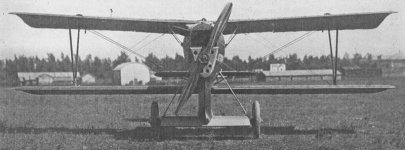
Keith's offering is the Koolhoven F.K. 30.
https://www.flightglobal.com/pdfarchive/view/1928/1928%20-%200019.html
(Full photo of Ricci R.7 attached for BG).
Keith's offering is the Koolhoven F.K. 30.
https://www.flightglobal.com/pdfarchive/view/1928/1928%20-%200019.html
Attachments
 (at least to me)


giruXX
Members +
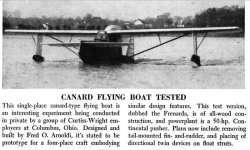
The Frenard Duck from 1949, perhaps. Built by Curtiss-Wright employees as protoype for a planned 4p version that never made it to the marketplace [N69966].
secretprojects says:
Frenard (Arnoldi) Duck N69966
This single-seat amphibian/flying boat was designed and built by Mr. Fred N. Arnoldi (hence Frenard) and several colleagues of the Curtiss-Wright company. The aircraft was intended as flying scale for a planned (unbuilt) 4-seat aircraft and it was completed in 1948/1949 and then powered by a 50hp Continental A50. Many year later (in the 1970s) the aircraft was advertised for sale as the Bohmer Canard and it had been re-engined with a 65hp Continental A65. The aircraft is still on the FAA register as the Frenard Experimental. The Duck was claimed to be easy to convert for land or water use and the wing floats and landing gear were removable.
secretprojects says:
Frenard (Arnoldi) Duck N69966
This single-seat amphibian/flying boat was designed and built by Mr. Fred N. Arnoldi (hence Frenard) and several colleagues of the Curtiss-Wright company. The aircraft was intended as flying scale for a planned (unbuilt) 4-seat aircraft and it was completed in 1948/1949 and then powered by a 50hp Continental A50. Many year later (in the 1970s) the aircraft was advertised for sale as the Bohmer Canard and it had been re-engined with a 65hp Continental A65. The aircraft is still on the FAA register as the Frenard Experimental. The Duck was claimed to be easy to convert for land or water use and the wing floats and landing gear were removable.



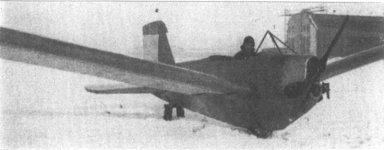
 That, sir, is because it is the Weltensegler! - built in Baden-Baden by Herr F Wenk in 1925. Thought it might hold you off for longer.....
Could she be the Ansaldo A300C? There's also the A300T which is almost identical but with round WindowsThanks Mike.
Have a go at this one.

Cheers
BG