Patforms and Ships

dvslats

Charter Member
Hi All,

I've been trying to understand these notes from the .cfg files from CFS2 ships.

[platform.0]
; platforms are the actual surface that the planes
; land on. You can define as many platforms as you
; want by adding subsequent sections with increasing
; numbers. e.g. [platform.1], [platform.2] etc.
;
; vertices should be defined in model coordinates,
; and counter-clockwise order when viewed from above.
: REMEMBER, positive z is out to the TAIL of the ship
; the shape may be concave or convex
; there may be from 3 to 20 vertices (limitation
; may go away later) and they must all be on the same
; plane.

vertex.0=10.880001,16.896,-117.376007
vertex.1=-12.416,16.896,-117.632004
vertex.2=-12.672001,16.896,-106.624008
vertex.3=-13.824001,16.896,-81.408005
vertex.4=-13.952001,16.896,-49.152004

My brain is not cooperating. :dizzy: How is a platform created with only three numbers.
Vertices are the items I do not understand.
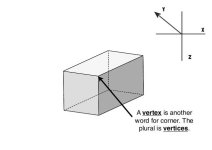
A picture from googling.
 

Attachments

  • vertices.jpg
    vertices.jpg
    17 KB · Views: 1
DV, looking at the diagrams and the notes from the cfg files it looks like each vertex has a length, width and height. I assume that the height is above sea level. Is it the case that the platform would have 4 sets of 3 vertices? That looks like the platform has a minimum (if it is rectangular) of 12 vertices or one set of 3 for each corner. I may be way off here but that's how it looks to me.
 
I think your explanation helped clear some of my head fog Ravenna. :encouragement:
Off to give it a try.
Thank You!
Dave
 
platforms

can I put my 5 cents worth in here ?

think of a vertex as a point in space - in its simplest form a platform ( ie a flight deck ) must have four vertices - one for each corner of the flight deck - the three numbers are the coordinates of each point

width is + or - from the centre line of the deck, left or right
height is height above sea level ( 0 = sea level )
length is forward or backward along ship centre line from the centre point ( 0, 7.5, 0 )

vertex.0=3,7.5,-3 ( width, height, length )
vertex.1=3,7.5,-22
vertex.2=-3,7.5,-22
vertex.3=-3,7.5,-3

width of the flight deck is 3 + 3 = 6 - the deck / platform is 6 metres wide
height is 7.5 above sea level
length is -3 -22 = 25

hope this is helpful and I haven't bored you into sleep

baldy
 
Reply...

Hope this is helpful and I haven't bored you into sleep.

baldy

Baldy,

I feel the same way when trying to explain how to convert boost and atmospheres into inches of mercury when adjusting engine data in an airfile. :costumed-smiley-034
 
Icing on the Cake

can I put my 5 cents worth in here ?

think of a vertex as a point in space - in its simplest form a platform ( ie a flight deck ) must have four vertices - one for each corner of the flight deck - the three numbers are the coordinates of each point

width is + or - from the centre line of the deck, left or right
height is height above sea level ( 0 = sea level )
length is forward or backward along ship centre line from the centre point ( 0, 7.5, 0 )

vertex.0=3,7.5,-3 ( width, height, length )
vertex.1=3,7.5,-22
vertex.2=-3,7.5,-22
vertex.3=-3,7.5,-3

width of the flight deck is 3 + 3 = 6 - the deck / platform is 6 metres wide
height is 7.5 above sea level
length is -3 -22 = 25

hope this is helpful and I haven't bored you into sleep

baldy

Thanks for the five cents Baldy. Every bit helps and this with Ravenna's info has it all clear now.
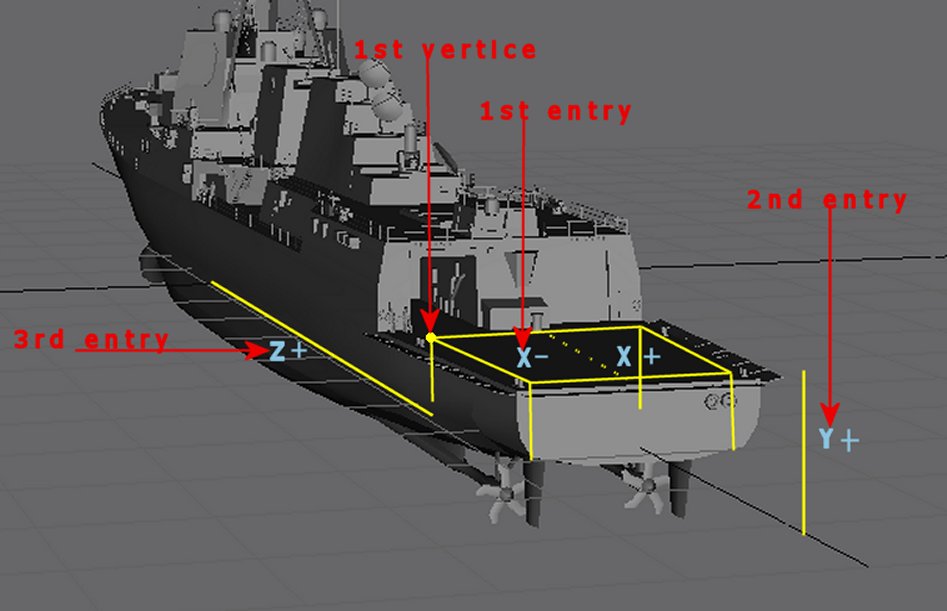
I made a graphic for reference. I'll post it here for future help.

42809462222_d0bfb6a834_o.jpg


Appreciate all of the help gents. :frog:
Cheerz,
Dave
 
Back
Top