-
Please see the most recent updates in the "Where did the .com name go?" thread. Posts number 16 and 17.
-
Special Server Maintenance
Just when you think you have everything running some what better...
You get a message from the Hosting company. Short story they need to move us to a new server. I have been working with them to plan a good date for all concerned. Here is what we have come up with as a schedule.
- November 4th 17:00 -5UTC shut off the forums and start backup proceedures. During this time there will be no access to the forums or the Resource Section.
- November 5th Continue with Backups and download same until complete.
- November 6th 7:00 turn over server to hosting company to move system to new server
- November 7th - 8th restore backups and upgrade forum software.
If all goes well we should be back online on November 8th.
To keep you updated we will post updates on AVSIM forums.
Thank you for your support.
You are using an out of date browser. It may not display this or other websites correctly.
You should upgrade or use an alternative browser.
You should upgrade or use an alternative browser.
Northrop P-61C Black Widow project
- Thread starter DC1973
- Start date


 I will now begin my daily check of the downloads section for a beta!
dharris
Charter Member
Here is an interesting video of a P-61 https://www.youtube.com/watch?v=vDUHjD0MLqY

DC1973
Members +
Here is an interesting video of a P-61 https://www.youtube.com/watch?v=vDUHjD0MLqY
Great video! Nice to see some rare colour shots of the P-61 in service.
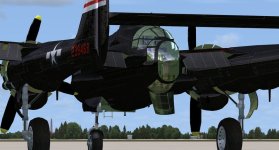
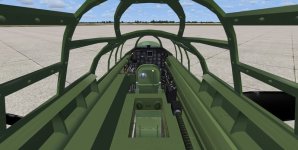
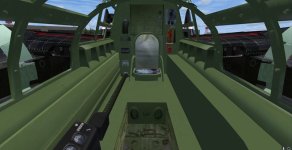
I'm beefing up the detail levels throughout the VC at the moment. The exterior model is pretty much complete, so it's all about extra realism in all three stations now in the cockpit so that folks have the best possible experience I can produce in the time I have left on the project. The RO station is now also fully operational after a bit more effort on my part.

DC1973
Members +
You have no idea how incredible it is to see the Black Widow come to life with this kind of detail! Thank you...
Ted
Thanks Ted!

A few quick shots of extra details now being added; piping and wiring etc will follow once the main details are in place.
Attachments

Seahawk72s
SOH-CM-2023
Very impressive glass work...

warchild
Charter Member
A good and proper landing..
There are many ways to land this plane, but the proper way, the way used by most pilots during WWII ( albeit in a P-61B ) was to glide down the runway, pull up into the vertical and execute either a hammerhead, or a chandelle. Thats because they didnt have thirty miles to slow down in like the manual suggested. This is rough, this is dirty and the sound is beyond horrible, for which i profusely apologize, but none the less, here is an example of a good and proper landing, for a P-61.
Pam
There are many ways to land this plane, but the proper way, the way used by most pilots during WWII ( albeit in a P-61B ) was to glide down the runway, pull up into the vertical and execute either a hammerhead, or a chandelle. Thats because they didnt have thirty miles to slow down in like the manual suggested. This is rough, this is dirty and the sound is beyond horrible, for which i profusely apologize, but none the less, here is an example of a good and proper landing, for a P-61.
Pam

Mario Donadon
Members +
Amazing too beautiful

This is from flight testing the FDE. You might want to watch it on Youtube in a large screen setting. The objective was to check the drag and weight coefficient. Approach the field with 300 KIAS, put throttle to idle, execute a chandelle maneuver (directed by air speed) and land without ever touching the throttle again.
This aircraft is really a joy to fly, not easy though. Pam is doing an exceptional job on the FDE, I must say.
Cheers,
Mark
This aircraft is really a joy to fly, not easy though. Pam is doing an exceptional job on the FDE, I must say.
Cheers,
Mark
Seahawk72s
SOH-CM-2023
There are many ways to land this plane, but the proper way, the way used by most pilots during WWII ( albeit in a P-61B ) was to glide down the runway, pull up into the vertical and execute either a hammerhead, or a chandelle.....
Is there an online reference that describes this necessity...?
DC1973
Members +
Is there an online reference that describes this necessity...?
I haven't been able to find one. I did find a single reference to a P-61 performing a chandelle as a braking aid prior to landing, however never with any vertical manoeuvres but the more standard climbing turn into the downwind familiar to most real-world pilots. I'd be happy to be proven wrong but I can see no tactical reason for doing so either as the risk of wing or tip-stall over an active airfield were the hammerhead manoeuvre to be performed incorrectly would produce obvious hazards, as does the initial pass presumably directly against the circuit pattern. Furthermore, rolling out off the top instead of a hammerhead would put the active field out of sight of the pilot, directly below the airplane, not something that would be done lightly without a good reason.
I suspect the P-61 ( and other aircraft ) chandelle was a precursor to the modern "run and break" pattern used by modern fighters to bring formations down swiftly while also performing a visual check of the runway condition. The chandelle manoeuvre was mostly used in air combat after an initial head-on merge, however the reverse of a chandelle, a 180-turn with constant descent, is also the military landing pattern and thus may well have been a reference for some airfield procedures.
Last edited:
warchild
Charter Member
it's all going to depend on how much of any given publication on the p-61 you can read online. The chandelles and following landings are mostly found in pilot stories and pireps and accident reports. The three different types of approved landings, can be found in the Pilots training manual. The ideal as presented in the manual was to take the thirty miles needed to slow down, then to either glide in, or land with power off or power on and dirty. Chandelles were "practiced" it seems by most pilots every day. It is singularly the most reported maneuver throughout all the publications. The hammerhead is a quick and dirty chandelle. it accomplishes the same thing: rapid speed reduction which facilitates landing. The reasons for these more rapid landings were multi-fold. Part of it was bragging rights. Like making a landing on a carrier, setting one of these planes down on a short runway, was not easy and using chandelles, added to the pilots prestige. the second reason was that these planes opperated in contested zones where a mile outside of the airbase was enemy heald, and a slow flying aircraft was little more than target practice for the enemy, so the planes had to make a fast approach, then slow down rapidly to land. This was especially present in the CBI theatre where japanese surrounded the majority of air bases scattered throughout china and burma.
The main problem with publications is that they arent cheap, and usually are quite skimpy though they provide a massive amount of relevant material, though you kind of have to ignore the repetitiveness of some of the data. There are several publishers, but the best source i have found is Amazon, where a quicj search through books for P-61 will unveil a plethora of different books available. Youll find these maneuvers as well as an incredibly rich history of the men who flew them, in there..
As a comparison for the reality these units existed in: When I landed at Camh Ran Bay in 1969, The Viet Cong walked mortars up the runway, trying to hit our plane which was a DC-8. Units stationed on small islands had it a tiny bit better and only had to deal with japanese patrol boats sitting off shore looking for target practice..
The main problem with publications is that they arent cheap, and usually are quite skimpy though they provide a massive amount of relevant material, though you kind of have to ignore the repetitiveness of some of the data. There are several publishers, but the best source i have found is Amazon, where a quicj search through books for P-61 will unveil a plethora of different books available. Youll find these maneuvers as well as an incredibly rich history of the men who flew them, in there..
As a comparison for the reality these units existed in: When I landed at Camh Ran Bay in 1969, The Viet Cong walked mortars up the runway, trying to hit our plane which was a DC-8. Units stationed on small islands had it a tiny bit better and only had to deal with japanese patrol boats sitting off shore looking for target practice..
Seahawk72s
SOH-CM-2023
warchild
Charter Member
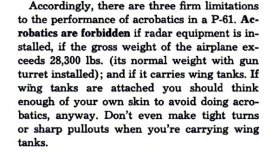
The flight manual has something to say about this...
indeed, but the books and information are there. Combat doesnt give a crap about limitations. You do what you have to do to ensure survival. Trust me on that one.
https://www.amazon.com/s/ref=nb_sb_ss_i_1_4?url=search-alias%3Dstripbooks&field-keywords=p-61+black+widow&sprefix=p-61%2Cinstant-video%2C250&crid=17Z9GGH0DWI0
[url]http://www.flyingmandocumentary.com/
[/URL]
DC1973
Members +
I have a copy of the first book in the Amazon list and use it for reference all the time. It's a complete history of the airplane and never mentions either chandelle or hammerhead approaches. That doesn't mean that they didn't happen if course but the hammerhead version breaks so many basic airmanship conventions both in peace time and war that I would be extremely surprised to find out that it was performed by pilots except in extreme circumstances. I'm certain that it would not have been routine practice. The chandelle seems far more likely.
I only did the chandelle for FDE testing á la Hoover, not for historic reasons.
I have read numerous accounts of non-conform variants of approach patterns on fighter bases, one of them being the 180 degree landing which P47 Thunderbolt pilots used. This is certainly not a safe landing technique due to the high power settings that are required (if the engine misbehaves or quits during that you're toast), but was designed to get the fighters quickly to the ground and have them not roaming around the airfield in a vulnerable manner at low speed. There's a nice thread on the A2A forum about that and how to conduct it.
Cheers,
Mark
I have read numerous accounts of non-conform variants of approach patterns on fighter bases, one of them being the 180 degree landing which P47 Thunderbolt pilots used. This is certainly not a safe landing technique due to the high power settings that are required (if the engine misbehaves or quits during that you're toast), but was designed to get the fighters quickly to the ground and have them not roaming around the airfield in a vulnerable manner at low speed. There's a nice thread on the A2A forum about that and how to conduct it.
Cheers,
Mark
warchild
Charter Member
Also, if anyone is interested in how these planes were flown, who these men were and what they did, here's an exceptional place to start. Night Fighter, the memoirs of the crew of the P-61 Jing Bow Joy Ride .
http://www.nightfighter.us/
Also please allow me to recommend This book. https://www.amazon.com/gp/product/1...102-2733054-9097760?s=books&v=glance&n=283155
http://www.nightfighter.us/
Also please allow me to recommend This book. https://www.amazon.com/gp/product/1...102-2733054-9097760?s=books&v=glance&n=283155

SH427
Members +
Also, if anyone is interested in how these planes were flown, who these men were and what they did, here's an exceptional place to start. Night Fighter, the memoirs of the crew of the P-61 Jing Bow Joy Ride .
http://www.nightfighter.us/
Also please allow me to recommend This book. https://www.amazon.com/gp/product/1...102-2733054-9097760?s=books&v=glance&n=283155
dangit pam, now you got me all excited n' stuff
