• Please see the most recent updates in the "Where did the .com name go?" thread. Posts number 16 and 17.

    Post 16 Update

    Post 17 Warning old domain name stealing credentials

  • IMPORTANT INFORMATION - ALL MEMBERS PLEASE READ

    Due to an increase in the number of new members who are trying to systematically download our entire Resource Library (one new member yesterday tried to download 3,000+ files AT ONCE!) we are being forced to implement some changes regarding who can download what, how many files at a time and at what speed. As the forums and Resource Library share the same bandwidth when the Library gets overloaded with demand like that the forums fall over, as we have all seen recently. It's sad that greed has forced our hand in this way but we must do something for the benefit of all our legitimate members (many of whom paid money for the upkeep of the site) and to prevent the files stored here being used for nefarious purposes. Many of our uploads have specific conditions tied to them that forbid uploading to any other site or deny uploading to any site that has a 'paywall' (i.e. a pay to download policy). Due to the number of mass download attempts recently we can only assume that somebody, somewhere, is attempting to stock up a new file library with our files and we owe it to our up-loaders to protect their files and intellectual property especially as many (like my own LDR Development projects) are made available at SOH only and are specified as such in the 'read me' files.

    The forums and Resource Library will be taken offline as of 13:00 EDT with the forums coming back online shortly after without the resources library while we work on setting up permissions on the new Library module.

    We hope our members understand why we need to do this and will bear with us while we implement the changes.

    Thanks in anticipation, SOH ADMINISTRATION

    The download limits are a work in progress. Please hold on until we work out the details of how it will work.

new Messerschmitt Bf 109E-7's released by Team Daedalus

Team Daedalus

Members +
Messerschmitt Bf 109E-7 3./(J)LG2

751916672652398661.jpg

A new entry has been added to Add-Ons Library, category CFS 2 Aircraft - German

Description: Messerschmitt Bf 109E-7
by Design Team Daedalus


Unit: 3./(J)LG2 Calais-Marck, France Aug 1940
Pilot: unknown


Following the E-4, the E-7 was the next major production variant, entering service and seeing combat at the end of August 1940. One of the limitations of the earlier Bf 109Es was their short range of 660 km (410 mi) and limited endurance, as the design was originally conceived as a short-range interceptor. The E-7 rectified this problem as it was the first Bf 109 subtype to be able to carry a drop tank, usually the standardized Luftwaffe 300 L (79 US gal) capacity unit mounted on a centre-line rack under the fuselage, which increased its range to 1,325 km (820 mi). Fuel from the drop tank was pumped to the internal fuel tank via a large fuel line that ran up and along the inside starboard wall of the cockpit, with a clear sight glass located in the fuel line's main span so the pilot could easily see the flow of fuel and know when the tank was empty. Alternatively, a bomb could be fitted and the E-7 could be used as a Jabo fighter-bomber. Previous Emil subtypes were progressively retrofitted with the necessary fittings for carrying a drop tank from October 1940. Early E-7s were fitted with the 1,100 PS DB 601A or 1,175 PS DB 601Aa engine, while late-production ones received 1,175 PS DB 601N engines with improved altitude performance – the latter was designated as E-7/N. A total of 438 E-7s of all variants were built.


There were many small differences between individual E-7s because the E-7 was often modified in the field by groundcrew and rear area repair depots. The production standard had no pilot armor. Mods included types of pilot head armor, armored windscreen, tropical sand filters, etc.


So each model we have created has its own unique features. This aircraft was modified with a flat plate with curved top pilot head armor.


Pstrany is the primary model author with some small model refinement and additions by Captain Kurt as the model was collaborated on during development. Captain Kurt created the textures for each, the 2D instrument panel, the individual .dp files, air files and aircraft.cfg files.

To check it out, rate it or add comments, visit Messerschmitt Bf 109E-7 3./(J)LG2
The comments you make there will appear in the posts below.
 
Messerschmitt Bf 109E-7 3./JG1

302116672654922319.jpg

A new entry has been added to Add-Ons Library, category CFS 2 Aircraft - German

Description: Messerschmitt Bf 109E-7
by Design Team Daedalus


Unit: 3./JG1 De Kooy, Holland 1941
Pilot: Hans Schubert (rank unknown)


Following the E-4, the E-7 was the next major production variant, entering service and seeing combat at the end of August 1940. One of the limitations of the earlier Bf 109Es was their short range of 660 km (410 mi) and limited endurance, as the design was originally conceived as a short-range interceptor. The E-7 rectified this problem as it was the first Bf 109 subtype to be able to carry a drop tank, usually the standardized Luftwaffe 300 L (79 US gal) capacity unit mounted on a centre-line rack under the fuselage, which increased its range to 1,325 km (820 mi). Fuel from the drop tank was pumped to the internal fuel tank via a large fuel line that ran up and along the inside starboard wall of the cockpit, with a clear sight glass located in the fuel line's main span so the pilot could easily see the flow of fuel and know when the tank was empty. Alternatively, a bomb could be fitted and the E-7 could be used as a Jabo fighter-bomber. Previous Emil subtypes were progressively retrofitted with the necessary fittings for carrying a drop tank from October 1940. Early E-7s were fitted with the 1,100 PS DB 601A or 1,175 PS DB 601Aa engine, while late-production ones received 1,175 PS DB 601N engines with improved altitude performance – the latter was designated as E-7/N. A total of 438 E-7s of all variants were built.


There were many small differences between individual E-7s because the E-7 was often modified in the field by groundcrew and rear area repair depots. The production standard had no pilot armor. Mods included types of pilot head armor, armored windscreen, tropical sand filters, etc.


So each model we have created has its own unique features. This aircraft was unmodified and had no pilot head armor.


Pstrany is the primary model author with some small model refinement and additions by Captain Kurt as the model was collaborated on during development. Captain Kurt created the textures for each, the 2D instrument panel, the individual .dp files, air files and aircraft.cfg files.

To check it out, rate it or add comments, visit Messerschmitt Bf 109E-7 3./JG1
The comments you make there will appear in the posts below.
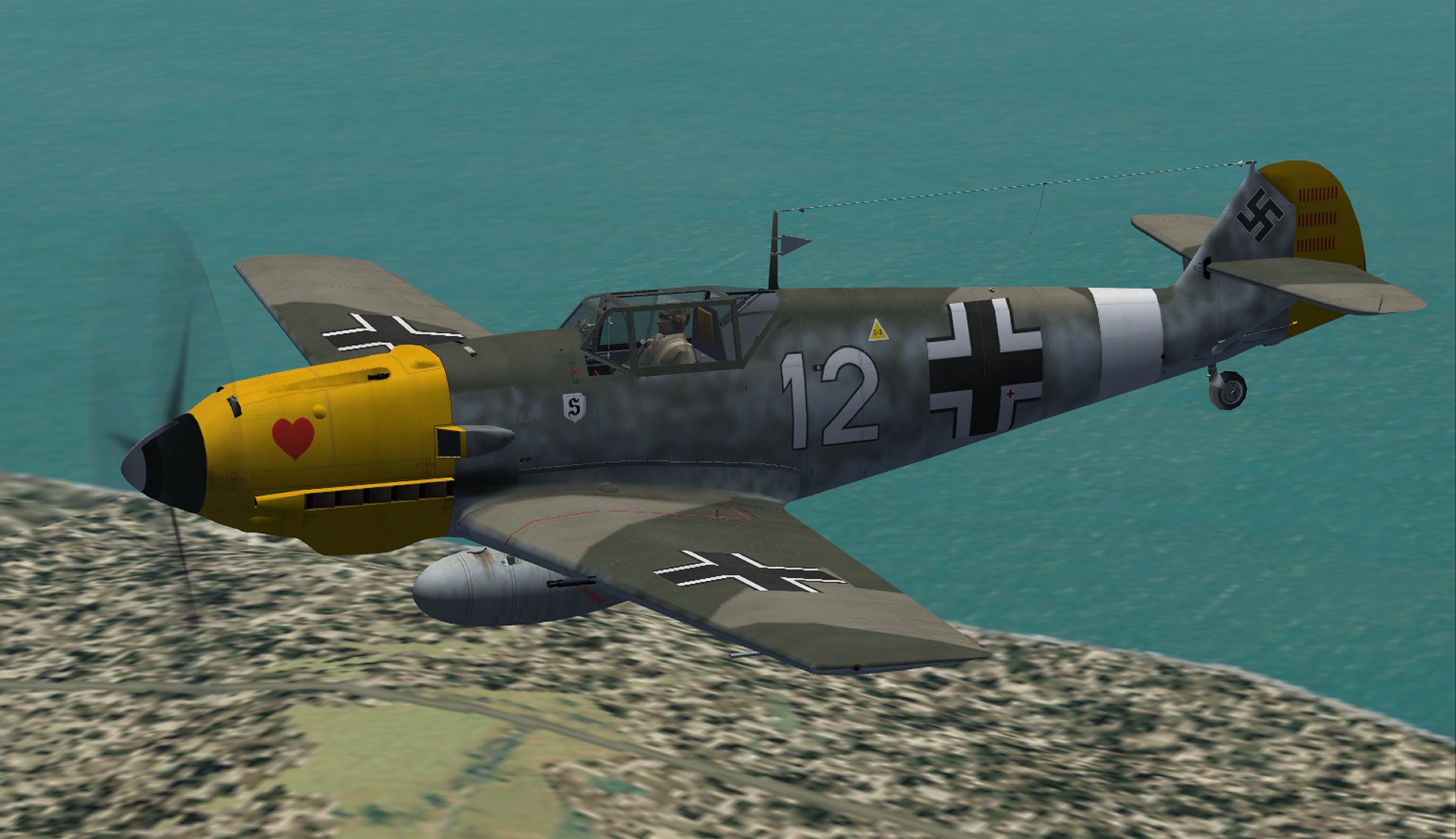
 
Messerschmitt Bf 109E-7 7./JG26

559116672656812452.jpg

A new entry has been added to Add-Ons Library, category CFS 2 Aircraft - German

Description: Messerschmitt Bf 109E-7
by Design Team Daedalus


Unit: 7./JG26 Gela, Sicily 1941
Pilot: Oblt. Joachim Muncheberg


Following the E-4, the E-7 was the next major production variant, entering service and seeing combat at the end of August 1940. One of the limitations of the earlier Bf 109Es was their short range of 660 km (410 mi) and limited endurance, as the design was originally conceived as a short-range interceptor. The E-7 rectified this problem as it was the first Bf 109 subtype to be able to carry a drop tank, usually the standardized Luftwaffe 300 L (79 US gal) capacity unit mounted on a centre-line rack under the fuselage, which increased its range to 1,325 km (820 mi). Fuel from the drop tank was pumped to the internal fuel tank via a large fuel line that ran up and along the inside starboard wall of the cockpit, with a clear sight glass located in the fuel line's main span so the pilot could easily see the flow of fuel and know when the tank was empty. Alternatively, a bomb could be fitted and the E-7 could be used as a Jabo fighter-bomber. Previous Emil subtypes were progressively retrofitted with the necessary fittings for carrying a drop tank from October 1940. Early E-7s were fitted with the 1,100 PS DB 601A or 1,175 PS DB 601Aa engine, while late-production ones received 1,175 PS DB 601N engines with improved altitude performance – the latter was designated as E-7/N. A total of 438 E-7s of all variants were built.


There were many small differences between individual E-7s because the E-7 was often modified in the field by groundcrew and rear area repair depots. The production standard had no pilot armor. Mods included types of pilot head armor, armored windscreen, tropical sand filters, etc.


So each model we have created has its own unique features. This aircraft was modified with flat plate pilot head armor and had a command pennant atached to the antenna mast.


Pstrany is the primary model author with some small model refinement and additions by Captain Kurt as the model was collaborated on during development. Captain Kurt created the textures for each, the 2D instrument panel, the individual .dp files, air files and aircraft.cfg files.

To check it out, rate it or add comments, visit Messerschmitt Bf 109E-7 7./JG26
The comments you make there will appear in the posts below.
 
Messerschmitt Bf 109E-7 III./JG5

552416672658588920.jpg

A new entry has been added to Add-Ons Library, category CFS 2 Aircraft - German

Description: Messerschmitt Bf 109E-7
by Design Team Daedalus


Unit: III./JG5 Petsamo, Finland 1942
Pilot: Hptm. Gunther Scholz


Following the E-4, the E-7 was the next major production variant, entering service and seeing combat at the end of August 1940. One of the limitations of the earlier Bf 109Es was their short range of 660 km (410 mi) and limited endurance, as the design was originally conceived as a short-range interceptor. The E-7 rectified this problem as it was the first Bf 109 subtype to be able to carry a drop tank, usually the standardized Luftwaffe 300 L (79 US gal) capacity unit mounted on a centre-line rack under the fuselage, which increased its range to 1,325 km (820 mi). Fuel from the drop tank was pumped to the internal fuel tank via a large fuel line that ran up and along the inside starboard wall of the cockpit, with a clear sight glass located in the fuel line's main span so the pilot could easily see the flow of fuel and know when the tank was empty. Alternatively, a bomb could be fitted and the E-7 could be used as a Jabo fighter-bomber. Previous Emil subtypes were progressively retrofitted with the necessary fittings for carrying a drop tank from October 1940. Early E-7s were fitted with the 1,100 PS DB 601A or 1,175 PS DB 601Aa engine, while late-production ones received 1,175 PS DB 601N engines with improved altitude performance – the latter was designated as E-7/N. A total of 438 E-7s of all variants were built.


There were many small differences between individual E-7s because the E-7 was often modified in the field by groundcrew and rear area repair depots. The production standard had no pilot armor. Mods included types of pilot head armor, armored windscreen, tropical sand filters, etc.


So each model we have created has its own unique features. This aircraft was modified with a flat plate with curved top pilot head armor and an armored glass windscreen.


Pstrany is the primary model author with some small model refinement and additions by Captain Kurt as the model was collaborated on during development. Captain Kurt created the textures for each, the 2D instrument panel, the individual .dp files, air files and aircraft.cfg files.

To check it out, rate it or add comments, visit Messerschmitt Bf 109E-7 III./JG5
The comments you make there will appear in the posts below.
 
Messerschmitt Bf 109E-7/B 5./SchG1

130816672660747607.jpg

A new entry has been added to Add-Ons Library, category CFS 2 Aircraft - German

Description: Messerschmitt Bf 109E-7/B
by Design Team Daedalus


Unit: 5./SchG1 Russia 1942
Pilot: unknown


Following the E-4, the E-7 was the next major production variant, entering service and seeing combat at the end of August 1940. One of the limitations of the earlier Bf 109Es was their short range of 660 km (410 mi) and limited endurance, as the design was originally conceived as a short-range interceptor. The E-7 rectified this problem as it was the first Bf 109 subtype to be able to carry a drop tank, usually the standardized Luftwaffe 300 L (79 US gal) capacity unit mounted on a centre-line rack under the fuselage, which increased its range to 1,325 km (820 mi). Fuel from the drop tank was pumped to the internal fuel tank via a large fuel line that ran up and along the inside starboard wall of the cockpit, with a clear sight glass located in the fuel line's main span so the pilot could easily see the flow of fuel and know when the tank was empty. Alternatively, a bomb could be fitted and the E-7 could be used as a Jabo fighter-bomber. Previous Emil subtypes were progressively retrofitted with the necessary fittings for carrying a drop tank from October 1940. Early E-7s were fitted with the 1,100 PS DB 601A or 1,175 PS DB 601Aa engine, while late-production ones received 1,175 PS DB 601N engines with improved altitude performance – the latter was designated as E-7/N. A total of 438 E-7s of all variants were built.


There were many small differences between individual E-7s because the E-7 was often modified in the field by groundcrew and rear area repair depots. The production standard had no pilot armor. Mods included types of pilot head armor, armored windscreen, tropical sand filters, , etc.


So each model we have created has its own unique features. This aircraft was modified as an E-7/B with an ETC 500/IXB bomb rack and a flat plate plus curved top pilot head armor.


Pstrany is the primary model author with some small model refinement and additions by Captain Kurt as the model was collaborated on during development. Captain Kurt created the textures for each, the 2D instrument panel, the individual .dp files, air files and aircraft.cfg files.

To check it out, rate it or add comments, visit Messerschmitt Bf 109E-7/B 5./SchG1
The comments you make there will appear in the posts below.
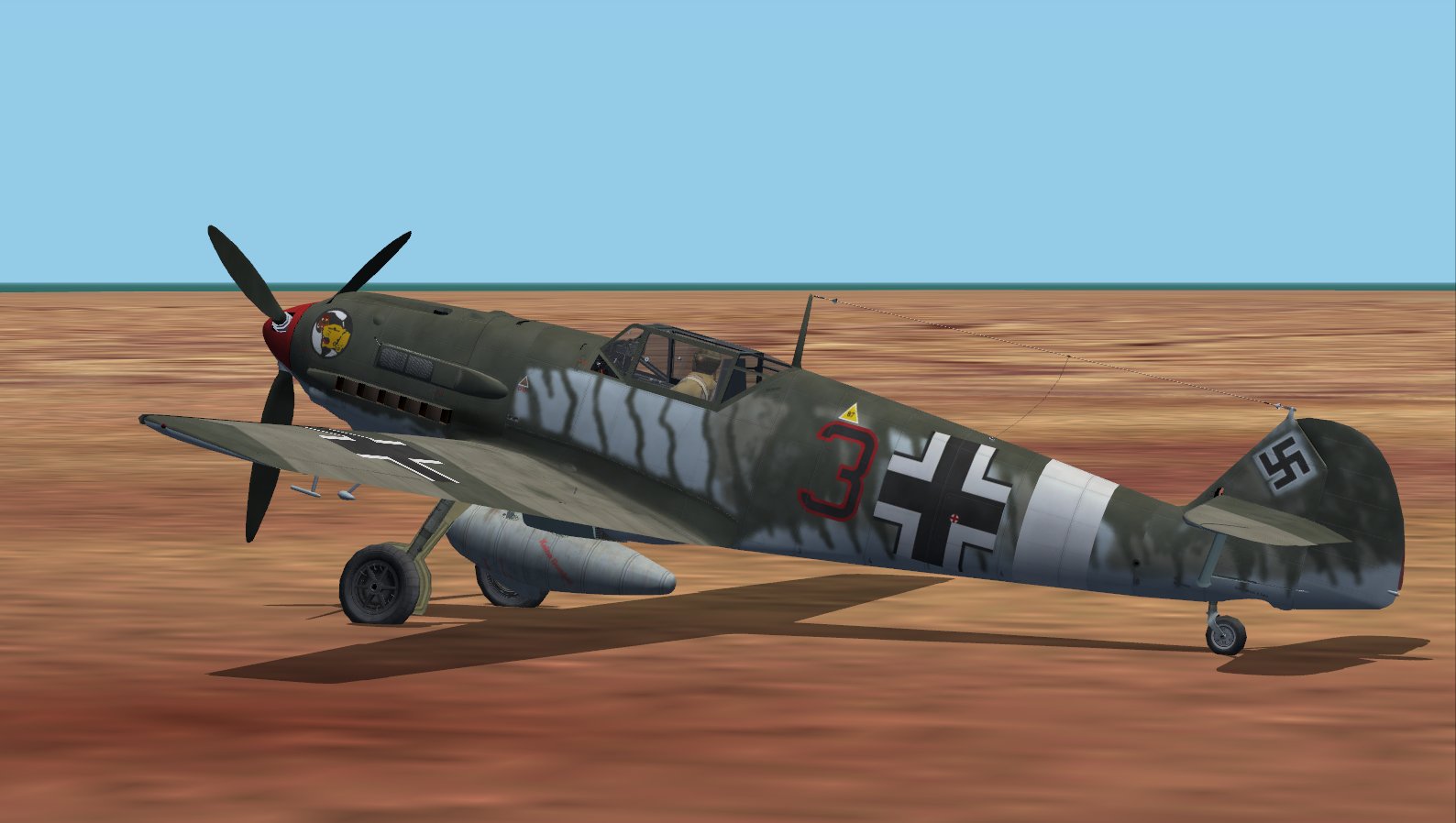
 
Messerschmitt Bf 109E-7/Trop 2./JG27 Neumann

799216672662484763.jpg

A new entry has been added to Add-Ons Library, category CFS 2 Aircraft - German

Description: Messerschmitt Bf 109E-7/Trop
by Design Team Daedalus


Unit: 2./JG27 Ain-el-Gazala. Libya 191
Pilot: Hptm. Eduard Neumann


Following the E-4, the E-7 was the next major production variant, entering service and seeing combat at the end of August 1940. One of the limitations of the earlier Bf 109Es was their short range of 660 km (410 mi) and limited endurance, as the design was originally conceived as a short-range interceptor. The E-7 rectified this problem as it was the first Bf 109 subtype to be able to carry a drop tank, usually the standardized Luftwaffe 300 L (79 US gal) capacity unit mounted on a centre-line rack under the fuselage, which increased its range to 1,325 km (820 mi). Fuel from the drop tank was pumped to the internal fuel tank via a large fuel line that ran up and along the inside starboard wall of the cockpit, with a clear sight glass located in the fuel line's main span so the pilot could easily see the flow of fuel and know when the tank was empty. Alternatively, a bomb could be fitted and the E-7 could be used as a Jabo fighter-bomber. Previous Emil subtypes were progressively retrofitted with the necessary fittings for carrying a drop tank from October 1940. Early E-7s were fitted with the 1,100 PS DB 601A or 1,175 PS DB 601Aa engine, while late-production ones received 1,175 PS DB 601N engines with improved altitude performance – the latter was designated as E-7/N. A total of 438 E-7s of all variants were built.


There were many small differences between individual E-7s because the E-7 was often modified in the field by groundcrew and rear area repair depots. The production standard had no pilot armor. Mods included types of pilot head armor, armored windscreen, tropical sand filters, etc.


So each model we have created has its own unique features. This aircraft was modified as an E-7/Trop with a tropical sand filter and flat plate pilot head armor. This aircraft was originally with JG54 in France before being hurriedly modified, transferred to JG 27, and sent to Africa, still wearing its European camouflage.


Pstrany is the primary model author with some small model refinement and additions by Captain Kurt as the model was collaborated on during development. Captain Kurt created the textures for each, the 2D instrument panel, the individual .dp files, air files and aircraft.cfg files.

To check it out, rate it or add comments, visit Messerschmitt Bf 109E-7/Trop 2./JG27 Neumann
The comments you make there will appear in the posts below.
 
Messerschmitt Bf 109E-7/Trop 2./JG27

771316672664113359.jpg

A new entry has been added to Add-Ons Library, category CFS 2 Aircraft - German

Description: Messerschmitt Bf 109E-7/Trop
by Design Team Daedalus


Unit: 2./JG27 Ain-el-Gazala. Libya 191
Pilot: Most likey Ltn. Franz Elles


Following the E-4, the E-7 was the next major production variant, entering service and seeing combat at the end of August 1940. One of the limitations of the earlier Bf 109Es was their short range of 660 km (410 mi) and limited endurance, as the design was originally conceived as a short-range interceptor. The E-7 rectified this problem as it was the first Bf 109 subtype to be able to carry a drop tank, usually the standardized Luftwaffe 300 L (79 US gal) capacity unit mounted on a centre-line rack under the fuselage, which increased its range to 1,325 km (820 mi). Fuel from the drop tank was pumped to the internal fuel tank via a large fuel line that ran up and along the inside starboard wall of the cockpit, with a clear sight glass located in the fuel line's main span so the pilot could easily see the flow of fuel and know when the tank was empty. Alternatively, a bomb could be fitted and the E-7 could be used as a Jabo fighter-bomber. Previous Emil subtypes were progressively retrofitted with the necessary fittings for carrying a drop tank from October 1940. Early E-7s were fitted with the 1,100 PS DB 601A or 1,175 PS DB 601Aa engine, while late-production ones received 1,175 PS DB 601N engines with improved altitude performance – the latter was designated as E-7/N. A total of 438 E-7s of all variants were built.


There were many small differences between individual E-7s because the E-7 was often modified in the field by groundcrew and rear area repair depots. The production standard had no pilot armor. Mods included types of pilot head armor, armored windscreen, tropical sand filters, etc.


So each model we have created has its own unique features. This aircraft was modified as an E-7/Trop with a tropical sand filter and a flat plate plus curved top pilot head armor.


Pstrany is the primary model author with some small model refinement and additions by Captain Kurt as the model was collaborated on during development. Captain Kurt created the textures for each, the 2D instrument panel, the individual .dp files, air files and aircraft.cfg files.

To check it out, rate it or add comments, visit Messerschmitt Bf 109E-7/Trop 2./JG27
The comments you make there will appear in the posts below.
 
Messerschmitt Bf 109E-7/B Trop 8./ZG1

257116672665361690.jpg

A new entry has been added to Add-Ons Library, category CFS 2 Aircraft - German

Description: Messerschmitt Bf 109E-7/B Trop
by Design Team Daedalus


Unit: 8./ZG1 El Daba, Libya 1942
Pilot: unknown


Following the E-4, the E-7 was the next major production variant, entering service and seeing combat at the end of August 1940. One of the limitations of the earlier Bf 109Es was their short range of 660 km (410 mi) and limited endurance, as the design was originally conceived as a short-range interceptor. The E-7 rectified this problem as it was the first Bf 109 subtype to be able to carry a drop tank, usually the standardized Luftwaffe 300 L (79 US gal) capacity unit mounted on a centre-line rack under the fuselage, which increased its range to 1,325 km (820 mi). Fuel from the drop tank was pumped to the internal fuel tank via a large fuel line that ran up and along the inside starboard wall of the cockpit, with a clear sight glass located in the fuel line's main span so the pilot could easily see the flow of fuel and know when the tank was empty. Alternatively, a bomb could be fitted and the E-7 could be used as a Jabo fighter-bomber. Previous Emil subtypes were progressively retrofitted with the necessary fittings for carrying a drop tank from October 1940. Early E-7s were fitted with the 1,100 PS DB 601A or 1,175 PS DB 601Aa engine, while late-production ones received 1,175 PS DB 601N engines with improved altitude performance – the latter was designated as E-7/N. A total of 438 E-7s of all variants were built.


There were many small differences between individual E-7s because the E-7 was often modified in the field by groundcrew and rear area repair depots. The production standard had no pilot armor. Mods included types of pilot head armor, armored windscreen, tropical sand filters, , etc.


So each model we have created has its own unique features. This aircraft was modified as an E-7/B Trop with an ETC 500/IXB bomb rack, a tropical sand filter and a flat plate plus curved top pilot head armor. For some unknown reason, all of this unit's E-7/B's had an E-4 type prop spinner but those of their known Werk Nummers show they were in fact listed as E-7's. It's possible they were originally E-4s that were upgraded to E-7s except for the spinner.


Pstrany is the primary model author with some small model refinement and additions by Captain Kurt as the model was collaborated on during development. Captain Kurt created the textures for each, the 2D instrument panel, the individual .dp files, air files and aircraft.cfg files.

To check it out, rate it or add comments, visit Messerschmitt Bf 109E-7/B Trop 8./ZG1
The comments you make there will appear in the posts below.
 
Attention .!!!!!!
You have to add the points 534/535 in the air file to release the drop tank.
[FONT=Verdana, Arial]


Cheers
[/FONT]
 
Attention .!!!!!!
You have to add the points 534/535 in the air file to release the drop tank.


Cheers

Thank you for catching that fani. I missed that. Actually it only needs 534. That is needed to make the fuel in the tank available as well as dropping the tank.

I am uploadiing the corrected aircraft packages now. But in the meantime for those who have already downloaded the original posts, here are the corrected air files for you.

View attachment air files fix.zip
 
Reply...

Kurt and Team Daedalus,

Amazing work. I will make sure to retire the older AH model and update my campaigns to use your models as a tribute to your team's dedicated work and efforts! :medals:
 
Back
Top