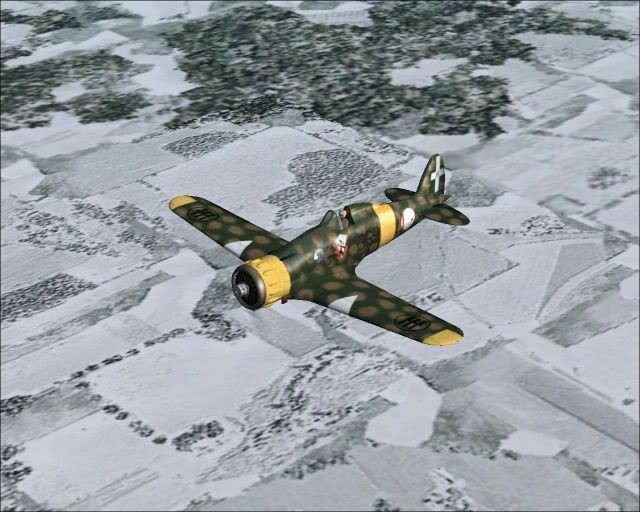
I did it for you
OMG, I've been seeing pics and profiles of Italian WW2 planes for years and I had never realised that. Thanks for pointing it.
Maybe I will release an update correcting that and adding a couple of changes I found out after uploading the file: low visibility top fasces (could someone explain why would they do that having YELLOW Eastern front marks all over the plane

) and white triangle ¿recognition marks? in the leading edge of the wings.
Hi JapLance,
I have the original fasci roundels fixed for you in the upper and lower wing textures. They are still with the white background, do you want me to send them to you or have you taken care of it already?
I see you painted low visibility roundels this time, correctly oriented. Which is the right version, with or without the white background?
Italian traditional roundels are green-white-red, inner to outer, since WWI. Fascism changed that. The fascio is a Roman time consular symbol of the power of justice that Roman consuls could apply. It's an axe wrapped up in a bundle of thin branches, symbolizing a death sentence (the axe) for the worst crimes down to public lashing (the bundled whips) for minor crimes. Fascio, in Italian, means "bundle".
During fascism Italian aircrafts wore the fascio on both upper and lower wings and on the fuselage, sometimes under the cockpit, more frequently between the cockpit and the engine. On the rudder the white cross was the coat of arms of the Savoias royal house. On multi-engined aircrafts the fuselage fascio was painted on the engine cowls, instead.
The fascio axe blade must always point outward, away from the fuselage, on the wings and forward on the fuselage.
I cannot answer your question about Estern Front recognition marks, as I am not too well informed about Regia Aeronautica in Russia, but I can guess that the yellow wingtips, cowl and fuselage band come from Luftwaffe theatre markings of the same colour, to distinguish Axis planes from drab VVS aircrafts.
Cheers!
KH :ernae:



 Nice job!
 .
. fficial%26hs%3DjQu%26sa%3DG