• There seems to be an uptick in Political comments in recent months. Those of us who are long time members of the site know that Political and Religious content has been banned for years. Nothing has changed. Please leave all political and religious comments out of the forums.

    If you recently joined the forums you were not presented with this restriction in the terms of service. This was due to a conversion error when we went from vBulletin to Xenforo. We have updated our terms of service to reflect these corrections.

    Please note any post refering to a politician will be considered political even if it is intended to be humor. Our experience is these topics have a way of dividing the forums and causing deep resentment among members. It is a poison to the community. We appreciate compliance with the rules.

    The Staff of SOH

  • Please see the most recent updates in the "Where did the .com name go?" thread. Posts number 16 and 17.

    Post 16 Update

    Post 17 Warning

A2A Spitfire out!

Once all of the systems are sorted out, it's a wondeful flightsimulation with nothing else to do. Meaning that it was fairly easy to master as flight sims go and there is nothing to shoot down! Guess I'll try some crosswinds.

I can't say that I necessarily disagree with this, though the Mk I is more difficult than the Mk II.

That doesn't take anything away from what A2A has created though. The Spitfire is loads of fun! It is among the best addons available for FSX, no doubt. The sounds of the merlin, propeller, and airframe together create unparalleled immersion. Can't forget to mention there's a near-perfect paint kit for it too!
 
I dont care what you say jankees I have been flying your repaints for a long time now, together with jeansy's and Bobs stuff for military things, I rate them as some of the best
 
I would like to point out that A2A simulates random failures of various systems. Even if you are not finding the flying particularly challenging should you have mastered it, there is ALWAYS the possibility of a failure in flight.
 
As cody has mentioend we also have failures random/rare ones + of course everything is yours. You may think you have mastered it, but if after five hours the wear is so bad you need an overhaul then you may want to go over procedures.

All I can say DVJ is you are in the minority for being able to master it so easily (Pure Jealousy from me :p ). However if you want a challenge try to get up within 2mins and then climb to combat altitude within mins also without causing too much damage. I applied this to our P47 once I had that 'under control' and soon found that trying to get up to mid level altitude over Suffolk/Norfolk and then head out to Occupied europe reaching coast at say 23,000ft was bloody difficult and made me realise I only had her under control when playing around at 9000ft and below.

Or you could try different environments, if you are flying in a cold place then its going to be harder to cook an engine, maybe try Malta in the summer. Another thing to play with is the two Marks + the different props all of which will require a diferent technique into mastering the aircraft for all locations and altitudes.

Also as I mentioned first, as time goes on you will know how good you stack up against other pilots as they post how many hours an average engine, or cylinder etc last.
 
In all honesty

it shouldnt be too hard, relatively speaking of course!, to fly a warbird and have her perform well. If they weren't rugged in the first place, they wouldn't have been too successful at all historically. Of course, that all being said, as Lewis points out, see how the engine does over time. And of course, if the engine stays in good condition for a long long time, that probably just goes to show you that you are already putting some TLC towards the aircraft; quite the feet in itself that Accusim can force upon a person to treat a simulated aircraft with so much care!
 
I also have not had any problems keeping temperatures in line and keeping the bird in fairly good shape in many hours of normal flight and varying temperatures...but here is where the challenge comes:
Fly the plane as if you were scrambling from the ground including the warm-up time they used after radar spotted incoming aircraft and called a scramble alert. Then climb to altitude above what you pre planned the attack to be from and at what altitude. Using power dives and recoveries, snap rolls, barrel rolls, loops, spins, etc as if you were actually dogfighting...now see how well your engine holds up. By the way don't repair to new condition every time you fly-just flyable because during the Battle of Britain they scrambled several times a day.
What fun! Wish I had time to play today
Ted
 
As experienced and knowledgeable warbird pilots will tell you, warbirds are aircraft to fly and have fun with. The worst is to put a pilot into a warbird who is scared of it - they are to be respected of course, but they are also to be enjoyed. The Spitfire is not a difficult warbird to master, with next to no vices, as long as you have proper stick and rudder skills, tail-dragger experience, and maintain proper airmanship. Keeping on top of the temperatures of the coolant and oil, and the oil and fuel pressures, shouldn't be your main focus, especially when flying. A glance down every now and then, to confirm everything's good, but most of the time you should have your head up, looking out of the aircraft. This is especially easier if you use proper engine settings!

BTW, some of the best warbird pilots are also some of the best mechanics and gear-heads as well - they know what to do in all circumstances of operating the aircraft, because they know the aircraft's systems inside and out, as they work on them first hand. For instance, you cannot be a pilot for the Air Museum Planes of Fame, unless you start from the bottom, and work your way up, actually getting your hands dirty helping to maintain the aircraft and know their inner-workings.

Most typical Merlin-engine power settings in a Spitfire today are:

Take-off: 8+ Boost, 3,000 RPM
Climb: 4-6+ Boost, 2,400-2,600 RPM
Cruise: 2+ Boost, 1,800-2,000 RPM

For display use, I use 4+ Boost, 2,400 RPM. There isn't as much power on tap as 6+ and 2,600, but your maneuvers can be tighter with lower speeds, and managing your energy is a bit more of a challenge, which makes for a more interesting display I find. As a result, the display will be closer into the airport as well.
 
It just makes me wonder how much fun a Hawker Typhoon with Accusim would be with that aircrafts temperamental engine.
<?xml:namespace prefix = o ns = "urn:schemas-microsoft-com:eek:ffice:eek:ffice" /><o:p> </o:p>
<o:p> </o:p>Regards,
Ian. <o:p></o:p>
<o:p> </o:p>
 
It just makes me wonder how much fun a Hawker Typhoon with Accusim would be with that aircrafts temperamental engine.
<?xml:namespace prefix = o ns = "urn:schemas-microsoft-com:eek:ffice:eek:ffice" /><o:p></o:p>
<o:p></o:p>Regards,
Ian. <o:p></o:p>
<o:p></o:p>

**Shudder**

And then imagine trying to belly land the damn thing with that great big scoop out front!!
 
I also have not had any problems keeping temperatures in line and keeping the bird in fairly good shape in many hours of normal flight and varying temperatures...but here is where the challenge comes:
Fly the plane as if you were scrambling from the ground including the warm-up time they used after radar spotted incoming aircraft and called a scramble alert. Then climb to altitude above what you pre planned the attack to be from and at what altitude. Using power dives and recoveries, snap rolls, barrel rolls, loops, spins, etc as if you were actually dogfighting...now see how well your engine holds up. By the way don't repair to new condition every time you fly-just flyable because during the Battle of Britain they scrambled several times a day.
What fun! Wish I had time to play today
Ted

I'll do that. Hmmmmm, I think I just got flat tire.
 
Jan Kees!

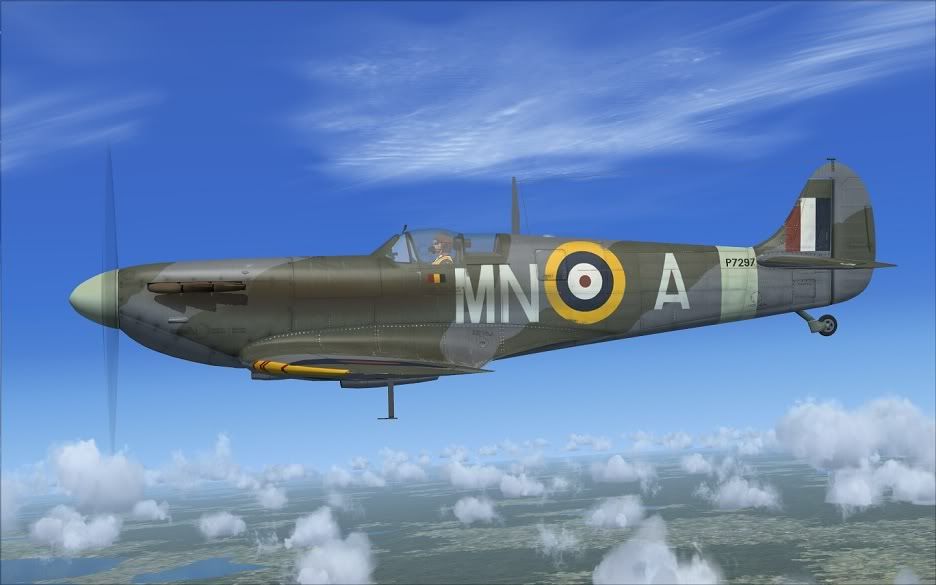
After I did the repaint from the Belgian Spitfire for the old A2A model, I was pointed to an error by a volunteer from the "Musée royal de l'Armée et d'Histoire Militaire" in Brussels.

On the original aircraft the Belgian flag was painted mirrored as you can see here: http://home.pi.be/~braf/350Sqn/aircraft/350mn-a-P7297.htm

so it should be painted as shown below......

Belgianflag.jpg


Cheers,
Huub
 
Back
Top