• There seems to be an uptick in Political comments in recent months. Those of us who are long time members of the site know that Political and Religious content has been banned for years. Nothing has changed. Please leave all political and religious comments out of the forums.

    If you recently joined the forums you were not presented with this restriction in the terms of service. This was due to a conversion error when we went from vBulletin to Xenforo. We have updated our terms of service to reflect these corrections.

    Please note any post refering to a politician will be considered political even if it is intended to be humor. Our experience is these topics have a way of dividing the forums and causing deep resentment among members. It is a poison to the community. We appreciate compliance with the rules.

    The Staff of SOH

  • Please see the most recent updates in the "Where did the .com name go?" thread. Posts number 16 and 17.

    Post 16 Update

    Post 17 Warning

Which is the better teacher...taildragger or trike?

I would rather learn in

  • A Trike...150/172/Cherokee...etc

    Votes: 29 46.0%
  • A Taildragger...Cub/Citabria/Tiger Moth...etc

    Votes: 34 54.0%

  • Total voters
    63
Many years ago, a friend and I were learning to fly. He in his Luscombe 8 and me in my Cessna 140. When it got to checkride time, he went into Anchorage and took his ride in a 150 - "because he wanted to pass" - not all days are good wheel landing days. His airmanship from having learned in his Luscombe made the checkride in the 150 a walk in the park. Myself, I faced the checkride in my 140 - my wheel landings were described as controlled crow-hops but I passed - and that's the name of the game.
 
The ERCOUPE,415-C..for $2,665. ya could own a jaunty plane,sliding cockpit ,canopy.forked Tail,.yer very own P-38, with 65 hp. Continental A-65 engine, providing a cruising speed of 105 mph , with no rudder pedals,would not stall,Limited Up elevator,and it drove around on the ground like a car!..X-winds? no problem,with Castering Landing gear ,you crabbed it to touch down,into as much as a 25mph X-Wind!!.The nose wheel straigned ya out..No problem.flying for the masses after WW2.in1946.

Many thought the Ercoupe was a fun plane to fly.Slide open the windows,open cockpit fun.In Summer,smell the hay Fields..many thought the Ercoupe was the greatest plane ever!

But it was accumulative Peer Ridicule at air ports that done it in..this by those Haughty TAIL DRAGGER PILOTS!...Park next to a Cub, or a Strearman,with this,ya got the Ole HE Haw!\Snickering and all...Darn those Tail Dragger Pilots..Me? welll I flew it a few times,and I liked it..but I was Young ,and Those BULLY,SNOOTY WW2 fighter Jocks,Tail dragger Pilots was to much to put up with..WHAT NO RUDDER PEDALS?? YA MEAN YA CANNOT SPIN IT..WON'T STALL??..thats no plane,Thats a KIDDI CAR!and so on!!....From then on , Aviation for the Masses went BACKWARDS,and may still be doing it..Egos,Money,the GOTTCHA attitude,,and many trying to keep up with the Jones at the Hangers, and falling on their face!for Ya see HANGER TALK WAS A FORCE to be Reckoned with!!............The OLE HICCUP!was an American classic!!..in retrospect ,I sill am sorry for not having one..it was all a young flyer ever needed!!The girls then also liked it...For they knew they too could fly it..BUT of Course!!<label for="rb_iconid_19">
icon26.gif
</label>


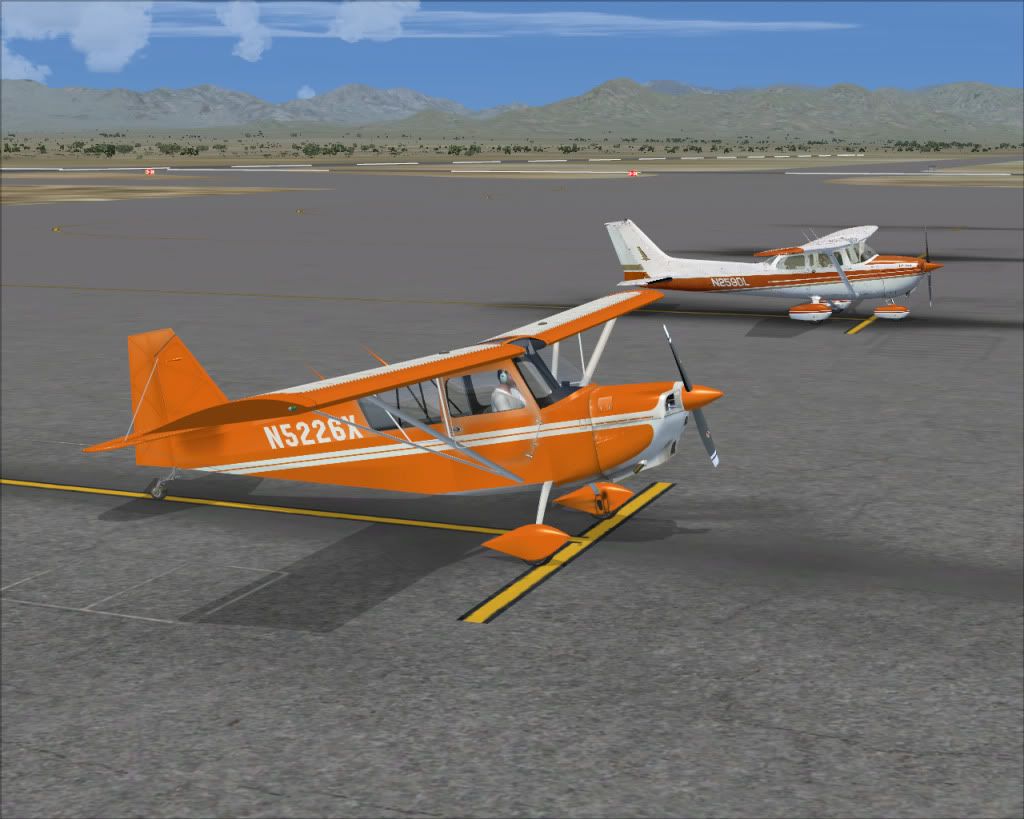
I'm currently just finishing my 26th hour of training for Private, and I'm doing most of it in a Citabria. I took my first lesson in the Citabria for my fifth hour, by which time I had flown a 172 and Warrior, and had three other instructors! After another 10 hours switching it up like that, I've decided to mostly stick with the Citabria, though I'll be doing my long cross country next week in the Warrior.
When I first flew the Citabria, I was a little nervous, due to all the stories about ground looping taildraggers, but my opinion has always been, 'if thousands of other people can do it, so can I'. Well, the first two hours worth of landings were pretty sorry in the Citabria (even though I had been landing the 172 fine from the first lesson, thanks to FSX). And I have proven to myself that it's harder to ground loop than some make it out to be. My first taildragger landings were in crosswind and on pavement, and they were UGLY! I learned that you can perform S turns at 60 mph and still not ground loop. My instructor kept saying, 'You're not the worst I've seen by far', and I started calling him the bravest person I know. Fortunately, by the third hour, it began to feel natural and has since been much more controlled, if not pretty!
Having flown both tailwheel and tricycle gear now, I would say that it hasn't made much difference to me, except the fact that I really had never learned how to use the rudder in the 172 and Warrior, whereas the Citabria demanded it. Also, the tricycle easily tolerates lateral movement on landing but the tailwheel punishes you quickly and harshly for it. Consequently, I have learned to keep it on centerline! Also, not having flaps has turned out to be a blessing, because I've become very comfortable with flying a slip to bleed speed on final.
Mostly, I prefer the Citabria because it's just more responsive and FUN to fly, and the ability to spin it has provided some respite from the work of learning to fly! And in the end, it will save me some money because I'll still get my Private with 40 hours of training, and I will not have to pay for additional dual to transition to tricycles, whereas (according to my instructor) it takes several hours of dual for someone who learned only in tricycles to get their Tailwheel signoff.
Hats off to Aaron and Brant at Acro Air in Huntsville, AL. Also to the Real Air developers, because I fly my lessons in their Citabria before I do them in real life, and their Citabria is EXTREMELY accurate!
 
Started in the Cessna 150. but wished had learnt in a tailwheel aeroplane!! Flown lots of hours in Cubs, but always found (and still do) the Auster a very difficult aeroplane to master. As to the larger taildraggers, only have about 50 hours all from the backseat, so cant really comment there.

Martin
 
LOL Beana yeah the Ercoupe drivers seem to get similar ribbing that Skymaster drivers get from 'real' twin drivers. :D

It is funny, I have been watching the poll, it seems there was a big initial jump in taildraggers, then the trikes caught up, then another spike in taildraggers, trikes catching up again to a roughly 51% to 49% in favor of the taildraggers. That would make sense here being this forum has a general fondness for older airplanes. I bet if I asked the same question at PMDG or even Avsim it would probably be skewed a bit in favor of the Trikes. It isn't meant to be a competition really, just curiosity about preferences in teaching and learning styles.


lol here you go Wconkle...I plan on teaching my wife to fly in FSX using the Citabria/taildragger method....if she groundloops it...no biggie..and she will build good fundamental rudder coordination skills early on.
trainers.jpg
 
I voted for taildragger though I began on a Cessna 150. When I got instructed in my first taildragger (motoglider SF25C) I found the conversion rather difficult.
I'm a "learn-the-harder-way-first" type of guy.
 
HA! HA! Yes that's true PILOTTJ...those guys took grief also..when in fact the sky master solved single engine out yaw in a twin!.which kills!.....but its Pure American!!..the aggressive competitive ,drive,,,weather its planes ,boats ,Cars, or even Football teams,it will always be that RIVALRY!.....like GO GIANTS Go!.. but watch the SKINS this year! Or GO GO GO to the MOON!..its us!!..It always fostered growth,new concepts.I Love it!.....
Like this FORD ROUSH Mustang is the BEST EVER!<label for="rb_iconid_20">
icon22.gif
</label> .....Have fun!


...View attachment 39268
 
This question always comes up in the bastion of novice flyers, for some reason. Tail draggers have some special needs when it comes to ground contact and handling, but that's about it....they FLY the same. Do tail draggers make you a better pilot, NO. Do nose draggers make you an inferior pilot, NO. I've seen people (low timers and no timers for the most part) argue this point until they were blue, and it's a bit ridiculous, really. There are highly skilled pilots out there who have 5000, 10000, 20000 hours of flight time leaving contrails all around the planet, but not one minute of tail dragger time. There's alot of fighter pilots out there who have never flown a tail dragger, and I don't think they feel short-changed for not getting to train on a tail dragger.

The kind of pilot you are has more to do with who you are, rather than what you train on. Once you get away from the light single engine world of aviation, you really realize those type planes don't prepare you for much more than VERY basic stuff, anyway. Fly both, and enjoy both.
 
So I guess that means that you learned to ride a unicycle instead of a bicycle first?

Regards, Mike Mann

This example is bit lacking (don't ride unicycles). ;)

A better one would be learning to drive a car with manual transmission before you "convert" to a car with an automatic one. The other way around would be impractical IMHO.
The handling on the ground, take-off and landing are more demanding on a taildragger. Converting to a trike should be easier (as to convert from a manual to an automatic car).
 
A better one would be learning to drive a car with manual transmission before you "convert" to a car with an automatic one. The other way around would be impractical IMHO.

The driver training program I took (40 years ago) used automatic transmission vehicles; the reason was to train drivers to steer, parallel park and be observant of the rules of the road. This was easier to achieve without having the students concentrating on the relatively (in comparison) unimportant task of shifting the vehicles transmission. I later went on to a manual shift transmission with no problems, so I guess the driver training program took the right approach.

Regards, Mike Mann
 
It might depend on the type of training program available. I think in a large school environment such as ERAU or a military training program where time of training is an important factor...they would go with the Trike/Automatic method.

For those who are able to learn to drive from their parents/grandparents/friends or go to a small FBO with 1 or 2 planes and are not on a schedule, it might be beneficial to go with the more difficult Taildragger/Manual method. When there is no limit on the time, you can really spend the time to practice coordination first until it is instinctual, then move on to the meat of the training. As some have pointed out to, it probably depends on the environment in which you will fly. If you plan on doing a lot of bush flying, strong rudder coordination instinct is vital, then it would be wise to go the Taildragger method.

Ultimately it is the preference of the student or the teacher/school.
 
It might depend on the type of training program available. I think in a large school environment such as ERAU or a military training program where time of training is an important factor...they would go with the Trike/Automatic method.

You seem to be implying that military training programs, because they are in such a hurry to crank out pilots, don't have time to “properly” train their students in the mysterious ways of tail draggers, so they settle for “nose draggers.” If so, I would have to disagree a little. The training military pilots get is arguably superior to what civilian private pilot training courses provide. The reason military training airplanes are all nose draggers is because military pilots will never have to fly tail draggers. Does this mean that military pilots are somehow lacking something, anything, in their set of skills because they have never flown a tail dragger? I would find that hard to believe.

To answer the initial question in this thread, it seems to me that it makes more sense to start training with a nose dragger. It's the “step-by-step” approach. Walk, then run. If you have two otherwise identical pilots, each with 1000 hours, half in tail draggers and half in nose draggers, but Joe's first 500 hours was in tail draggers, and Suzy's first 500 was in nose draggers, which, after 1000 hours, is the better pilot? Answer, none, they are probably equal. In other words, starting in nose draggers, then transitioning to tail draggers, if you have to, doesn't result in a less skilled pilot than the other way around. Just my two pesos.
 
During the second world war technology leaps were placing kids skilled at driving a horse and buggy into the pits of some of the most sophisticated machines man has ever produced and those farmer's children had to deal with issues as intuitive as the compressibilty of air near the speed of sound!

Today it takes a year and a half and about 300 hours of flight time plus 1,000 hours of ground school to teach a college engineering graduate to fly a F-16. People, an F16 is many magnitudes of order "EASIER" to fly than a BF109 or a P47D!

Losses during WWII ran something like this; about 1/3 to training crashes, about 1/3 to operational accidents; and about 1/3 to enemy combat. It was twice as dangerous to learn, and get into combat, than it was to actually fly the mission!

More USAAF pilots were killed in the "graveyard spiral" than were killed in combat, more pilots and crews were lost in scud running and weather related collisions with the ground than were lost in combat.

Of course Kamikaze pilots had no such Problem...9/11 taught us some parts of flying can be learned,and other parts disregarded..

As of the end of 2006, in General aviation, there were 597,109 active certificated pilots, according to the AOPA Jan. 12, 07 newsletter which cites the FAA's estimates. This number has been declining slowly over the long term, down from a high of over 827,000 pilots in 1980.

I wonder how many Flight Simulator Pilots are the in the world?

Drone pilots and crews are the vanguard of a revolution in warfare, one that the U.S. military and intelligence agencies have bet on heavily. The first Predator carrying weapons was rushed to Afghanistan just four days after the Sept. 11, 2001, terrorist attacks. Today, the Air Force is spending nearly $3 billion a year buying and operating drones, and is training pilots to fly more unmanned than manned aircraft. Demand is so strong that even non-pilots such as civil engineers and military police are being trained.
More than 7,000 drones of all types are in use over Iraq and Afghanistan. The planes have played an integral part in the offensive now being carried out in Marja, Afghanistan, by U.S. Marines and British and Afghan troop.

an Air Force captain, was heading for his day shift on a new kind of job, one that could require him to kill another human being 7,500 miles away. Seated in a padded chair inside a low, tan building, he controlled a heavily armed drone aircraft soaring over Afghanistan. When his shift ended, he drove 40 minutes back through the desert to the hustle and neon of Las Vegas......


I would think this will end the debate ......I do not think the RED BARON would like this warfare.....for him no honor,no risk,no winning or losing,no sweat,no blood,no tears ,no shouts of joy,no exhilaration,...now just do your job,and off to dinner! War totally desensitized and antiseptic!..like some Star Trek Episode of Old!
 
The highly trained military pilot is excellent within his own flying environment. He would have no problem flying an F-16, especially with computers taking care of a lot of the stick n rudder stuff to allow the pilot to focus on the combat. Ask the F-16 pilot to land a Supercub on a riverbank in a tight valley on a gusty day, he would probably have a hard time. Likewise ask the experienced bush pilot to fly an F-16 would have a hard time too. However with the order of training I would think it would be slightly easier for the Bush Pilot to learn the F-16 than the F-16 pilot to learn the Supercub..and master them in their native flying environments. That being said I think the fighter pilot and the bush pilot have a lot in common in their instinct of momentum changes.

To echo Beana, i know we are armchair sim pilots but take the A2A P-47 and the VRS F-18. Once the systems are mastered in each, which is the more difficult plane to fly? Personally I think the P-47 is the more difficult plane to takeoff and land, especially in adverse conditions.

"If you have two otherwise identical pilots, each with 1000 hours, half in tail draggers and half in nose draggers, but Joe's first 500 hours was in tail draggers, and Suzy's first 500 was in nose draggers, which, after 1000 hours, is the better pilot? Answer, none, they are probably equal.

I would bet that Joe's crosswind landings are a little more precise as might be his Chandelles and Lazy 8s if they were both going for their commercial ticket.
 
People, an F16 is many magnitudes of order "EASIER" to fly than a BF109 or a P47D!

Losses during WWII ran something like this; about 1/3 to training crashes, about 1/3 to operational accidents; and about 1/3 to enemy combat. It was twice as dangerous to learn, and get into combat, than it was to actually fly the mission!

More USAAF pilots were killed in the "graveyard spiral" than were killed in combat, more pilots and crews were lost in scud running and weather related collisions with the ground than were lost in combat.

What do graveyard spirals, scud running, and CFIT have to do with tail draggers, and their "supposed" difficulty to fly over an F-16? Once the tail dragger is off the ground it flys like a plane. I find your cross reference to these loss rates and tail draggers to be irrelevent. The loss rate of USAAF pilots you're refering to didn't have anything to do with the fact they were tail draggers (or even P-47's). It was the relatively unsophisticated training doctrine of the day that influenced most of these mishaps. The first few squadrons of B-17's in the Air Corps didn't even utilize checklists. Checklists came about after years of crashes. They finally figured out they needed something to remind pilots to accomplish certain tasks, and to keep them from crashing. The ever growing rules and regs got bigger every time someone crashed (oops, better make a rule so that doesn't happen again.)

You may also be forgetting something else, they were training everyone and his dog to fly back then to win a war. Obviously many of these people were smart enough to learn to fly, but probably shouldn't have been out flying alone. Think "Doctors and their V-tail Bonanza's" or "Doctors in their Beech Barons", and then add to that "20 year old farm kid".
 
My dad learned how to fly during WWI, at Grand Prarie Texas, in a Stearman. About 5% of his cohorts were killed just in primary training. Perhaps not so much to do with the Stearman, or the students, or instructors, but wiht the war emergency. No one in training command today wants to be anywhere near an accident, brings a lot of heat!

Military pilots do get better training, for what they do. However I fly with a wide vareity of pilots of varying backgrounds from F-14 carrier jocks to C5 pukes. At the experienced level, the profeciency is often an individual matter. Civilian pilots, experienced ones, often have a lot more hours under much more varied conditions and a somewhat different view and response to situations.

I started out as a bush pilot, taught myself to fly taildraggers, back when you could do such things. There are different paths, no one knows it all. Challenging flying makes a better pilot.... if you are up to it.

T
 
Actually, as entertaining as this thread could be, i must ask that everyone keep a level head about them, before it gets nasty.
Taildraggers, Tricycles. So what??
Bush flying
Commercial transport
Cargo,
sport, hang gliding,
glider
Weather research
SAR
Ground support
Attack
firebombing
each and everyone of those would twist the brain of any pilot if they never did it before. Doesnt matter if its tail dragger or not.. As for learning?? How good the tool is isnt anywhere near as important as the effort applied by the student. If the effort is there, then both types are equally as good.. You can always transition later on..
 
I have to agree that a taildragger is best to learn on. My first flying lessons were in a restored WWII vintage Stearman PT-17. If you can handle that on the ground, you can handle just about anything. When I finished for my private license it was in a 152.
 
Back
Top