
Lavochkin La-5FN
Unit: 32 GIAP aircraft flight files,
Pilot: Captain Vladimir Orekhov -- He ended the war with 19 personal victories
The La-5FN's story begins with one of the most remarkable engineering rescues of the war. In 1942, Semyon Lavochkin's LaGG-3 fighter, nicknamed the "lacquered guaranteed coffin" by its pilots, was one of the worst Soviet fighters in service. Underpowered, heavy, and sluggish, the LaGG-3 was being slaughtered by Bf 109s. Lavochkin's design bureau faced closure. In a desperate gamble, he replaced the LaGG-3's inline Klimov engine with the available Shvetsov M-82 radial engine, creating the LaG-5 (soon redesignated La-5) almost overnight.
The La-5 was a massive improvement over the LaGG-3, but it still had significant problems. The carbureted M-82A engine was unreliable and difficult to maintain, the cockpit was poorly sealed and leaked exhaust gases that sickened pilots, and the airframe retained many of the LaGG-3's structural weaknesses. Lavochkin systematically attacked each problem. The cockpit was redesigned with improved sealing. The engine cowling was reshaped for better cooling. The canopy was lowered for improved pilot visibility.
The breakthrough came with the ASh-82FN engine, which featured direct fuel injection, a technology that the Soviets had independently developed, paralleling BMW's work on the German radial engines. Direct injection eliminated the engine cut-out during negative-G maneuvers that plagued carbureted engines, increased maximum power by nearly 200 hp over the original M-82A, and improved fuel efficiency. The combination of the FN engine with Lavochkin's refined airframe produced the La-5FN, which entered production in March 1943.
Testing at the Soviet Air Force Research Institute (NII VVS) confirmed that the La-5FN was superior to the Bf 109G-2 in speed below 20,000 feet, in rate of climb below 16,000 feet, and in horizontal maneuverability at all altitudes. For the first time since the German invasion, a Soviet fighter could claim genuine qualitative parity with the best Luftwaffe equipment. The aircraft also proved easier to manufacture than the aluminum-intensive Yakovlev fighters, as its wooden construction utilized materials that were readily available within the Soviet Union.
Credits
Captain Kurt: Aircraft model, VC, 2D panel. paint textures, and .dp
aircraft flight files: Thicko
Kelticheart: Prop blurred texture
Gauges: Most are by Morton for the Br Yak-9U others by authors unknown
Bombs, rockets, and racks are from Ivan Hsu's I-16 series
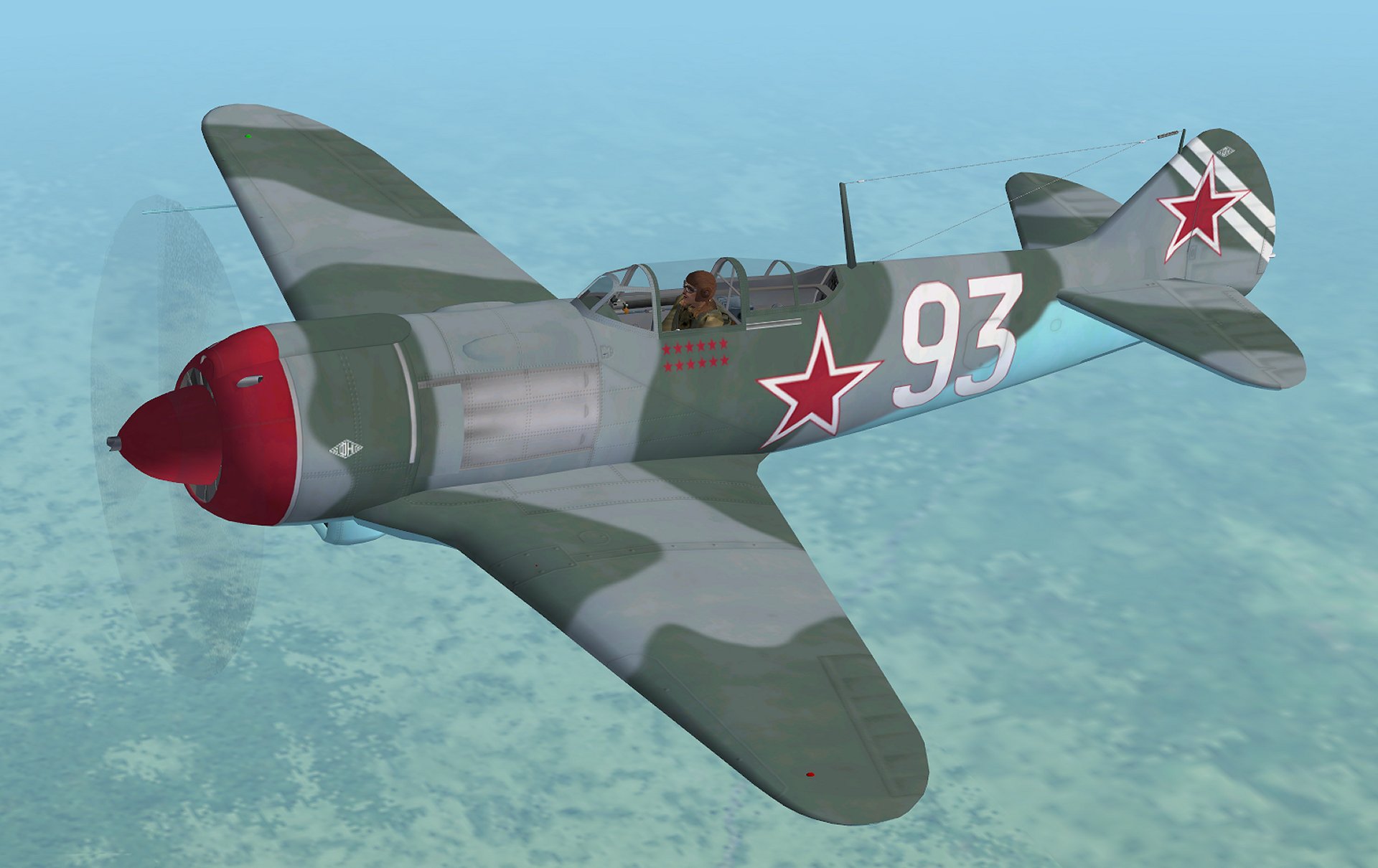
Unit: 32 GIAP aircraft flight files,
Pilot: Captain Vladimir Orekhov -- He ended the war with 19 personal victories
The La-5FN's story begins with one of the most remarkable engineering rescues of the war. In 1942, Semyon Lavochkin's LaGG-3 fighter, nicknamed the "lacquered guaranteed coffin" by its pilots, was one of the worst Soviet fighters in service. Underpowered, heavy, and sluggish, the LaGG-3 was being slaughtered by Bf 109s. Lavochkin's design bureau faced closure. In a desperate gamble, he replaced the LaGG-3's inline Klimov engine with the available Shvetsov M-82 radial engine, creating the LaG-5 (soon redesignated La-5) almost overnight.
The La-5 was a massive improvement over the LaGG-3, but it still had significant problems. The carbureted M-82A engine was unreliable and difficult to maintain, the cockpit was poorly sealed and leaked exhaust gases that sickened pilots, and the airframe retained many of the LaGG-3's structural weaknesses. Lavochkin systematically attacked each problem. The cockpit was redesigned with improved sealing. The engine cowling was reshaped for better cooling. The canopy was lowered for improved pilot visibility.
The breakthrough came with the ASh-82FN engine, which featured direct fuel injection, a technology that the Soviets had independently developed, paralleling BMW's work on the German radial engines. Direct injection eliminated the engine cut-out during negative-G maneuvers that plagued carbureted engines, increased maximum power by nearly 200 hp over the original M-82A, and improved fuel efficiency. The combination of the FN engine with Lavochkin's refined airframe produced the La-5FN, which entered production in March 1943.
Testing at the Soviet Air Force Research Institute (NII VVS) confirmed that the La-5FN was superior to the Bf 109G-2 in speed below 20,000 feet, in rate of climb below 16,000 feet, and in horizontal maneuverability at all altitudes. For the first time since the German invasion, a Soviet fighter could claim genuine qualitative parity with the best Luftwaffe equipment. The aircraft also proved easier to manufacture than the aluminum-intensive Yakovlev fighters, as its wooden construction utilized materials that were readily available within the Soviet Union.
Credits
Captain Kurt: Aircraft model, VC, 2D panel. paint textures, and .dp
aircraft flight files: Thicko
Kelticheart: Prop blurred texture
Gauges: Most are by Morton for the Br Yak-9U others by authors unknown
Bombs, rockets, and racks are from Ivan Hsu's I-16 series


