
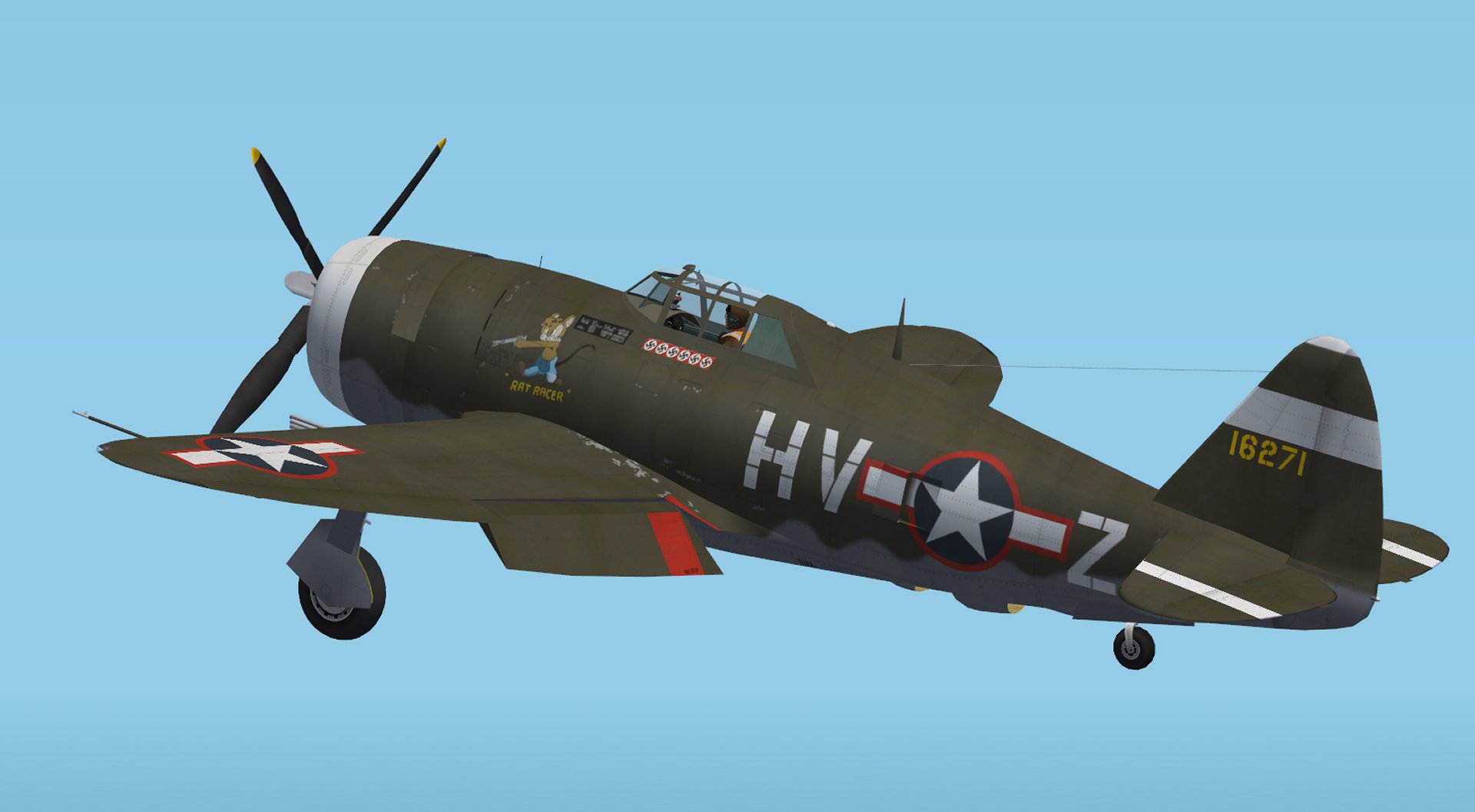
Republic P-47C-2-RE Thunderbolt
(v.2 corrected prop and flaps animation)
Unit: 61st Fighter Squadron, 56th Fighter Group Halseworth, England 1943
Pilot: Capt Frank E. McCauley
The U.S. Army Air Force’s P-47 Thunderbolt was a very effective fighter and fighter bomber. It was ruggedly built and heavily armed, famed for its ability to absorb damage, bringing its pilot home after inflicting punishment on the enemy.
The P-47 was conceived and engineered to be a high-altitude interceptor. Its designed purpose was to act in a defensive role, destroying attacking hostile bombers. However, by the time the P-47 became operational, it had become clear to military planners that an air attack on the continental United States was highly unlikely.
Newly classified as an escort fighter, the first P-47s were sent to England to support bomber missions. Even though the Thunderbolt’s range was limited to a combat radius of 200 miles, it was still about 50 miles more than the Spitfires of the time.
The P-47C-2 and P-47C-5 are historically important since they were the first P-47s to see combat. The first fighter groups to receive P-47Cs were the 4th, 78th, and 56th Fighter Groups. These P-47Cs arrived in Great Britain a few days before Christmas of 1942. Further shipments were planned to equip the three fighter groups with enough Thunderbolts to fill three squadrons in each Group. The 8th Air Force hoped to have all three Fighter Groups operational by mid-February 1943. Unfortunately, radio and engine problems during high altitude testing made that goal unattainable.
Once the solution to the communication problem was achieved, a sweep of 24 P-47C Thunderbolts over the Pas de Calais from all 3 Groups marked the real beginning of P-47 combat missions on April 8, 1943.
Credits
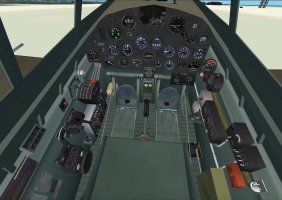
Captain Kurt: Aircraft model, drop tank, VC, paint textures, panel, and .dp
Pilot figure: Shessi and Captain Kurt
flight files: Jay McDaniel (modified to match P-47C performance)
Prop blurred texture: Kelticheart
Gauges: Alicat, Morton, Microsoft and others unknown
(v.2 corrected prop and flaps animation)
Unit: 61st Fighter Squadron, 56th Fighter Group Halseworth, England 1943
Pilot: Capt Frank E. McCauley
The U.S. Army Air Force’s P-47 Thunderbolt was a very effective fighter and fighter bomber. It was ruggedly built and heavily armed, famed for its ability to absorb damage, bringing its pilot home after inflicting punishment on the enemy.
The P-47 was conceived and engineered to be a high-altitude interceptor. Its designed purpose was to act in a defensive role, destroying attacking hostile bombers. However, by the time the P-47 became operational, it had become clear to military planners that an air attack on the continental United States was highly unlikely.
Newly classified as an escort fighter, the first P-47s were sent to England to support bomber missions. Even though the Thunderbolt’s range was limited to a combat radius of 200 miles, it was still about 50 miles more than the Spitfires of the time.
The P-47C-2 and P-47C-5 are historically important since they were the first P-47s to see combat. The first fighter groups to receive P-47Cs were the 4th, 78th, and 56th Fighter Groups. These P-47Cs arrived in Great Britain a few days before Christmas of 1942. Further shipments were planned to equip the three fighter groups with enough Thunderbolts to fill three squadrons in each Group. The 8th Air Force hoped to have all three Fighter Groups operational by mid-February 1943. Unfortunately, radio and engine problems during high altitude testing made that goal unattainable.
Once the solution to the communication problem was achieved, a sweep of 24 P-47C Thunderbolts over the Pas de Calais from all 3 Groups marked the real beginning of P-47 combat missions on April 8, 1943.
Credits
Captain Kurt: Aircraft model, drop tank, VC, paint textures, panel, and .dp
Pilot figure: Shessi and Captain Kurt
flight files: Jay McDaniel (modified to match P-47C performance)
Prop blurred texture: Kelticheart
Gauges: Alicat, Morton, Microsoft and others unknown


