
Republic P-47D-11-RE Thunderbolt
Unit: 84th Fighter Squadron, 78th Fighter Group, Duxford England June/July 1944
Pilot: Lt. Frank E. Oiler
The U.S. Army Air Force’s P-47 Thunderbolt was a very effective fighter and fighter bomber. It was ruggedly built and heavily armed, famed for its ability to absorb damage, bringing its pilot home after inflicting punishment on the enemy.
The P-47 was conceived and engineered to be a high-altitude interceptor. Its designed purpose was to act in a defensive role, destroying attacking hostile bombers. However, by the time the P-47 became operational, it had become clear to military planners that an air attack on the continental United States was highly unlikely. Newly classified as an escort fighter, the first P-47Cs were sent to England to escort bomber missions.
The P-47 D-11 Was a further refinement of the P-47 line, adding more armor protection for the pilot, fuel and oxygen systems, improvements to the turbocharger ducting, added two additional cowl flaps on either side of the cowling to improve engine cooling, and added water/alcohol mix injection to provide an emergency power boost of 15% for a short period.
Underwing pylons capable of carrying bomb and drop tanks did not appear until production block D-15. However the 78th FG and other groups in England installed the racks which could still carry bombs only. They were not made capable of using drop tanks because fitting the plumbing through the wing was a major refit issue. For some unknown reason the lower two cowl flaps were trimmed back to match the D-15 cowl flaps. Eileen wasn't the only 78th FG earlier block P-47 to receive this treatment.
Credits
Captain Kurt: Aircraft model, drop tank, VC, paint textures, panel, and .dp
Pilot figure: Shessi and Captain Kurt
flight files: Jay McDaniel (modified to match P-47D performance)
Prop blurred texture: Kelticheart
Gauges: Alicat, Morton, Microsoft and others unknown
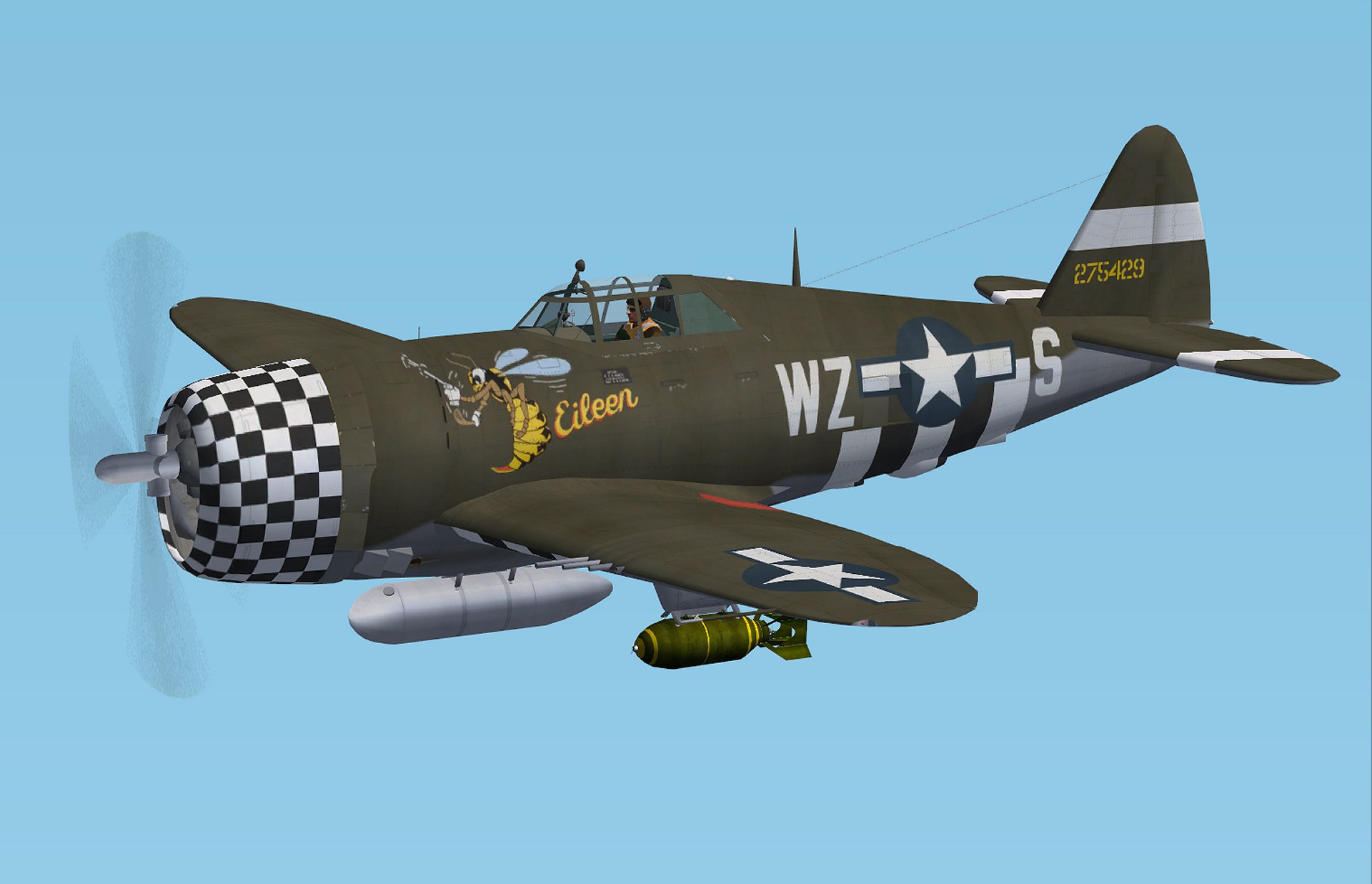
Unit: 84th Fighter Squadron, 78th Fighter Group, Duxford England June/July 1944
Pilot: Lt. Frank E. Oiler
The U.S. Army Air Force’s P-47 Thunderbolt was a very effective fighter and fighter bomber. It was ruggedly built and heavily armed, famed for its ability to absorb damage, bringing its pilot home after inflicting punishment on the enemy.
The P-47 was conceived and engineered to be a high-altitude interceptor. Its designed purpose was to act in a defensive role, destroying attacking hostile bombers. However, by the time the P-47 became operational, it had become clear to military planners that an air attack on the continental United States was highly unlikely. Newly classified as an escort fighter, the first P-47Cs were sent to England to escort bomber missions.
The P-47 D-11 Was a further refinement of the P-47 line, adding more armor protection for the pilot, fuel and oxygen systems, improvements to the turbocharger ducting, added two additional cowl flaps on either side of the cowling to improve engine cooling, and added water/alcohol mix injection to provide an emergency power boost of 15% for a short period.
Underwing pylons capable of carrying bomb and drop tanks did not appear until production block D-15. However the 78th FG and other groups in England installed the racks which could still carry bombs only. They were not made capable of using drop tanks because fitting the plumbing through the wing was a major refit issue. For some unknown reason the lower two cowl flaps were trimmed back to match the D-15 cowl flaps. Eileen wasn't the only 78th FG earlier block P-47 to receive this treatment.
Credits
Captain Kurt: Aircraft model, drop tank, VC, paint textures, panel, and .dp
Pilot figure: Shessi and Captain Kurt
flight files: Jay McDaniel (modified to match P-47D performance)
Prop blurred texture: Kelticheart
Gauges: Alicat, Morton, Microsoft and others unknown


