• There seems to be an uptick in Political comments in recent months. Those of us who are long time members of the site know that Political and Religious content has been banned for years. Nothing has changed. Please leave all political and religious comments out of the forums.

    If you recently joined the forums you were not presented with this restriction in the terms of service. This was due to a conversion error when we went from vBulletin to Xenforo. We have updated our terms of service to reflect these corrections.

    Please note any post refering to a politician will be considered political even if it is intended to be humor. Our experience is these topics have a way of dividing the forums and causing deep resentment among members. It is a poison to the community. We appreciate compliance with the rules.

    The Staff of SOH

  • Please see the most recent updates in the "Where did the .com name go?" thread. Posts number 16 and 17.

    Post 16 Update

    Post 17 Warning

Aircraft Pitch-Angle Question

Took me all day to notice this and i'll mot likely get slammed but, oh well.
Lets look at your numbers again ok??

reference_datum_position = 2.991, 0, 0 // (feet) distance from FlightSim Reference position: (1/4 chord, centerline, waterline)
empty_weight_CG_position = -3.2831, 0, - 2.255 // (feet) longitudinal, lateral, vertical distance from specified datum


[GeneralEngineData]
engine_type = 0 //0=Piston, 1=Jet, 2=None, 3=Helo-Turbine, 4=Rocket, 5=Turboprop
Engine.0 = 3.589, -5.837, 4.41 //(feet) longitudinal, lateral, vertical distance from reference datum
Engine.1 = 3.589, 5.837, 4.41 //(feet) longitudinal, lateral, vertical distance from reference datum
fuel_flow_scalar= 1.07
min_throttle_limit = -0.25; //Minimum percent throttle. Generally negative for turbine reverser


Your first entry tells me that your reference datum position is a bit over two feet ahead of the 1/4 cord default that microsoft sets. then, your moving the engines something over 3 feet ahead of the reference datum position?? I'm asking because the only time i normally see this is if the reference datum point for the plane is set to the leading edge of the wing.

So, before going any further, may i please make a suggestion?? Place the reference datum point on the tip of the nose. Its a fairly standard place among manufacturers to place it because everything is behind it and its far less complex to do the math..

Pam

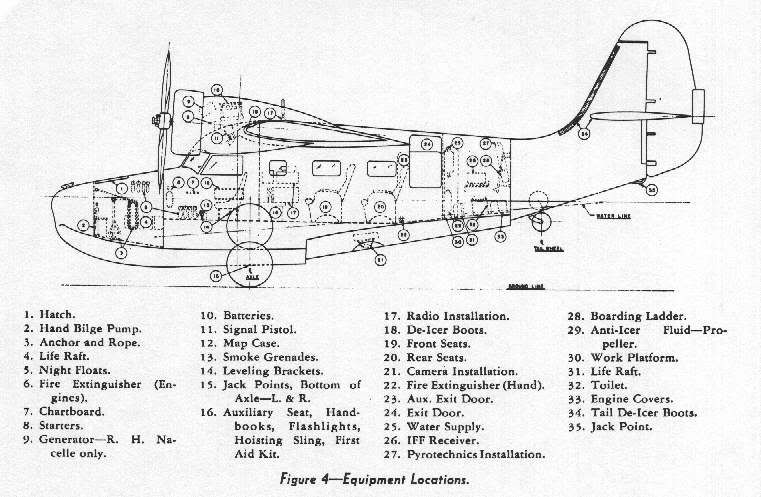
Oh and, if this is a Goose?/ Add the weight forthe toiled at station 26 and the water tank at station 25 and it'll balance out the weight of the engines against the CG..
 
Took me all day to notice this and i'll mot likely get slammed but, oh well.
Lets look at your numbers again ok??

reference_datum_position = 2.991, 0, 0 // (feet) distance from FlightSim Reference position: (1/4 chord, centerline, waterline)
empty_weight_CG_position = -3.2831, 0, - 2.255 // (feet) longitudinal, lateral, vertical distance from specified datum


[GeneralEngineData]
engine_type = 0 //0=Piston, 1=Jet, 2=None, 3=Helo-Turbine, 4=Rocket, 5=Turboprop
Engine.0 = 3.589, -5.837, 4.41 //(feet) longitudinal, lateral, vertical distance from reference datum
Engine.1 = 3.589, 5.837, 4.41 //(feet) longitudinal, lateral, vertical distance from reference datum
fuel_flow_scalar= 1.07
min_throttle_limit = -0.25; //Minimum percent throttle. Generally negative for turbine reverser


Your first entry tells me that your reference datum position is a bit over two feet ahead of the 1/4 cord default that microsoft sets. then, your moving the engines something over 3 feet ahead of the reference datum position?? I'm asking because the only time i normally see this is if the reference datum point for the plane is set to the leading edge of the wing.

So, before going any further, may i please make a suggestion?? Place the reference datum point on the tip of the nose. Its a fairly standard place among manufacturers to place it because everything is behind it and its far less complex to do the math..

Pam

Oh and, if this is a Goose?/ Add the weight forthe toiled at station 26 and the water tank at station 25 and it'll balance out the weight of the engines against the CG..

Naw.. no slamming... These aren't my numbers.. they're right out of the cfg.. (your Goose)

I agree.. the reference point should be the tip of the nose.. and most of the default planes are (or close).

MY preference, is for the model-center, empty CoG and the reference point to be the same... so that you can get all of the coordinates right from the modeling program. Literally hold the mouse on say a light location, or contact-point, and read the coordinates. It's really arbitrary though, and if you change an existing cfg reference datum.. you have to go through and changes ALL the other points.. (wing apexes, control-surface locations, weight stations, contact-points, lights, fuel tanks, etc).

Your first entry tells me that your reference datum position is a bit over two feet ahead of the 1/4 cord default that microsoft sets. then, your moving the engines something over 3 feet ahead of the reference datum position?? I'm asking because the only time i normally see this is if the reference datum point for the plane is set to the leading edge of the wing.

Microsoft doesn't set that. It's determined in the modeling program.. the literal center of the "scene". Most of the default models are close to 1/4 chord. I always set the center of my model to where the CoG would be (I cheated a little on my latest model (P35 Bonanza), because regardless of what you do in the cgf.. the sim "looks" at the model from the scene center).. and again.. it's arbitrtary. What's important is to get all of the locations correct, relative to each other. In theory, you could build the model with a center that's 100 feet in front of it.. it would just be tough to view it, in game :wiggle:

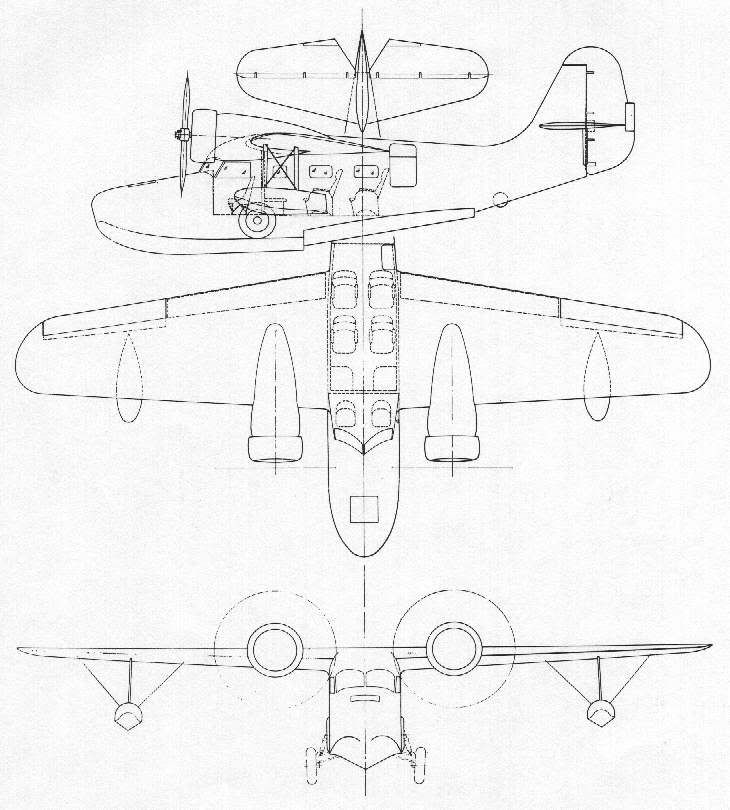
ANYway.. attached is an overhead of the Goose. You can see that the thrust points (reference datum + engine location).. are 6 feet or so in front of the model center :kilroy:
 
Most FS models have the reference datum (zero point) somewhere near the intended CG. Though real aircraft often have a ref datum near the nose, this is seldom a convention with FS planes.

A plane with a high thrust line such as the Goose do have some unplesant thrust/pitch attributes. Not as bad as say a Lake Amphib, but addition of power, say on final approach, causes a nose down pitch, which must be countered aggressively. By contrast, the 747 with low mounted pods can go from climb power/attitude to cruise power/attitude with very little trim change.

If you have AFSD, check to see at level cruise if much trim is being used to maintain level flight. If so it might be most effective to shift the CG aft. Also note that the pitch/thrust attributes are set inb the Primary Aerodynamics tab in the air file, in the poitch section.

T
 
Naw.. no slamming... These aren't my numbers.. they're right out of the cfg.. (your Goose)

:Chuckles:: It took me a while to realize it was a goose and why i made the comment about the toilet. the numbers were just too close though.. And no, i didnt use the nose as the RDP, i used the leading edge of the wing ( From Grumman plans ).. that was probably a mistake, but that was also a long time ago.

Technically, i should have made four FDEs. a reaistic one and a simplified one for each version. As it is, i dont particularly care for the pitch attributes myself but, when i've got goose pilots from real life telling me its spot on, not much i can do ya know?? I'm not a real life pilot. I just use numbers to define shapes and forces. And sometimes, even when i get it right, i get yelled at ( wel,, scolded ) because I make them too close to real and people have to go beyond their sense of enjoyment to use the plane.
I'm running into the very same dynamic on the P-36 i'm working on as well, but with that plane there will definately be two FDEs. One that is real as defined by the numbers and therefore more difficult to fy, and one that is more of what i consider fS standard. Easy to fly and fun..
 
Just an add on to the conversation.. thought i'd post these as an aid for you.. hope they help..
Pam
goose1-1.jpg


goose2-1.jpg


goose3-1.jpg
 
Oh man.. I love technical drawings..thanks :salute:

Remember.. I'm a big fan of that Goose.. helped sort out the weight vs fuel-load ? It's a realistic treasure to fly (I'm a real pilot, innactive CFI)..

When I build a model for FSX (have you flown my; Bonanza, 310, 177RG, CV240, CV580, or Saab 340 ?).. I start with a literal blank slate for flight-dynamics.. Plug in real numbers (dimensions, areas, MOIs, weights, etc), end it ends up pretty close.. Then I'll cheat a little with flight tuning, where needed.
 
Oh man.. I love technical drawings..thanks :salute:

Remember.. I'm a big fan of that Goose.. helped sort out the weight vs fuel-load ? It's a realistic treasure to fly (I'm a real pilot, innactive CFI)..

When I build a model for FSX (have you flown my; Bonanza, 310, 177RG, CV240, CV580, or Saab 340 ?).. I start with a literal blank slate for flight-dynamics.. Plug in real numbers (dimensions, areas, MOIs, weights, etc), end it ends up pretty close.. Then I'll cheat a little with flight tuning, where needed.

Not sure i've flown any of them, but would love too... I'll have to look around the library here and see what i can find..

i usually start with a printout of the threeview ( or in this case since i was lucky enough ) the original design 9 had that with the christan eagle too, was very lucky there ). Then i'll take specs from three seperate sources that agree on length and width and weight, and start taking measurments once i've scaled and measured the entire pane i'll take the weight and figure out the MOIs for roll pitch yaw and adverse ( coupled ) yaw.. once i have that in there, i'll start researching the engine. jets are easiest, but if theres a prop, i need to find data on the prop as well. if i can get the actual part number for that exact propellor, i'll get that data and enter it in..
over all, it can take me between 800 to 3000 hours of calculations to put an fde together, but in general, i try to get them as exact to reality as numbers will allow me to take them. heh.. like so many others, i'm a humble engineer, i dont actually get to fly the real thing..
The goose in many ways was more complex than even the Vulcan and it took my team 9 months to develope the flight model for the vulcan, yet, i did the goose by myself in 5 months i think it was. The fuel was correct when i released it. yeah, true, it was designed as an aircraft for rich new york executives to fy from their home in the hamptons to their job in the city, but given the knowledge of aerodynamics at the time it was made, it would in comparison to todays aircraft be difficult to handle.. The video i made of it on you tube more shows that i'm a wise ass and show off than it does the amount of work needed to fly this thing..
The changes you made may have indeed helped many people to enjoy this bird and if so, i'm glad for that. i wasnt making an easy to fly bird. I was asked to do high definition so i did and that isnt always making it fs friendly. Sometimes it puts me directly in the firing line for everyone elses curiousities and comments.
After over a thoyusand hours of work, sleepless nights, lost weekends, it can sometimes be difficult to listen, but i do try..
Always.
Pam
 
Oh man.. I love technical drawings..thanks :salute:

Ya know.. I'm wondering if there would be any interest in a technical library here.. graphs charts technical drawings, you name it. i mean, we're a community of developers here, and i cant think of how having available data woudnt be of assistance. its not like physics can be copyrighted right?? Just an idea but would love your thoughts on it..
Pam
 
i believe we are describing the same phenomena, only you have a formal education in regards to flying and are capable of describing things in far greater detail.. i am but myself.. :) ..
Pam

I thought that might have been the case but wasn't sure. I can see now how there are two different ways to describe the same resultt. I'm focusing on the decrease in angle of attack to maintain level. You are talking about how an increase in airspeed without an associated decrease in angle of attack will cause an initial pitch up for a climb.

In terms of being able to describe things ... well only for actual aviation. In terns of dissecting the wizard arts of airfiles in FSX, I'm a total newbie! :engel016:

Cheers,

Ken
 
I thought that might have been the case but wasn't sure. I can see now how there are two different ways to describe the same resultt. I'm focusing on the decrease in angle of attack to maintain level. You are talking about how an increase in airspeed without an associated decrease in angle of attack will cause an initial pitch up for a climb.

In terms of being able to describe things ... well only for actual aviation. In terns of dissecting the wizard arts of airfiles in FSX, I'm a total newbie! :engel016:

Cheers,

Ken

heh.. no problemo.. in terms of building real airplanes i'm a newbie too :) ..
seriously. when i started programming flight models, the first thing i did was to not listen to anything about flight sim, and instead concentrated on learning the reality of flight. I'm still learning.. Just when i thought i was beginning to get a grip on things, the russians come along with dynamic instability ( The principals used behind the su-37) and change all the rules on me.. Back to kindergarden for me :;lol:;..
 
Any sort of fly by wire system presents difficulties in FS. Meaning that the first thing you have to throw out (since we are results oriented) is the basic attributes of the airframe! Ms did in the FS series retain a good degree of legacy material in the sim engine, which has allowed port overs, eased the re-learning curve for developers etc, but has carried on limitations of the days of more limited computing power.

The workarounds necessary for more sophisticated aircraft get quite time consuming in themselves. That and ve are stepping beyond the bounds of real world experience for almost all of us.... and those who do have such experience may not be at liberty to chat.

T
 
The workarounds necessary for more sophisticated aircraft get quite time consuming in themselves. That and ve are stepping beyond the bounds of real world experience for almost all of us.... and those who do have such experience may not be at liberty to chat.

T

Precisely; I couldnt agree more. We may be engineers here, and therefore, beyond war, but we are still citizens of the nations we love ( or not as the case may be ) and we muct live by the nations rules that govern us. For us in flight Sim, that means that some things will remain beyond our reach. But fortunately, an aircrafts purpose and capabilities lay strictly within the design. Everything we as engineers need to know about an aircrafts performance and capabilities stares back at us from its shape and construction as unblinkingly as a cat. If we break what we see down into its measurments of height width depth and angles of curvatures, we can fairly faithfully create a true representation of the way the forces of lift, drag, gravity and adverse yaw will function across its frame.
But yeah, it takes a massive amount of time to do that.. :(
 
We always end up with a somewhat "bend to fit, paint to match" solution as a full wind tunnel, and possibly flight test program would be necessary to find out the full aerodynamic story. A couple of WWII examples from the neolithic age of flight test.... The P-38 had some serious buffet issues resulting from the shape of the fillet along the cockpit/wing root area, a small item not factored into the gross statistics we use. The F4U-1 had the wing drop on landing issue patched by the small stall strip at the leading edge, at the loss of some effective CL. The wing shape or attributes were not otherwise changed. Sometimes very small items can have big effects. We can (have to) often replicate the effect in FS by flight test and adjustment.

Being a 20,000 plus hour pilot I can often read the fligh evaluation notes and piece together a fair idea of what was happening, but you have to read alot of them as opinions vary when it comes to handeling. Raw performance numbers are easier to meet.

T
 
yeahhh, i tried getting a wind tunnel. the people that didnt laugh at me held out their hand for thousands of dollars.. It was depressing, but i sure could use that kind of data..
I'm sitting here with this mohawk about to have all my bull**** called on me by it as i calculate the forces needed to put it into a stall/spin situation. The mohawk had a very very violent spin characteristic, and without the wind tunnel data, its gonna be a real joy to estimate.. ( Sarcastically speaking of course )..
 
Back
Top