• There seems to be an uptick in Political comments in recent months. Those of us who are long time members of the site know that Political and Religious content has been banned for years. Nothing has changed. Please leave all political and religious comments out of the forums.

    If you recently joined the forums you were not presented with this restriction in the terms of service. This was due to a conversion error when we went from vBulletin to Xenforo. We have updated our terms of service to reflect these corrections.

    Please note any post refering to a politician will be considered political even if it is intended to be humor. Our experience is these topics have a way of dividing the forums and causing deep resentment among members. It is a poison to the community. We appreciate compliance with the rules.

    The Staff of SOH

  • Please see the most recent updates in the "Where did the .com name go?" thread. Posts number 16 and 17.

    Post 16 Update

    Post 17 Warning

Craig and Matt's Sopwith Camel Released 12th

Been talking with Paul this morning :).. He's telling me all the things hes done since i stepped away. You guys are gonna love this.. Its not a plane your going to be able to just get into and just steer around the sky. Your gonna have to work this plane.. About a sixty mile flight wears me out :). but, you can certainly consider the ability to fly one of these proficiently as a kind of badge of honor.. After all. If you can fly a Sopwith camel.....
I sincerely hope you all enjoy it :)..
Pam

If it flies like the one in ROF... it's defiantly going to be a handful to fly! Especially if you have a D.VII on your tail!
 
not having flown anything in ROF, i have nothing to compare it too.. right now, it kinda flies like the planes in the you tube videos.. Challenging yes, but, still flyable.. What we've found is that the torque of the engine nwas not the culprit that killed everyone. it was the landing gear.. it was completely stiff and its width was just perfect to bounce you into a ground loop on both takeoff and landing.. We may have tamed that down a tiny bit.. my last version i sent to paul a few days ago, you had to land absolutely perfect or you died.. there was no mercy.. Frankly, landing on a carrier in the middle of the night without lights would be easier.. Soo, yeah, we may have tamed that a tiny bit..
 
not having flown anything in ROF, i have nothing to compare it too.. right now, it kinda flies like the planes in the you tube videos.. Challenging yes, but, still flyable.. What we've found is that the torque of the engine nwas not the culprit that killed everyone. it was the landing gear.. it was completely stiff and its width was just perfect to bounce you into a ground loop on both takeoff and landing.. We may have tamed that down a tiny bit.. my last version i sent to paul a few days ago, you had to land absolutely perfect or you died.. there was no mercy.. Frankly, landing on a carrier in the middle of the night without lights would be easier.. Soo, yeah, we may have tamed that a tiny bit..

Six sorties later starting to get the hang of flying the Camel. Getting in the air is no problem... landing is another story. Just like the one that crashed in the building, same with me... turns to the right if not careful on landings. If you use the ailerons only, the Camel will spin very easly, but hard to recover, with the combination of ailerons and rudder it's much more stable. I just need to practice my landings.

Here's a short video of the ROF Camel... http://www.youtube.com/watch?v=-AdfdUkCN6E
 
While I'm wrapping up the Sopwith Camel (Manual) I though I'd share this link, I just love the sound of the Gnome rotary, and how the plane vibrates with the engine torque, makes me smile :)

<iframe src="http://www.youtube.com/embed/MZM1kc_N770?feature=player_detailpage" allowfullscreen="" frameborder="0" height="360" width="640"></iframe>
 
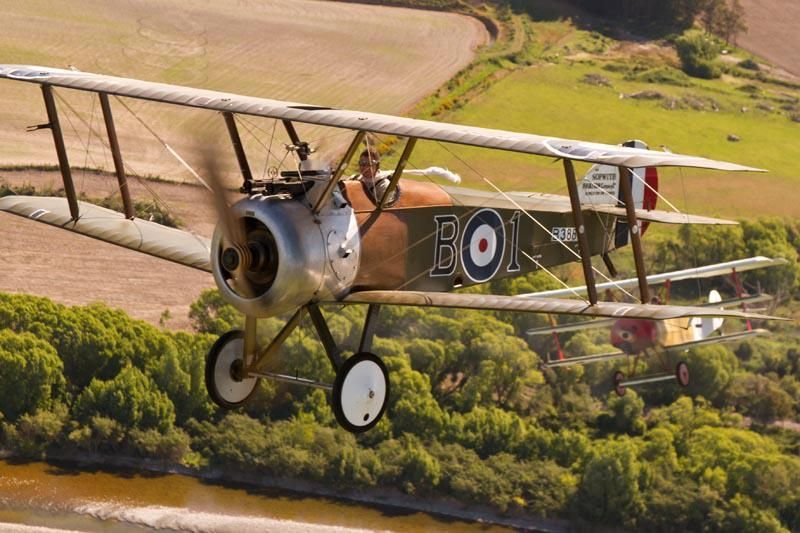
I love that video too, Craig! That happens to be the only authentic-reproduction Sopwith Camel flying today, and operated by those who know what they're doing (the pilots and engineers of 'The Vintage Aviator' at Masterton, New Zealand - a company owned by film maker Peter Jackson, specializing in the operation and manufacture of exact reproductions of WWI aircraft and engines). The Old Rhinebeck Camel, as far as I know, hasn't flown in several years, with the new management - and as has been brought up a few times here, the aircraft has seemingly not had pilots at the controls that know enough about what they're doing, in recent years, resulting in loss of control while just performing fast taxi runs. Fortunately none of these aircraft are original priceless relics of WWI, but rather are very accurate reproductions that can be repaired when items are damaged or broken. With these types of aircraft, if there is no prop wash over the rudder, the rudder will be useless. As soon as the engine is stopped or at idle, you're not going to get any rudder control, and there will be no way for you the pilot to be able to steer the aircraft on the ground. When the ORA pilot lost control of the Rhinebeck Camel in that particular video mentioned, he's trapped by that fact - the engine is cut when the right-turn starts coming, and because of this, even though he puts in full left rudder, it has no effect. Had he caught it soon enough, he would have needed to blip the power back on while feeding left rudder - wait too long, of course, and it would be too late.

When you watch and listen to any experienced pilot landing a rotary-powered aircraft, you'll hear the engine blip on and off while the pilot feeds in brief movements of rudder, to keep the aircraft going fairly straight down the runway.

I saved this image off of The Vintage Aviator's Facebook page yesterday, of their Camel being trailed by one of the numerous Fokker Dr.1 reproductions based in New Zealand. Both Gene DeMarco (who pilots this aircraft) and Kermit Weeks, are never to be seen flying these types of aircraft without the trademark white scarf. ; )

488032_440580802679841_1994796887_n_zps5ec2500f.jpg
 
I actually considered bribing Craig to make a scarf for the pilot. it adds so much by being there, but, it would be incredibly tedious to animate so i thought better of it..

Paul and i studied that plane from every aspect imaginable. Sadly, he's in wales and i'm in the US so we could never get eyeballs on it, but the videos helped a great deal. we knew we had to make this plane fly like a Sopwith camel, and not an FSx Sopwith camel. So we broke every rule in the book on making flight models.. the only thing that mattered to us was make it real.. many aspects of the plane have never been included in flight simulator at all. the torque of a rotary engine that weighs almost half as much as the rest of the plane twisting around at 1200 rpm while the attached prop pulled it through the air. the almost rigid landing gear and the way it could bounce you not only in the wrong direction but completely roll you over.
Craig has done a simply amazing job on this aircraft, and Paul and I felt compelled to give it just as great of an effort on our part. I sincerely hope you all enjoy it when its released..
Pam
Oh yes, by the way.. The reason for the scarf is that the engine didnt have any exhaust, and the oil was pretty much a system where it entered the engine and dropped out of it somehow ( i'm certainly no expert on rotaries ), so the pilot would use the scarf to wipe the oil from their goggles as well as to help prevent chafing from the cold wind during flight..
one thing we were not able to incorporate is that at 130 mph ( in a dive 0 the windscreen would cause the nose of the plane to oscillate up and down. i didnt see any way to make that happen so its a reality that is not there. i apologize for that. perhaps in a future release if we can figure out a way to invent it..
 
Six sorties later starting to get the hang of flying the Camel. Getting in the air is no problem... landing is another story. Just like the one that crashed in the building, same with me... turns to the right if not careful on landings. If you use the ailerons only, the Camel will spin very easly, but hard to recover, with the combination of ailerons and rudder it's much more stable. I just need to practice my landings.

Here's a short video of the ROF Camel... http://www.youtube.com/watch?v=-AdfdUkCN6E
::LOL:: this makes me wish i had ROF. i still cant draw a comparison, and i cant say which is more accurate ( having never actually flown a camel myself ), but we;ve done our very best to make it match not only the videos, but the pilot reports and old geezer stories as well.. I hope you enjoy it.,. Just, dont expect the normal FSx aircraft :;lol:;
PS.. The ROF plane seems way too stable after losing its prop. but i could be incorrect :)..
 
While talking about the Sopwith Camel, did you know...

There is a company called Airdrome Aeroplanes, based in Missouri, that can build you a replica Sopwith Camel. It will be a full size replica (in all dimentions), but is built to be cost effective and to provide the safest WWI style flying experience, utilizing modern construction and a modern engine. This is the company's website, showing all of the different replica WWI (and older) type aircraft that they can, and have, manufactured (my personal favorites are the Bleriots they have built): http://www.airdromeaeroplanes.com/

Here is a thread showing one of these having been built (the first example). As mentioned in the thread, instead of a 130 hp Clerget rotary, as the original Camels were manufactured with, it is powered by a modern Rotec radial engine, of similar size, that produces 150 hp, and instead of a wooden frame, it has a steel tube frame. Other than that, it has the same frabric, wood, and metal skins, and various period items that make it look the part. Be sure to look at some of the pics later in this thread, showing the fully completed aircraft (especially the last pic of it at the very end of the thread). Save for the engine and tail wheel, you would be hard pressed not to believe it was an exact copy. The really cool part is that it can be treated as just an ordinary, every day flyer!

http://warbirdinformationexchange.org/phpBB3/viewtopic.php?f=26&t=35166

And here is a gallery on the Airdrome Aeroplanes web site: http://www.airdromeaeroplanes.com/airdrome_camel/album/index.html

The owner of this aircraft has also had a Sopwith Hamble Baby Convert manufactured by the company as well (this was sort of a land-based version of the Sopwith Tabloid), as seen here: http://warbirdinformationexchange.org/phpBB3/viewtopic.php?f=16&t=41516&hilit
 
The Camel is a fascinating aeroplane, it's spectacular combat abilities only matched by it's (supposedly) deadly flying vices. The only other aircraft that comes close in reputation for such a combination of good and bad is arguably the F4U Corsair. There have been several quality books written that involve the Camel, one of the best being 'Winged Victory' by Yeates; another being 'Open Cockpit' by A.G. Lee.

But the best to my mind, and one of my most treasured books is "Flying The Old Planes" by Frank Tallman. Published in 1973 Frank describes flying original WWI aircraft in marvellous detail. Given that not everyone may have read this book I thought I would reproduce the chapter on the Camel. It's a first hand account of a skilled pilot flying an original (as clsoe as maybe) restored Camel.

Just as background Frank Tallman, who along with Paul Mantz formed Tallmantz Aviation, was famous as a stunt pilot for Hollywood and a collector of rare and vintage aircraft. Paul was killed in 1965 on the film set for 'Flight of the Phoenix'. Frank died in 1978 while delivering a Piper Aztec. In bad weather, with a lowering ceiling and rain, he struck the side of Santiago Peak in the Santa Ana Mountains near Trabuco Canyon. RIP.

Here's the abridged chapter from "Flying The Old Planes".

My Sopwith Camel is, as far as I’m aware, the only original World War 1 Camel ever brought back to flying condition. It was originally owned by Colonel Jarrett of the Jarrett War Museum located on the old Steel Pier in Atlantic City; who in the 1930’s had the best museum of WWI equipment ever assembled, including the Belgian War Museum in Brussels. The Jarrett Museum fell on hard times following WWII and, with time and money on my side after my service period, and a lifelong ambition of owning a WWI aircraft, I purchased for a small sum (by today’s standards) several antique aircraft including the Camel, a Nieuport 28, a Pfalz D.XII, a Fokker D.VII and a SPAD VII.

The Camel was the first WWI aircraft I brought back to flying condition and required some major rebuilding, which took several years, many thousands of dollars and a whole host of experts including Paul Poberzney of the Experimental Aircraft Association, the gifted master craftsman Ned Kensinger, the Hawker Siddeley Group and a number of very dedicated volunteer’s.

(NB: There is quite a bit on the rebuilding process in the Chapter but I have left it out of this extract for the sake of space).

When the day finally came to fly the air was filled with great anticipation. On arrival at the airport though I was dismayed to hear from my team that they had been trying to get the temperamental 110 h.p. Le Rhone started since 8.00am that morning, without success. The lack of knowledge amongst us regarding the Le Rhone was appalling. Did we have spark? Yes. Was the mag set? Yes. Had the commutator ring been wiped off? Yes. Had we primed it? Only every other cylinder.

With only a vague notion of what I was doing I clambered into the cockpit (a very tight fit) and reviewed the cord-wrapped Spade stick, the Block tube, carburettors next to one’s knees, the flexible air intake to the outside air scoops, the wood wire brace longerons, the instrument panel with it’s clutter and the duel control cables to the wooden rudder bar. At my request, the crew forced open the intake valves as the engine was pushed through (switch off) and shot a charge of fuel in each cylinder, as the cylinder came in front of the hole in the cowling. By accident, rather than by knowledge, I advanced the long lever controlling the air, and in pushing the manet (a small wheel knob on the miniature control quadrant) forward and then returning it, I had hit on the correct starting procedure. Wonder of wonders, as I flipped the porcelain-mounted switch up and called for contact, the Le Rhone started with a full-throated bellow, scaring both me and the crew!

By shoving the fuel-controlling lever forward and using the coupe (cut-out) button on the stick, I was able to keep the engine running. Soon the never-to-be-forgotten smell of castor oil infused our area, and the sight of oil splattering the leading edge of the low wings indicated that the engine was lubricating properly. Taxiing practice ended ignominiously a hundred feet from the starting point, when my newfound knowledge wasn’t equal to the delicate adjustment of fuel and air, and the Le Rhone quit.

The revitalised ground crew hauled the 900 pound airplane over the grass and faced me into the wind. For safety sake we changed the plugs, and the Le Rhone started first try. I headed down the field with the throttle wide open. The tail came up almost instantly, and visibility was good, except for the Aldis sight and the twin Vickers. Not having planned on flight it came as something of a shock to find the Camel airborne at about 35 mph after a ground run of just 150 feet. Being afraid of jockeying with my ticklish fuel and air controls I stayed low and just got used to the Camel’s sensitive ailerons, elevators and rudder.

I circled the field once, got into position for landing, shut fuel air and switch off, and made a light forward slip, touching down gently on three points. Total landing couldn’t have been much longer than the initial take-off run.

So much for my first (unintentional) flight in the Camel.

Since then I’ve spent more time flying the Camel than any of the other historical aircraft in our collection. I’ve also had more forced landings in it than all the rest of the WWI aircraft combined. It’s that temperamental Le Rhone. Cylinders have blown, magneto’s have failed, even fouled spark plugs have brought me down unceremoniously, with sweating hands and my heart in my mouth, desperately seeking a patch of open ground on which to land. Yet for all that it’s the one I turn to first for any show or exhibition, as the Camel gets my blood going like no other. This is an aircraft that is a joy to fly.

With the Le Rhone 9J, you cannot adjust either the fuel or air intake without running the risk of a dead-stick landing. You must leave them alone and use you Coupe (cut-out) button for all fight handling.

The take-off run is easy. In a wind of 10 to 15 knots you are airborne in a couple of plane lengths at 35 mph and climbing out at 60 mph, with a rate of climb of almost 1,000 feet a minute. The elevators are sensitive, as is the rudder. Consequently, when fling for any distance I often put the heels of my shoes on the floor tie wires, because the vibration of the Le Rhone through the rudder bar exaggerates the rudder movements.

In level flight at 100 mph indicated, the Camel is delightful, with just a hint of rudder being required for straight flight. The structure is rugged enough to feel comfortable in loops, and being slightly tail-heavy it goes up and over in an incredibly small circle in the sky, and faster than any other WWI aircraft I have flown. Sneeze and your halfway through a loop before your aware of what’s happened. 110 mph is enough to carry you through, and as you slow down over the top you must feed in rudder against the torque.

In military shows I have ground strafed, and as soon as the airspeed reaches 130 to 140 mph the nose begins to hunt up and down, and the elevator becomes extremely sensitive. I feel this action is due largely to the square windshield between the two Vickers guns, causing a substantial burble over the tail surfaces.

Turns are what the Camel is all about. Turning to the right with the torque requires the top rudder to hold the nose up, and the speed with which you can complete a 360-degree turn is breathtaking. Left turns are slower, with the nose wanting to rise during the turn. But small rudder input easily keeps the nose level with the horizon. In stalls at 35 to 40 mph the nose drops frighteningly fast and hard to the right, but you also get control back quickly, although a surprising amount of altitude has been lost. I have had the pleasure of limited dog fighting with other WWI fighters, and there are none that can stay with a Camel in a turn.

With the Le Rhone being temperamental as it is, flying the Camel is best done at times when there are few other aircraft in the sky, leaving easy access to the airport in cases of emergency. The Camel touches down easily but runs out of rudder control almost instantly, and if you bounce your landing at all, you are likely to find yourself in a hairy ground loop looking at a rapidly bending aileron dragging in the grass.

For a wide variety of reasons, the Camel is a fascinating airplane, flight-wise as well as historically. But don’t think I ever got out of the Camel after being airborne even in the coldest weather without buckets of perspiration and considerable gratitude that I had gotten the little girl home again without breaking her into splinters!
 
Thank you for posting that, Pips! I really enjoyed reading it, and I think I'll have to try and trace down a copy of that book. Frank Tallman, Paul Mantz, and the Tallmantz collection have really fascinated me in recent years (much of the collection of course eventually went to Kermit Weeks/Fantasy of Flight).

A photo of that particular WWI survivor Sopwith Camel taken at the museum in 1964 can be seen on this page, about halfway down: http://www.aerovintage.com/tman_photo3.htm
(Speaking of which, many great old Tallmantz photos can be found in the galleries here: http://www.aerovintage.com/tallmantz.htm)

The Camel still survives to this day, and is owned by the Arkansas Aviation Historical Society.
 
thanks pips..
That article became part of our bible for developing the flight model. Had we created the flight model the "normal" way, you wouldnt have seen any of that happening. to begin with, theres no such thing as a bi-plane in Flight sim. The program simply will not allow you to use two wings. its an old problem thats very familiar, but in the case of the Sopwith, it gets magnified a hundred fold as the rotational center ( not the cg ) is located just below the top wing, and the dihedral on the bottom wing plays a significant roll . Paul and i worked up a strategy whereby instead of programming in empirical data, we calculated the forces involved in effecting the flight, and programmed the flight model with those forces. fine tuning the flight model became easy. all we had to do was put the real plane under a magnifying glass and duplicate the usage of the control surfaces.. the fact that in some videos the sopwith is flying with a dr.1 made it all that much better as we had a second aircraft to use as reference for wind strength and such so we could make a fairly accurate assessment of how much reaction was needed because of weather and how much was needed because of the planes characteristics. what we have is an aircraft that mimics the sopwith camel seen in the videos in all aspects of flight..
Also, when you download it.. turn the engine off and set the chocks. then step out of the cockpit and hit ctrl-e.. enjoy :) :) ( yes, it mimics the start up torque as well )
 
I'd just like to thank Craig for taking on my mesh and making it into something we can enjoy using in FSX for a long time. What he has done has exceeded my expectations for this project. Thank you to Pam and Paul too for the hours they have put into the FDE which is amazing. The whole package adds up to hours of fun:icon_lol:

Matt
 
Back
Top