• There seems to be an uptick in Political comments in recent months. Those of us who are long time members of the site know that Political and Religious content has been banned for years. Nothing has changed. Please leave all political and religious comments out of the forums.

    If you recently joined the forums you were not presented with this restriction in the terms of service. This was due to a conversion error when we went from vBulletin to Xenforo. We have updated our terms of service to reflect these corrections.

    Please note any post refering to a politician will be considered political even if it is intended to be humor. Our experience is these topics have a way of dividing the forums and causing deep resentment among members. It is a poison to the community. We appreciate compliance with the rules.

    The Staff of SOH
  • Please see the most recent updates in the "Where did the .com name go?" thread. Posts number 16 and 17.

    Post 16 Update

    Post 17 Warning

Duck flaps

jojohnson9

Charter Member 2016
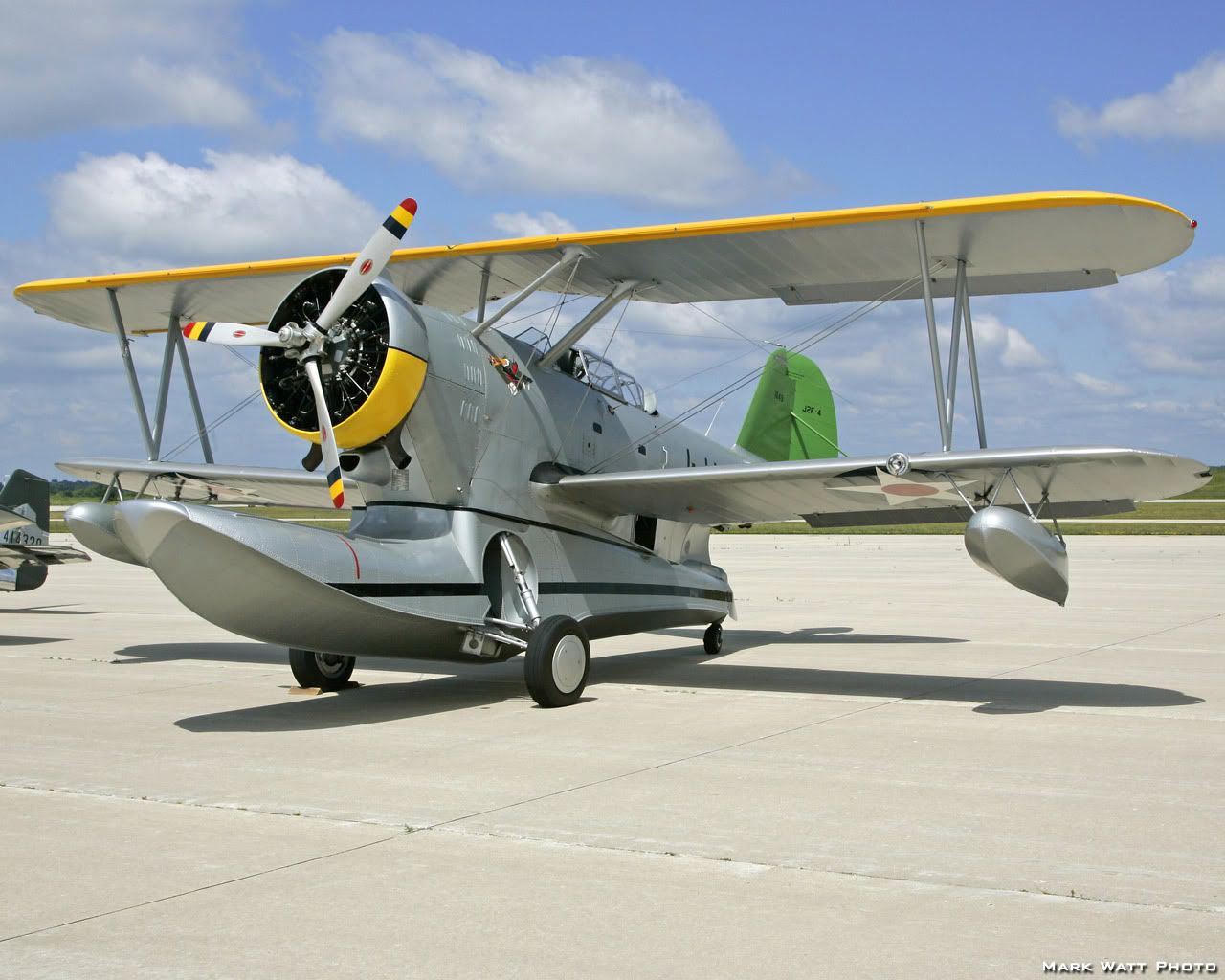
I have two Grumman J2F "Ducks" from two different sources. One is configured with wing flaps, the other is not. I do not believe that the "Duck" had wing flaps in any of its models. Am I wrong? I have tried to find a flapped "Duck" on the internet, but no luck.
 
As far as I know, the Duck did not have flaps...it did not need them. With the dual wing configuration, there was more than enough lift for take off and landing. And those dual wings and all those wing struts and braces acted like speed brakes, bleeding airspeed sufficiently for landing approaches.

OBIO
 
No, the Duck didn't have flaps, at least on production models.

The only instance I can find was with a 'one-off' conversion, where an early J2F-1 was operated with upper-wing, full-span flaps, at NAS Anacostia.

There are images floating around of a plastic model Argentina-finished Duck (that was also shown to confirm the usage of flaps on the Icarus Duck), that the model-kit builder has the lower wing ailerons both fixed at a downward angle, but that, as far as everything I have read, was a mistake. Furthermore, the flap gauge in said-Duck, is actually supposed to be a suction gauge.
 
As far as I know, the Duck did not have flaps...it did not need them. With the dual wing configuration, there was more than enough lift for take off and landing. And those dual wings and all those wing struts and braces acted like speed brakes, bleeding airspeed sufficiently for landing approaches.

OBIO
Has a final determination been made by SOH staff regarding the accusations?

Provided the outcome shows no conflict between the two models, and in advance of that happening:

OBIO,
were the flight model tweaks ever completed?

BR's
mal
View attachment 35055 View attachment 35054 View attachment 35056 View attachment 35057 View attachment 35058 View attachment 35059

 
Great photos, Mal! As you can see in the first photo, both ailerons are down on the right wing, and both would be up on the left wing (the stick would be resting at the left-side of the cockpit).

Here's a great view of the cockpit on Kermit Weeks' late model J2F-6 Duck (to compare with the earlier variant, WWII-period photo posted by Mal).
http://www.fantasyofflight.com/Images/aircraft/Grumman%20Duck%20cockpit%201.JPG

While there are three J2F Ducks flying in the US today, and a fourth on the way, only one is an original Grumman-built Duck, that being the J2F-4 owned/flown by Chuck Greenhill. The others, which are all J2F-6 variants, which two are owned by Kermit Weeks (1 current flyer, and 1 restoration to be a flyer), as well as the airworthy Tillamook-based Duck, were manufactured by a lesser-known company called Columbia Aircraft Corp., which built all of the J2F-6 variants.

There are many differences throughout the airframes, from the Grumman J2F-4 to the Columbia J2F-6 (much more than you might expect!), but the most noticeable is of course the engine difference. The J2F-4 was fitted with an R-1820-30 engine, producing 850 HP, but with the J2F-6, the engine was upgraded to an R-1820-64 engine, producing 1,050 HP. There were only 32 J2F-4's built, and only 330 J2F-6's built.
 
Thanks, Bomber. I had already deflapped the "I" bird. Now I'll put the suction gauge in the VC. I like the freeware "Duck" so much, that I have put the other one in the hanger.
 
I was reading up about Chuck Greenhill's J2F-4 last night, and I didn't know how rare the powerplant that drives it is! While there were only 32 J2F-4's manufactured to begin with, the engine that powered them, the R-1820-30 variant, there were only 112 ever made. Amazingly one was found, that was in superb condition, and has been running like a champ ever since Mr. Greenhill's Duck first flew back in 2005. A superb photo gallery of this aircraft is available here:

http://warbirddepot.com/aircraft_liaisons_j2f-greenhill.asp

201-b-1280.jpg
 
Great pics once again, Mal! I know that about 25 years ago, Kermit purchased around 50 Allison V-1710 engines, many of them still in their original crates. At that time, they were all being offered for cheap within the hydroplane and tractor-pull businesses, and they were simply being red-lined until they blew up. When the lot went up for auction, Kermit Weeks bought them all, saving them for future and continued use in warbirds, and only warbirds. They have been for use not only within the Fantasy of Flight collection, but they are also available for sale to other warbird owners/restorers.

In his collection, some of it of which is stored/being restored around the world, he has got some of the most interesting piston aero-engines ever made, from about WW1 until the mid-40's. Amongst these are two Napier Sabre engines, the incredibly rare, large engines used on the Hawker Typhoon, and up to five Allison V-24, 3420 cubic inch engines, which were mostly used/intended for the P-75. He is also one of the major backers of the amazing WWI aero-engine productions occurring in New Zealand, along with film maker and WWI/WWII aviation nut, Peter Jackson.
 
I have spent a lot of time, before the war, with the J2-Fs at the Coast Gard base at Winter Island, Salem, Massahusetts and none of them had flaps. - Not a one.
Another thing. There was no propeller warming stripe on the floats until 1950 when some stupid Admiral got clipped. We ran around on the flight deck all during the war without any warnings. Then they got Admiral Zumwalt, got rid of the recips, and brought women on board ships and it's gone down hill since...
 
Helldiver, thank you for your input! As stated earlier in the thread, the only spot you would have seen a sole J2F Duck, with flaps, would have been the one and only modified example at NAS Anacostia.

I have seen evidence also, not only within the Navy, but the USAAF/USAF transition around the late 40's, that there were a lot of additional prop-warning markings and 'No Step' and 'No Push' stencils added to aircraft. Some of the photos however, that have been posted in this thread, were clearly taken early in WWII, or at least pre-1945 based on the paint scheme and national insignias, and you can see the prop warning stripe painted on the float, but not in all cases.
 
It is fair to say that many pictures from the WWII period do not have that warning stripe as well. I have seen at least two in this thread alone.

Warning stencils on aircraft based on my time in the service have always been a matter of contention among the men I worked with. Often the dangers that they warn against are rather obvious.

As a Sergeant once told me, "If there is a warning or a safety notice to adhere to, it is because some person caused it with an accident."

Another saying I heard often was "Things are the way they are because they were earned in blood."

I guess it is what it is.
 
"REMOVE BABY BEFORE FOLDING" - warning label on collapsible baby stroller. :icon_lol:
Back when Helldiver was in NavAir most of the planes had no place to put a red warning stripe, the prop was right up front. You had to stay alert, watch where you were going and what was sneaking up behind you. I've noticed in stores, so many people walk backwards or turn their heads while they're walking. You don't do that around airplanes. As for the various warning and maintenance stencils you see on aircraft, they tend to disappear as the plane is maintained in the squadron. Corrosion control sanding and spot-repainting removes a lot of them, also foot traffic and daily cleaning. Speaking only for USN/USMC planes here, you USAF types get to keep your planes ashore in nice hangars and hardened shelters. ;)
 
I don't give a RA as to how many pictures you got, I'll tell you right now there were no prop warning stripes on WWII aircraft. Put that in your pipe and smoke it.
 
Helldiver, I am not taking your opinion lightly, and you're free to believe and say what you will based on your experiences and memories from your service for this country, which I am very thankful for and honored to even have the chance to communicate with you in this form!

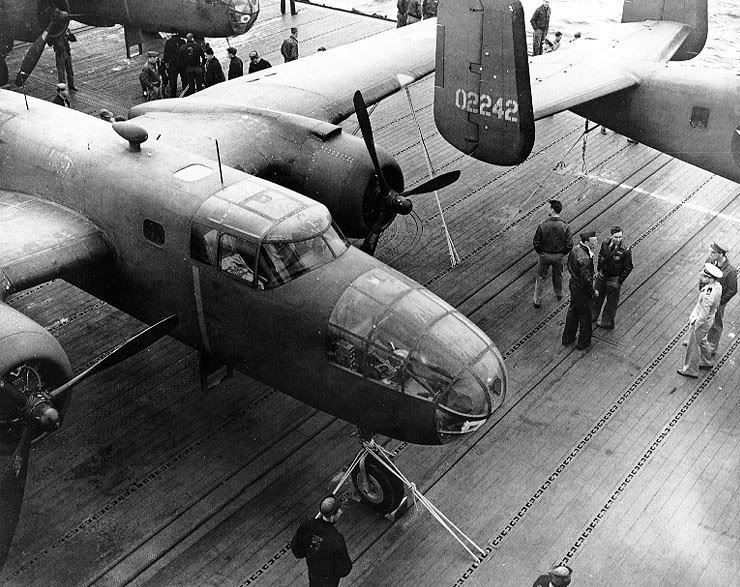
Related to remembering a piece of American history this weekend, the following photo was taken 69 years ago this month, perhaps 69 years ago today (the Doolittle Raiders launched on April 18, 1942).

B25-1.jpg
 
I don't give a RA as to how many pictures you got, I'll tell you right now there were no prop warning stripes on WWII aircraft. Put that in your pipe and smoke it.

I started this thread about Duck flaps, and now we are discussing prop warning stripes. My question was answered so maybe it is time to end it.
But before we do....I do like pictures. I am a WWII buff (not historian). I have hundreds of books on WWII. Most of them deal with all aspects of the air war. Many written by brave men who lived through those terrible years; others written by well qualified historians.
Many of these books show pictures of aircraft without prop warning stripes. And many books show the very same aircraft types WITH prop warning stripes. Examples are OS2U, J2F, JRF, B-25/PBJ, A-20, A-26, and others.
One very good reference will show this clearly: "WWII War Eagles in Original Color" by Jeffrey L. Ethell & Warren M. Bodie. All the photographs were taken during World War II, not after.

As an "editorial" note, I served on active duty in the Navy from 1963 to 1986. I do not consider myself an expert on the Vietnam War.
 
Back
Top