• There seems to be an uptick in Political comments in recent months. Those of us who are long time members of the site know that Political and Religious content has been banned for years. Nothing has changed. Please leave all political and religious comments out of the forums.

    If you recently joined the forums you were not presented with this restriction in the terms of service. This was due to a conversion error when we went from vBulletin to Xenforo. We have updated our terms of service to reflect these corrections.

    Please note any post refering to a politician will be considered political even if it is intended to be humor. Our experience is these topics have a way of dividing the forums and causing deep resentment among members. It is a poison to the community. We appreciate compliance with the rules.

    The Staff of SOH

  • Server side Maintenance is done. We still have an update to the forum software to run but that one will have to wait for a better time.

Flight Replicas P-40N Released [Payware}

Hi Mike or John

Any advice - as you know the tail plane surfaces are split on the repaint kit. What is odd is that the squares on my attempted repaint seem to resise to a different scale on each separate surface. can this be rectified somehow before I spend 2 hours reworking the black squares?


Echoing Diego's comments..... :) Although, I've got the stables full and saddled with John's ponies, I think Mike's work is very compelling. Just need to wait for some $$.$$ to spend on such items....just installed a rock pathway to the backyard, which ate up my spending money!! Arrg! I am loving the multiple variants. I believe that whenever I end up with this one in the hangar, it'll be the complete package. I'm very interested in the light weight training variant. I would like to do a progression series of flights, starting with the wozza AT-6, moving on to the training P-40, then to a fully equipped and eventually transitioning to the P-51, then finally to the F-86F-30 in my collection. And do this over a few months, where when I fly for personal fun; fly each in a series of training flights, XC flights and meeting a set of training goals I set for myself in each aircraft before moving on to the next.

John, loving the repaint. She looks great. I'm also very impressed with the paints included standard with this product.
 
Performance fine tuned, will send the new files to Mike within the next few hours but I haven't found any test flight or performance table that results in any higher speed than 352mph (9000ft).

Mr. Stolle,

I think the published 378mph TAS is widely known, but I could be wrong...

However, I pulled up the following document on the P-40N, take-off gross of 7,413, armed, at 57", 3000RPM, and a little above 10,000ft... there it is again, 378mph
See: HERE
I believe this aircraft is using the -81 also, rated, around 1,360hp, and of course, normally aspirated. As mike has depicted the stripped lightweight model as well, which would have the belly shackles removed, as well as guns, etc., I would expect the TAS number at critical altitude to be in the 385+ market, conservatively.

On these performance tables, for the N model, (see HERE) I'm seeing the upper 340-350ish mark at critical altitude, with a 6-gun ship, when an aircraft is gross around 8,000 plus... And these carry above 340mph TAS through 20,000ft. Currently, in the sim, I can not make enough power at 20,000, at those weights, to get anywhere close to that. I believe it says they were making around 39" at 20,000ft.

My test example was absolute minimum, take-off gross around 6,200lbs, unarmed...coming in at around 335mph, 57", 3000 RPM, around 10K. That's the best I can do. Haven't got serious with the heavier and more armed ships. Ambient temperature were around 70 degrees Fahrenheit at 5,000 (airport elevation), and maybe around 35-40 degrees at the 10K mark. Weather clear. Winds zero for the purpose of testing.

Hope this helps!
Really liking the overall feel, and control, And the low-speed numbers seem quite accurate.

- Joseph
 
Are you guys able to overheat the engine on this baby? I tried to idle it on ground cowl flaps closed air temperature being over 20C and then tried to fly the plane with quite high power hugging the ground and keeping it in warm air for a while. Either case coolant temperature seems to stop on the green shy of 100C no matter of the position of cowl flaps. You would think that it should overheat quite quickly with cowl flaps fully closed or am I missing something here?
 
Love this but just one thing , if I may . I know Mike is looking for problems . The engoine sound ( which is fantastic) but I am not hearing any difference in engine sound at the top end . It sounds the same to me at 50" @ 3000rpm as it does at about 30" @ roughly 2,000rpm . Please tell me I'm wrong because the rest is totally enjoyable

I'm going to see if I can do anything about this. Right now there's only four looping .wav files with which to try and simulate a whole RPM range, so something has to give a bit somewhere - but I'll see what I can do!

Mike
 
Mr. Stolle,

I think the published 378mph TAS is widely known, but I could be wrong...

However, I pulled up the following document on the P-40N, take-off gross of 7,413, armed, at 57", 3000RPM, and a little above 10,000ft... there it is again, 378mph
See: HERE
I believe this aircraft is using the -81 also, rated, around 1,360hp, and of course, normally aspirated. As mike has depicted the stripped lightweight model as well, which would have the belly shackles removed, as well as guns, etc., I would expect the TAS number at critical altitude to be in the 385+ market, conservatively.

On these performance tables, for the N model, (see HERE) I'm seeing the upper 340-350ish mark at critical altitude, with a 6-gun ship, when an aircraft is gross around 8,000 plus... And these carry above 340mph TAS through 20,000ft. Currently, in the sim, I can not make enough power at 20,000, at those weights, to get anywhere close to that. I believe it says they were making around 39" at 20,000ft.

My test example was absolute minimum, take-off gross around 6,200lbs, unarmed...coming in at around 335mph, 57", 3000 RPM, around 10K. That's the best I can do. Haven't got serious with the heavier and more armed ships. Ambient temperature were around 70 degrees Fahrenheit at 5,000 (airport elevation), and maybe around 35-40 degrees at the 10K mark. Weather clear. Winds zero for the purpose of testing.

Hope this helps!
Really liking the overall feel, and control, And the low-speed numbers seem quite accurate.

- Joseph

I'll let Bernt address this more fully if he'd like to (as I'm no expert), but I believe the report you're referring to involved a test aircraft with experimental radiators, and with other possible experimental modifications that were not mentioned. Apparently critical altitude is also 57" higher than elsewhere for the -81 engine. If I can quote Barfly, regarding this report: "It's very possible however in this case that they (USAAF) was attempting to maximize speed including possibly a slightly different motor configuration - apparently the Allison V1710 was very modular and it was easy to modify with upgraded performance parts at the type evolved."
 
Sounds good Mike!

I believe these tests were that I'm referring to, were pretty stock aircraft, and with stock -81 Allisons.

Anxious to hear from Mr. Stolle.

- Joseph
 
Mr. Stolle,

I think the published 378mph TAS is widely known, but I could be wrong...
- Joseph

I think you'll find that the 378 mph figure was for the lightweight N-1. (I seem to recall that figure is in 'America's Hundred Thousand').

As fsxar177 pointed out, WWII Aircraft Performance has some good data for the P-40N-1 & -5.

Are you guys able to overheat the engine on this baby? I tried to idle it on ground cowl flaps closed air temperature being over 20C and then tried to fly the plane with quite high power hugging the ground and keeping it in warm air for a while. Either case coolant temperature seems to stop on the green shy of 100C no matter of the position of cowl flaps. You would think that it should overheat quite quickly with cowl flaps fully closed or am I missing something here?

This can be done, (the rate of change and cooling scalars for liquid cooled, or CHT temp for air cooled engines, needs to be set up in the .air file), and is something I do with all the FMs' I make. It adds a bit of extra pressure, especially on a hot day, and gets your eyes constantly looking at the temps and pressures, as you would do in real life, or on an Accusim aircraft.

Obviously, by default, there will be no consequence if you do overheat the coolant, CHT, or oil, unless of course you decide to model say the coolant boiling and venting with a custom effect file.

But I guess this is why most developers don't pay much attention to these settings, simply because FS does not mind how high they go, and has no effect on the engine or it's performance.

Cheers

Paul
 
Mr. Stolle,

I think the published 378mph TAS is widely known, but I could be wrong...

However, I pulled up the following document on the P-40N, take-off gross of 7,413, armed, at 57", 3000RPM, and a little above 10,000ft... there it is again, 378mph
See: HERE
I believe this aircraft is using the -81 also, rated, around 1,360hp, and of course, normally aspirated. As mike has depicted the stripped lightweight model as well, which would have the belly shackles removed, as well as guns, etc., I would expect the TAS number at critical altitude to be in the 385+ market, conservatively.

On these performance tables, for the N model, (see HERE) I'm seeing the upper 340-350ish mark at critical altitude, with a 6-gun ship, when an aircraft is gross around 8,000 plus... And these carry above 340mph TAS through 20,000ft. Currently, in the sim, I can not make enough power at 20,000, at those weights, to get anywhere close to that. I believe it says they were making around 39" at 20,000ft.

My test example was absolute minimum, take-off gross around 6,200lbs, unarmed...coming in at around 335mph, 57", 3000 RPM, around 10K. That's the best I can do. Haven't got serious with the heavier and more armed ships. Ambient temperature were around 70 degrees Fahrenheit at 5,000 (airport elevation), and maybe around 35-40 degrees at the 10K mark. Weather clear. Winds zero for the purpose of testing.

Hope this helps!
Really liking the overall feel, and control, And the low-speed numbers seem quite accurate.

- Joseph

I think that test is rather odd; it was meant to represent an "N" series test but they used a modified "K", which normally comes with a different engine. They claim a dash-81 engine configuration, but the HP and crit altitude numbers aren't from a -81. I suspect they had a -73 motor that came with the K and corresponding better engine performance. I could be completely wrong, but that's what it looks like - the test plane could have been a 'ringer', for whatever reason. The later production aircraft used 1200 hp motors; not sure why you would start the N series with a better motor, then decrease hp when weight of successive variants went up.
 
I think the published 378mph TAS is widely known, but I could be wrong...

However, I pulled up the following document on the P-40N, take-off gross of 7,413, armed, at 57", 3000RPM, and a little above 10,000ft... there it is again, 378mph
See: HERE
The table you quoted shows that the -81 engine used in this test delivered a whopping 1480hp but the standard -81 delivers 'only' 1200hp AFAIK. That explains the difference IMO.
 
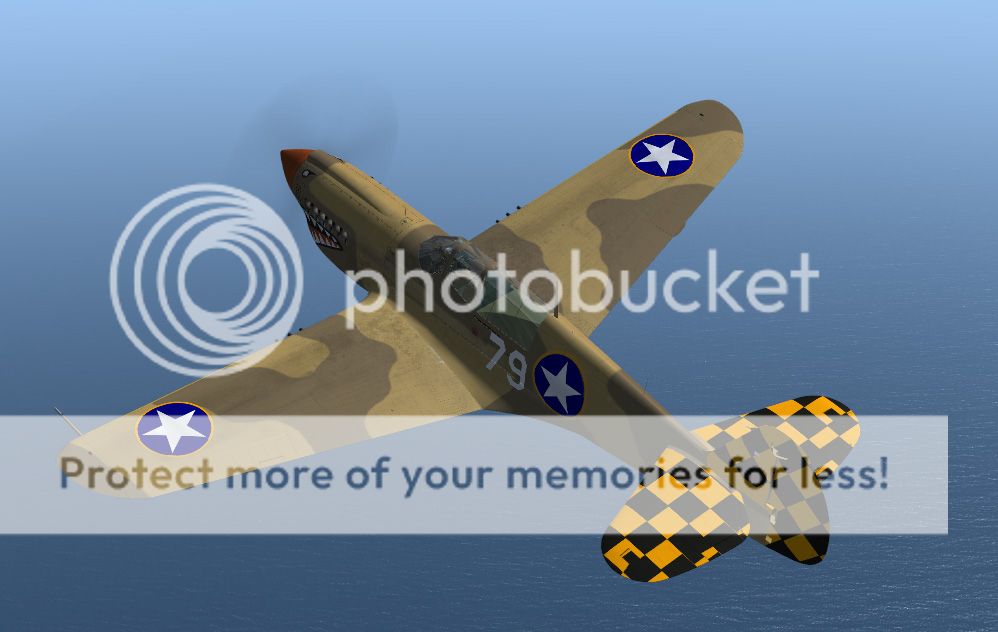
Here are some new screenshots of my repaint of NL540TP. I 'think' its done, and when uploaded I'll be including a minor update for my "Little Jeanne" repaint as well.


The table you quoted shows that the -81 engine used in this test delivered a whopping 1480hp but the standard -81 delivers 'only' 1200hp AFAIK. That explains the difference IMO.

Interesting.

Checking 'America's Hundred Thousand', it has the following power outputs for the V-1710-81/F20R, fitted to the P-40M/and early N models: -

Take Off - 1200 HP @ 3000 RPM (SL)
War Emergency - 1360 HP @ 3000 RPM (SL)
Military - 1125 HP @ 3000 RPM @ 14600 - 15500ft
Normal - 1100 HP @ 2600 @ 13800 -14000ft

Unfortunatley, it does not give the Manifold pressures, but luckily, thanks to the pilots manual, we know that the War Emergency rating was 57 inches. Also listed with the same power outputs are the V1710-99/F26R (N-20/35) & V1710-115/F31R (N-40).

According to the P-40N Operational Suitability Report (N-1), this seems to back up what AHT gives for the V-1710-81 power ratings.

Looking at the max speed results table in this report, it gives 355 TAS @ 15000ft @ 56 inches/3000 RPM, and 244 TAS @ SL @ the same power setting, at an AUW of 7500lbs

Oh, another lovely repaint as usual John!

Cheers

Paul
 
Hi Mike or John

Any advice - as you know the tail plane surfaces are split on the repaint kit. What is odd is that the squares on my attempted repaint seem to resise to a different scale on each separate surface. can this be rectified somehow before I spend 2 hours reworking the black squares?


They shouldn't resize to a different scale, at all, so I'm puzzled! As you can see by the original textures, everything should just lay out normally - otherwise the included paint schemes would look wrong, as well. On your trim tabs, it looks as if two squares have been 'cut' by the way the tabs are mapped to look like two small ones. Is this what you mean?

Mike
 
The table you quoted shows that the -81 engine used in this test delivered a whopping 1480hp but the standard -81 delivers 'only' 1200hp AFAIK. That explains the difference IMO.

I just checked the P-40N Pilots Manual (AN-01-25CN-1), and the Specific Engine Flight Chart gives the War Emergency Power Rating for the V-1710-81 and 99 (I note it doesn't give a sub model such as F20R) as 1480 HP @ 57 Inches @ 3000 RPM at 10000 ft (RAM), and the same rating at 7500 ft (no RAM).

Take Off Power is given as 1200 HP @ 52 Inches @ 3000 RPM at SL, whilst Military Power is given as 1125 HP @ 44.2 Inches @ 3000 RPM at 17000 ft (RAM) or 15000 ft (no RAM).

These power settings & outputs would all appear to be on 100 octane fuel.

So it would seem the report fsxar177 links giving the 378 MPH is indeed using the V-1710-81 and not the more powerful V1710-73/F4R of the K model as Barfly suggests. (This engines max HP is rated as 1550 HP @ SL according to AHT).

Cheers

Paul
 
The table you quoted shows that the -81 engine used in this test delivered a whopping 1480hp but the standard -81 delivers 'only' 1200hp AFAIK. That explains the difference IMO.

Actually, the -81 Allison is rated at 1,360hp. The 1480 b.h.p listed is from their power curves, tested on three series of Allison engines. (-81, -83, -85 ) This doesn't mean the engine installed was modified, or that would have to be listed in their report. I'm not sure what the single-stage supercharger was rated for altitude, But I would guess somewhere between 10-16k. Experimental radiators were used, but I'm sure had little to do with performance figures, as the aircraft didn't suffer from cooling problems at 10k anyway, and the temperature listed at the altitude during testing, was 10 degrees Fahrenheit.

.....According to the P-40N Operational Suitability Report (N-1), this seems to back up what AHT gives for the V-1710-81 power ratings.

Looking at the max speed results table in this report, it gives 355 TAS @ 15000ft @ 56 inches/3000 RPM, and 244 TAS @ SL @ the same power setting, at an AUW of 7500lbs....


Thank-you for the additional information Paul. Very interesting! And the report you mention, the aircraft is considerably heavier than my test platform within the simulator. I fear I'd be hard pressed to reach 320mph TAS at 15,000ft, if I was at 7,500lbs....

- Joseph
 
Thank-you for the additional information Paul. Very interesting! And the report you mention, the aircraft is considerably heavier than my test platform within the simulator. I fear I'd be hard pressed to reach 320mph TAS at 15,000ft, if I was at 7,500lbs....

- Joseph

No problem Joseph.

It's always interesting to look at different tests and compare them.

I just had a quick glance at the P-40N speed curves graph in 'America's Hundred Thousand', and for the N5-40 (8400lbs), it gives a max speed at altitude of around 350 MPH (approx 16000ft), and just over 300 MPH at about 2500ft (this is where the line on the graph starts). SL speed is about 275 MPH if you follow the line of the graph down.

I'll add that all the P-40 speed curves listed in AHT say they are for Military Power only.

Interestingly, these speeds seem to be, (using that much used cliche), 'In the Ball Park' of the War Emergency Ratings speeds given in the P-40N Operational Suitability report, and the P-40N Army Air Force Material Centre Report you linked.

Cheers

Paul
 
Just a note to say that there are updates on the way. When they're ready, previous purchasers will be notified (new purchasers will be getting the updated version at time of purchase). So far, these correct a few model issues, plus Bernt has sent some new airfiles to be incorporated. More news when the updates are ready.

Mike
 
Just a note to say that there are updates on the way. When they're ready, previous purchasers will be notified (new purchasers will be getting the updated version at time of purchase). So far, these correct a few model issues, plus Bernt has sent some new airfiles to be incorporated. More news when the updates are ready.

Mike


Sounds like a good'n to me Mike!

I really appreciate these threads, where things can be hashed out. Sure is a fine product, and you can't beat the support! I really like the clarity of the virtual cockpit. No problems whatsoever reading gauges, or finding my way around. The texture work inside is superb, and really gives an authentic feel. The differences between the earlier, and later N variants within the cockpit sure stand out! Found myself looking for my VSI in one model last night, and well..found out it ain't there! Fun stuff!

- Joseph
 
Back
Top