I'm sure that there are some Field Manuals on the web that would give you some particulars, but unless you are looking to create a particular air base, you can pretty much use your imagination.
Remember also that the EAF will be heavily influenced by who builds it.
if you are speaking of an Army or Marine FARP type setup, it can be quite austere. If the intention is to operate VSTOL/STOVL assets as well, then you will be well served by a couple of thousand of feet of runway and some AM-2 pads for vertical ops.
For Marine A/C, the lower limit used to be 5000ft for fixed wing. In fact, you could apparently land a Hornet A in Quantico without A gear and that is only 4200ft. I'm uncertain if that number has changed or if the Hornet numbers above are for the E/F models. Remember also that Hornets can use expeditionary arresting gear for routine short field ops...it's actually gentler than the ship gear IIRC. This is not the same gear that Navy airfields have for emergencies and I don't believe either are the same as the Air Force gear which is not normally kept in battery as it can mangle the lighter AF landing gear. Fields will also often have long field chain gear (literally a pendant connected to increasingly large links of chain) located at the runway's end.
Lastly, the markings can be very simple for a VMC only runway or one served by an essentially ad hoc non precision approach. The Harrier used to be able to use a All Weather Landing System (AWLS) for a poor man's ILS. That unit was portable and could be set up at any field. I'm not sure what the Hornets have/had in the way of approach options, but I believe the Air Force has ILS in all its jets and I would be surprised if that wasn't the case with the Superhornet and the F-35.
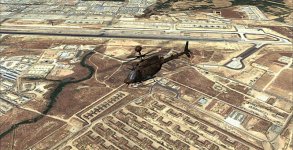
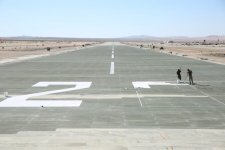
Here's a couple of pics I found of some EAFs. You might try Googling the following...
Twentynine Palms EAF
Bogue Field, MCALF
Red Beach, Camp Pendleton
Ie Shima, Okinawa
but again, these are Marine fields...AF fields will be built with different sensibilities.




 )
)