• There seems to be an uptick in Political comments in recent months. Those of us who are long time members of the site know that Political and Religious content has been banned for years. Nothing has changed. Please leave all political and religious comments out of the forums.

    If you recently joined the forums you were not presented with this restriction in the terms of service. This was due to a conversion error when we went from vBulletin to Xenforo. We have updated our terms of service to reflect these corrections.

    Please note any post refering to a politician will be considered political even if it is intended to be humor. Our experience is these topics have a way of dividing the forums and causing deep resentment among members. It is a poison to the community. We appreciate compliance with the rules.

    The Staff of SOH

  • Please see the most recent updates in the "Where did the .com name go?" thread. Posts number 16 and 17.

    Post 16 Update

    Post 17 Warning

Muroc Army Airbase, 1947...

Email sent Tim..

And for the rest of you folks :)..
Something i've been thinking about for the last couple days, is what your going to experience when you fly this thing. Its been a concern to be honest.. Designed to take advantage of thirty thousand pounds of thrust, the X/YB-35 was almost woefully inadequate with its four three thousand horsepower engines. Even with counter rotating props, it was only capable of reaching about three fourths of its design thrust. This meant that it didnt reach full flight design capabilities till after jets ( and basic computer assist ) were added, and that at lower speeds it had a whole range of bad behaviors, some of which i've had glimpses of in the videos i've watched and the documentation i've read. That means that you folks are gonna have your hands full. I wont kid you, the plane is going to be a challenge. Its not like the P-61 which in real life was more docile than a golden retriever. its more like Kato from Inspector Clouseau, jumping out at you when you least expect it..

now, i promise you all, that i will not excuse bad programming on my part, as being representative of the plane being difficult. The plane will in all ways, behave exactly like the real one. I'll make sure of that, but i do hope your all up for the challenge. It worries me that some of you wont be.

For all you non History buffs out there, Muroc air base was renamed Edwards Airforce Base on December 2nd, 1950, after Capt Glen Edwards, who, as a top ranked Test pilot, was killed with four other crew members during a test. They were flying a YB-49, the more advanced child of the Xb-35, and nowhere near as primitive.

As we've all seen, Piglet is doing an incredible job of building us a visual model that matches the original plane. because of that, the the people who died flying this thing, I'd be a fraud, if i didnt do my very best to make it real..

Stay tuned: its gonna be a hell of a ride ;)..

Pam

PS.. I wonder. With a top speed of 400 mph, if this qualifies for the round the world race?? There were definitely more than ten built.. :).
 
According to Wiki there were six YB-49's: "3 converted from YB-35, 2 YB-49 and one YRB-49A, more incomplete examples scrapped."

Anyway the rule stated at least ten in operational use, so no prototypes.
 
[FONT=Verdana,Helvetica]Designations on Jet Conversion Program, Feb 1949
[/FONT]
cleardot.gif

[FONT=Verdana,Helvetica]s/n[/FONT][FONT=Verdana,Helvetica]c/n[/FONT][FONT=Verdana,Helvetica]model[/FONT][FONT=Verdana,Helvetica]rev #1[/FONT][FONT=Verdana,Helvetica]rev #2[/FONT][FONT=Verdana,Helvetica]rev #3[/FONT][FONT=Verdana,Helvetica]disposition[/FONT]
[FONT=Verdana,Helvetica]42-13603
42-38323
42-102366
42-102367
42-102368
42-102369
42-102370
42-102371
42-102372
42-102373
42-102374
42-102375
42-102376
42-102377
42-102378
[/FONT]
[FONT=Verdana,Helvetica]1484
1485
1486
1487
1488
1489
1490
1491
1492
1493
1494
1495
1496
1497
1498
[/FONT]
[FONT=Verdana,Helvetica]XB-35
XB-35
YB-35
YB-35
YB-35
YB-35
YB-35
YB-35
YB-35
YB-35
YB-35
YB-35
YB-35
YB-35
YB-35
[/FONT]
[FONT=Verdana,Helvetica]XB-35
XB-35
YB-35
YB-49
YB-49
YB-35
RB-35
RB-35
RB-35
RB-35
YB-35A
YB-35A
YB-35A
YB-35A
YB-35A
[/FONT]
[FONT=Verdana,Helvetica]ERB-35
EB-35
RB-35
YB-49
YB-49
YRB-49A
RB-35B
RB-35B
RB-35B
RB-35B
RB-35B
RB-35B
RB-35B
RB-35B
static
[/FONT]
[FONT=Verdana,Helvetica]


YB-49
YB-49

YB-35B
YB-35B
YB-35B
YB-35B
YB-35B
YB-35B
YRB-49A
YB-35B
EB-35B
[/FONT]
[FONT=Verdana,Helvetica]salvaged
salvaged
salvaged
flight tests
crashed
salvaged
flight tests
flight tests
flight tests
flight tests
flight tests
flight tests
prototype
flight tests
test bed
[/FONT]

<tbody>
</tbody>
[FONT=Verdana,Helvetica]Data: Winged Wonders, E T Wooldridge, NASM 1983[/FONT]

More information on this link

http://aerofiles.com/_north.html
 
Thats a scarry video to watch! The aft section of the wing stalls out first!!! That means the aircraft could stall BACKWARDS if the pilots not carefull. The crash that happened was not due to the stall, but the pull-out from the stall. The YB-35 had gotten too fast in the recovery, and during pull-out, the massive ammount of lift collapsed the wing on itself.
 
I LIKE that video. It not only shows the center of lift moving in relationship to the angle of attack, but to the speed of the airstream over it as well..
( hoping i have enough coffee in me to think straight ).. The thing is, on any non twisted wing, the back of the wing will stall first. The only difference between this plane and a conventional plane is that a conventional plane has a second wing in the form of a horizonatal stabilizer. Whether the horizontal stabilizer is pushing the ass down, lifting it up or just being there to look good, doesnt matter during a stall. Since its still a wing, it will provide some type of force against the airstream to keep the plane level. Obviously, this plane doesnt have that advantage. Compounding that are the aft located engines which are adding thousands of pounds of downward force to the trailing edge of the wing. Its quite conceivable that in a stall the engines would fall downward, rotating the wing to a critical angle >60 degrees to the airstream, and pull the plane down backwards. Thats why i need to research and understand exactly how weight was distributed throughout the wing, because it needs to counter the weight of those engines to avoid such calamities.
 
ok, sooo, the engines are embedded inside the wing. probably close to the intake on the leading edge.. tat would help to keep the wing from stalling backwards. But it does create a problem with cooling..
 
Great stuff, KD!

I love how the cut-away drawing shows how the enormous scale of the XB-35 could actually make the massive "corn cob" P&W R-4360's appear small! You can just make them out, staggered in position, with a tremendous amount of cooling duct-work leading to them from the wing leading edge intakes.

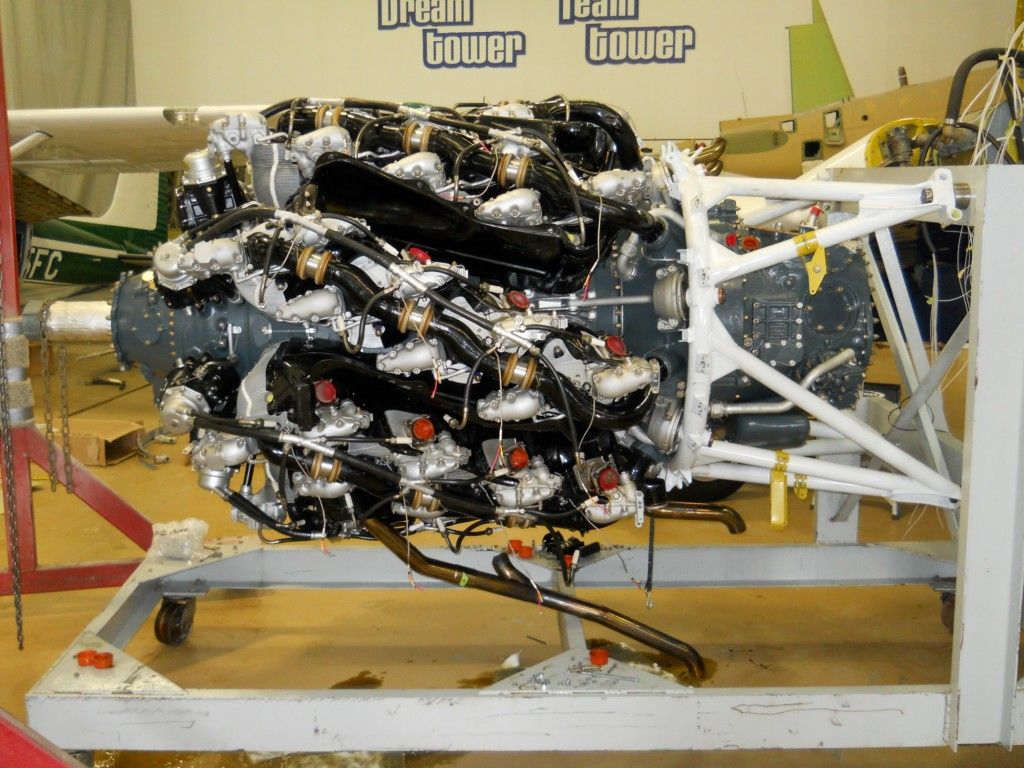
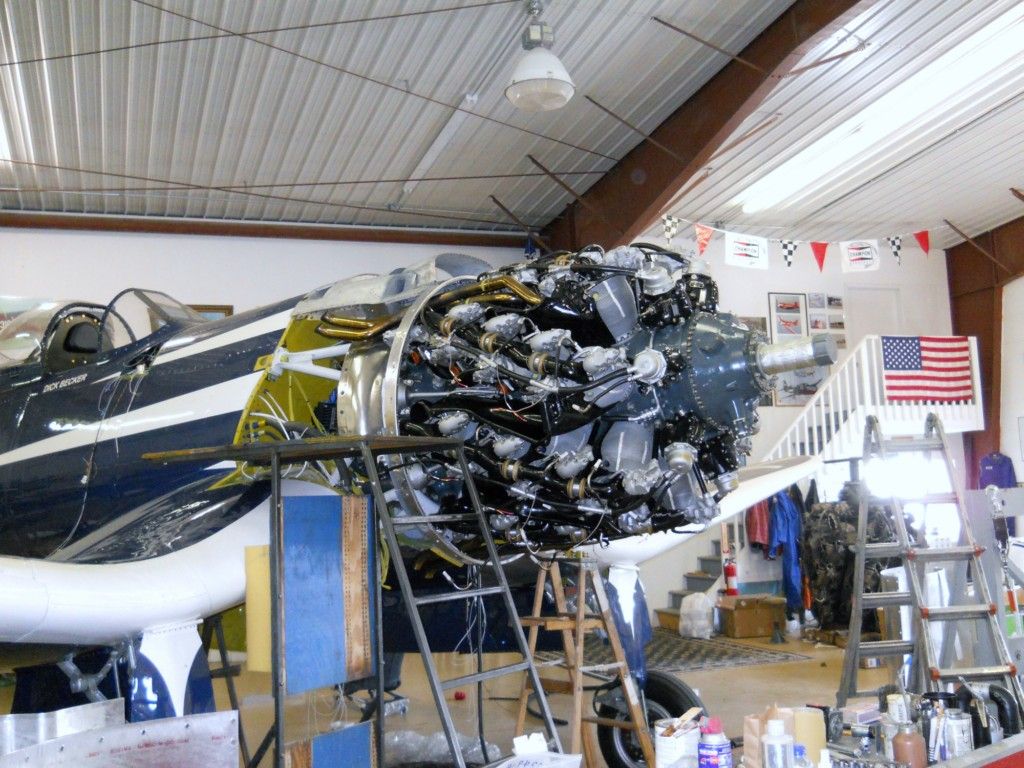
These are photos of the same engine type, as fitted to an F2G Super Corsair. Despite the 12,000 hp out-put generated from the four combined R-4360's on the XB-35, it is nothing compared to what the designers had wanted, in the use of the experimental Northrop gas-turbine engines, which would have produced a combined 40,000 hp, with four installed. Once jets were incorporated into the design, with the YB-49, this lack of power was no longer an issue, and the airplane then became a solid performer.

DSCN0346.jpg


DSCN0361.jpg
 

That first image tells a TON of info.. I can make a plane jane guess at the center of lift and CG and probably be within a few inches of it.. and my gods what a plumbing fiasco behind the air intakes.. no wonder this thing weighed 50000 pounds..
Thanks KD :)..
 
.95lb/1hp, pretty amazing, but a cylinder change every time you stop for gas! Most reports seemed to indicate that the wing had acceptable stall characteristics except with CofG aft, where the aircraft would rather violently snap nose over tail into a flat spin.
 
Empty weight, as I have read it, on the XB-35, was actually around 89,000 lbs...I guess it depends on where the information comes from. Gross weight was around 180,000 lbs! This was propelled by only 12,000 hp, through the combined power of all four R-4360's. That equates to only 1 hp for every 15 pounds of mass, at gross weight.

The original intenet was to have 40,000 hp on the XB-35, which would have equated to 1 hp for every 4.5 pounds, at gross weight.

(The YB-49, on the other hand, had a total of eight jet engines, producing 32,000 lbs. of force combined. As the original test pilots stated, this completely solved the power-problem, which was the major draw-back of the XB-35.)
 
yup, the hp was horrendous, even with those monsters in it, but thats why i stuck to thrust as opposed to HP. The extra set of blades on there added to the thrust allowing it to fly somewhat better than on the later single prop per engine versions. The Russians did a somewhat better job of using counter rotating props on their bear which was able to give some of our jets a run for their money. I just cant remember if the total thrust output was a similar formula to determining RMS values in a circuit or not. Its greater than a single prop per engine, but less than eight single prop engines. I'll have to do a thorough look for that formula..
 
Actual flight tests of the aircraft revealed several problems: The contra-rotating props caused constant heavy drive-shaft vibration and the government-supplied gearboxes had frequent malfunctions and reduced the effectiveness of propeller control. After only 19 flights, Northrop grounded the first XB-35; the second aircraft was grounded after eight test flights. During this time, the contra-rotating propellers were removed and replaced with four-blade single-rotation propellers. In addition to having continued drive shaft vibration problems, the new single-rotation props greatly reduced the aircraft's speed and performance. Furthermore, the intricate exhaust system turned into a fiasco to maintain. After only two years of use, the engines already showed signs of metal fatigue.

At least in the sim we won't have all the problems the real aircraft faced......:kilroy:
 
Back
Top