-
Please see the most recent updates in the "Where did the .com name go?" thread. Posts number 16 and 17.
-
IMPORTANT DOWNLOADING INFORMATION - ALL MEMBERS PLEASE READ
Please see this thread for updates. Update Thread
SOH ADMINISTRATION
You are using an out of date browser. It may not display this or other websites correctly.
You should upgrade or use an alternative browser.
You should upgrade or use an alternative browser.
Naval mustangs
- Thread starter b52bob
- Start date


Apparently only one arrested landing was made shipboard. The faults inherent in the aircraft as far as low speed directional control and structural strength were apparently too much to overcome. The speed range between running out of rudder and oversterssing the fuselage on aresstment was very small.
As with many other projects that had potential, the supply chain and keeping production up were other huge considerations. Hiding here on my eyepad is a head to head performance test between the F4U and the P51. For the performance envelope that the Navy was interested in the Corsair was a superior aircraft. In the Pacific neither super long range nor high altitude performance were required. The Corsair was certainly a better ground support aircraft. The capture of Iwo Jima allowed AAF to provide their own escort for the B29 to Japan.
The F4U-4 was coming into service and the -5 was on the horizon, besides there is the right way, the wrong way and the Navy Way. And then there is NIH (not the national institute of health).
Cheers. T
As with many other projects that had potential, the supply chain and keeping production up were other huge considerations. Hiding here on my eyepad is a head to head performance test between the F4U and the P51. For the performance envelope that the Navy was interested in the Corsair was a superior aircraft. In the Pacific neither super long range nor high altitude performance were required. The Corsair was certainly a better ground support aircraft. The capture of Iwo Jima allowed AAF to provide their own escort for the B29 to Japan.
The F4U-4 was coming into service and the -5 was on the horizon, besides there is the right way, the wrong way and the Navy Way. And then there is NIH (not the national institute of health).
Cheers. T

Bomber_12th
SOH-CM-2025
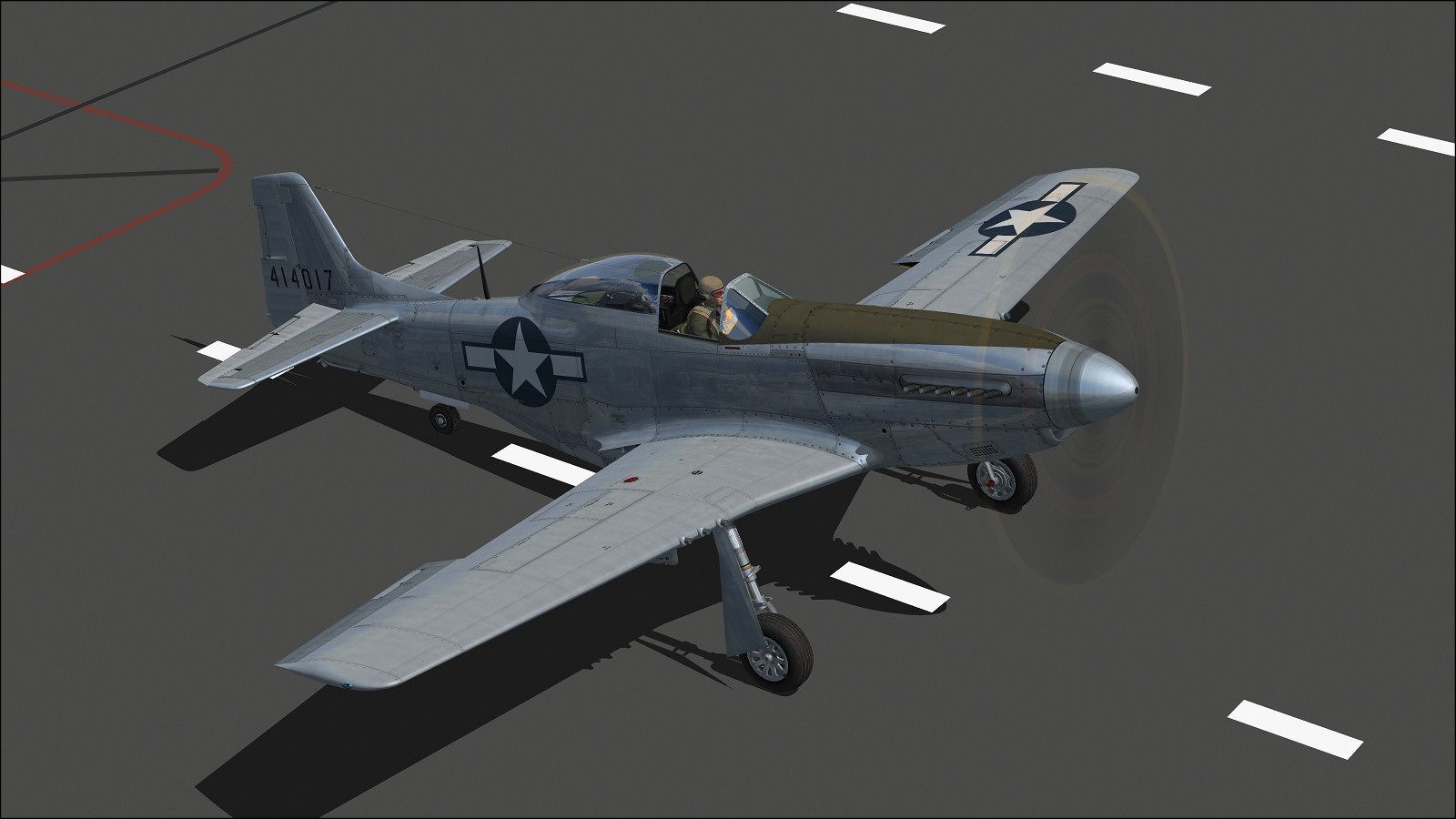
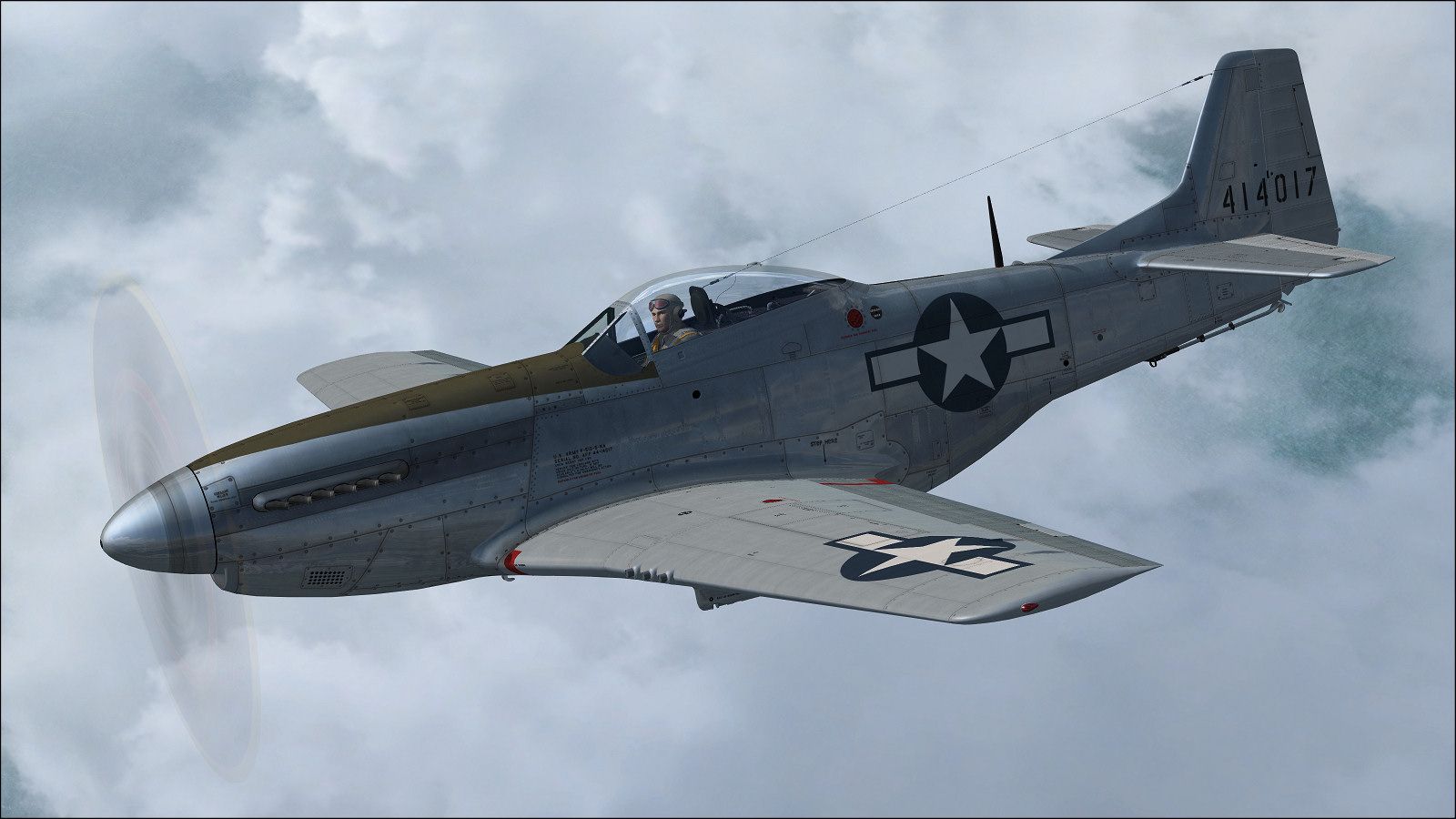
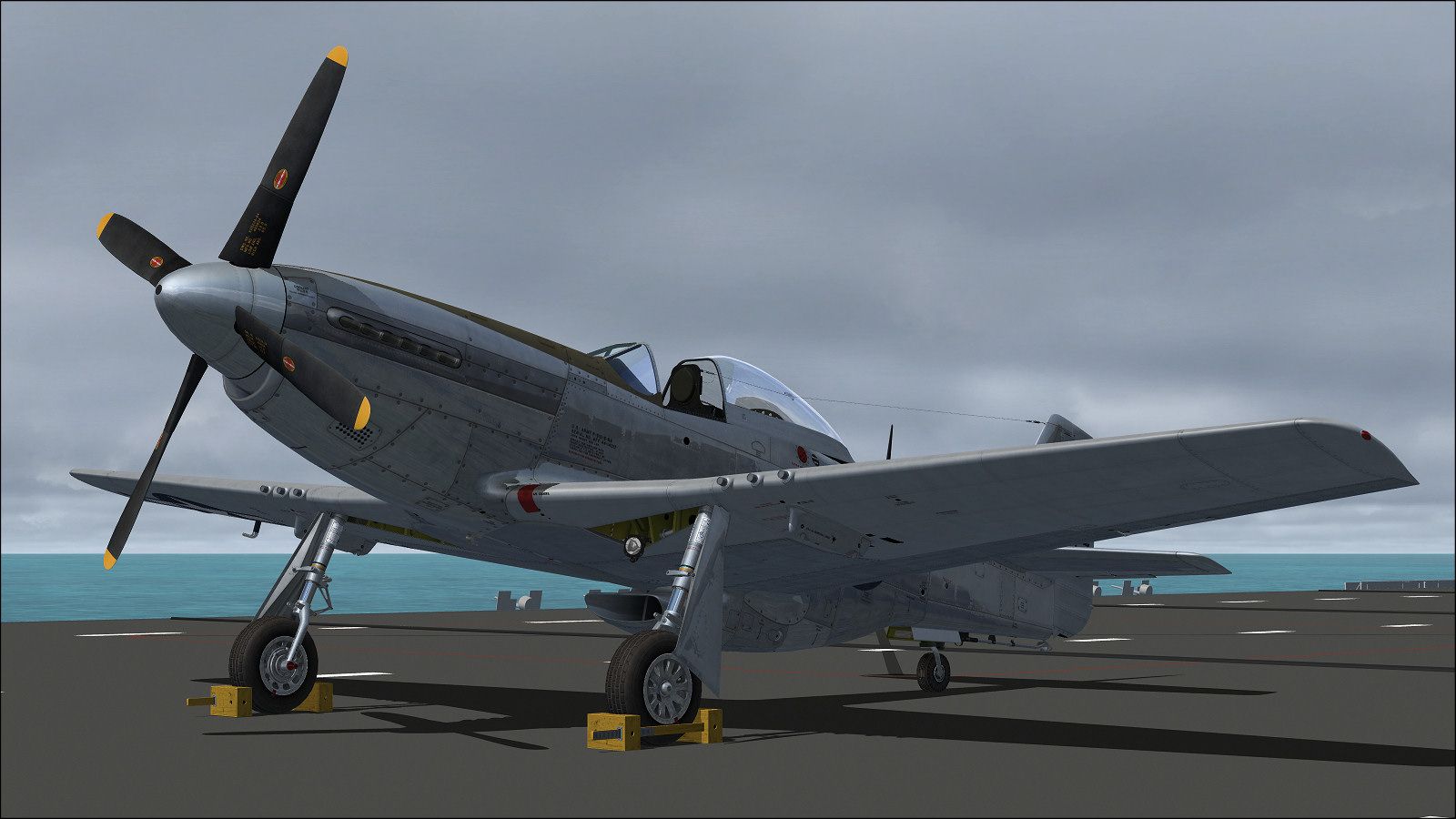
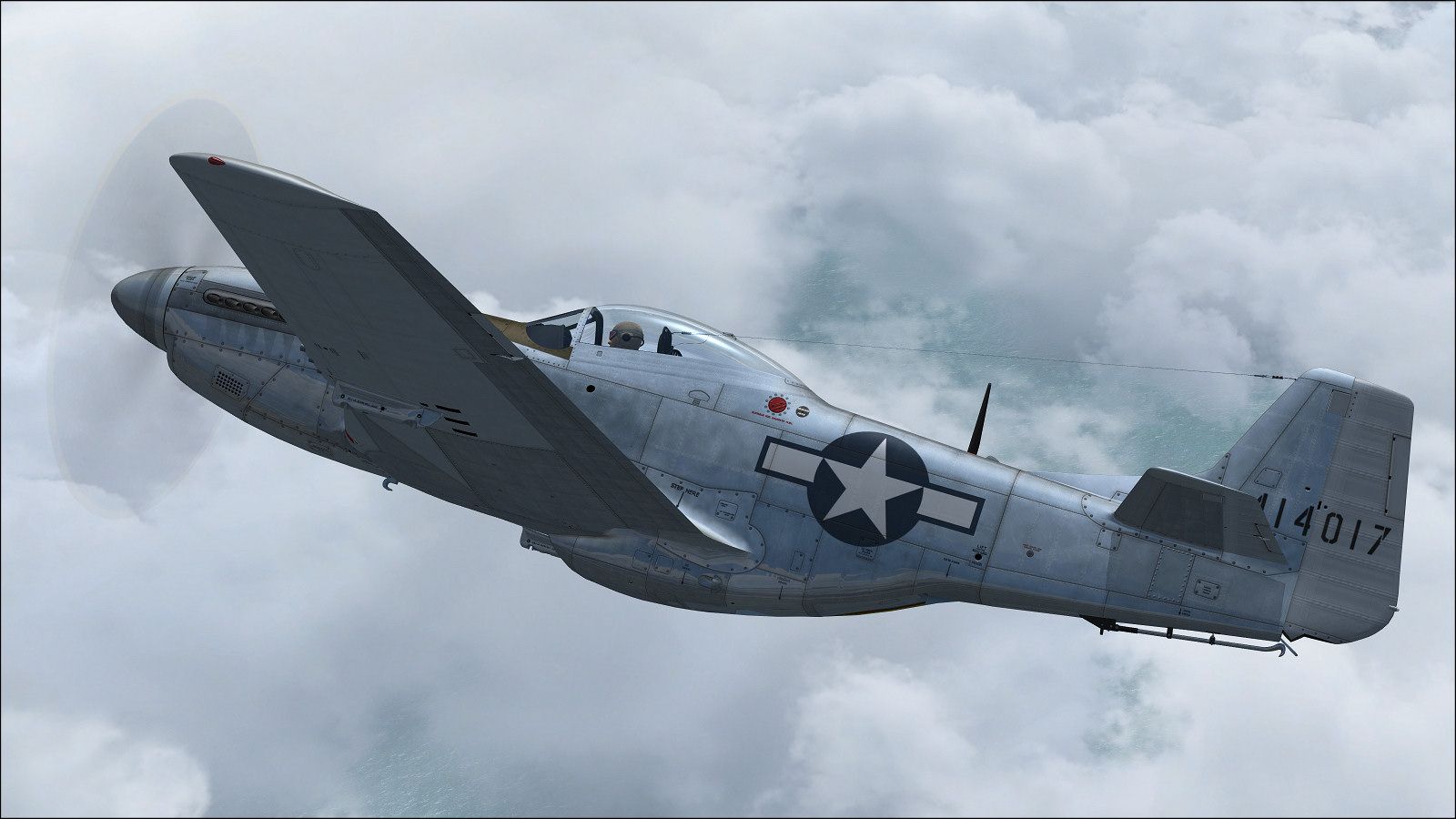
It's interesting that this topic has been posted! The following screenshots are a brief preview of a Warbirdsim FSX reproduction of P-51D-5-NA 44-14017, which the Navy borrowed and modified for the carrier trials in 1944. This is just a small part of a large project that has been on-going since October, and more information and screenshots will be posted soon... ; )

Bomber_12th
SOH-CM-2025
In all, Bob Elder made 150 land-based arrested landings and an untold number of land-based catapult launches (that's why the aircraft has a pendant-type catapult hook below the firewall, and a holdback bar/loop between the base of the tail and the base of the rudder), before moving out to sea. These land-based trials were done at Mustin Field NAS, which unfortunately isn't arround any more. Even before that, they started by just taxiing over the arrestor wires, laid out at Mustin Field, to see how their tail hook design(s) faired, before moving forward and doing actual landings. On November 15, 1944, Bob Elder made 4 landings and 4 deck-run takeoffs from the USS Shangri-La, near the Virginia Capes, all of which were completely successful (Bob Elder mentions all of this in a write-up that he authored, which I'll post here soon) - a total of 25 landings and takeoffs were made on the Shangri-La. At this same time, the SEU (Ship Experimental Unit) that was charged with making the P-51 carrier ready, was also doing similar trials with a B-25H and an early F7F Hellcat. I have another write-up that was authored by another individual that was part of the SEU (the pilot of the B-25H) during that time, who also mentions some details about this Mustang, which I'll post as well.
Note that this aircraft (and as depicted), was a standard late-model P-51D-5-NA, with all of the early details that go with that (early instrument panel and switch panels, white light on the spine, fabric elevators, low-position armor plate, early seat frame, circular camera port, etc.). By the time the aircraft was borrowed to the Navy, it had been upgraded with a dorsal fin fillet (the early design, sway-back type), and the later-designed canopy. The aircraft never officially enterred Navy inventory, and contrary to what has been posted years ago (and copied ever since), the aircraft never had its titled renamed nor did it ever have a BuNo assigned. In evidence I'll post later, this aircraft likely was given to the NACA and became NACA 102 (not NACA 127 as often stated, which is completely false).
Note that this aircraft (and as depicted), was a standard late-model P-51D-5-NA, with all of the early details that go with that (early instrument panel and switch panels, white light on the spine, fabric elevators, low-position armor plate, early seat frame, circular camera port, etc.). By the time the aircraft was borrowed to the Navy, it had been upgraded with a dorsal fin fillet (the early design, sway-back type), and the later-designed canopy. The aircraft never officially enterred Navy inventory, and contrary to what has been posted years ago (and copied ever since), the aircraft never had its titled renamed nor did it ever have a BuNo assigned. In evidence I'll post later, this aircraft likely was given to the NACA and became NACA 102 (not NACA 127 as often stated, which is completely false).

skyhawka4m
Charter Member
As a tester I can say that these planes are SWEET!!!! Some new goodies too! John has been very gracious to allow me to test his latest and best and can't wait till he shares all his info with everyone. So I can post screenies!!! LOL!!! 

Odie
Charter Member
I was going to give a shout out to Bomber about this model of the Mustang, as he was the first I thought of on this subject, but he was already there! Some interesting "what if" paints could be in the offing....
Interesting thought that if the Mustang had been beefed up to Navy standards for active carrier duty, would the modifications have diluted all the virtues that made it such a great fighter AND what Navy aircraft that came into the fleet, might not have made it due to being replaced by the SeaHorse? A bit of real history mixed in with an alternate one.
Interesting thought that if the Mustang had been beefed up to Navy standards for active carrier duty, would the modifications have diluted all the virtues that made it such a great fighter AND what Navy aircraft that came into the fleet, might not have made it due to being replaced by the SeaHorse? A bit of real history mixed in with an alternate one.
Bomber_12th
SOH-CM-2025
Odie, I too hope that there will be a number of "what if" repaints made available for this model. Although it won't be 'in use' by default, I will be including a separate, 'armed' Navy model, that will have the gun sight reinstalled, guns un-capped, and ammunition loaded, for any possible "what if" repaints to be used with (so that they can have all of the 'in-service' items that were stripped from or covered over on 44-14017).
As far as I've found, the tail hook design and installation was never documented - neither drawings nor detailed images of the tail hook have ever been found. This is due to the fact that it wasn't a 'big operation', but just conducted and overseen by a select few individuals (engineers and pilots) within the Ship Experimental Unit, and no drawings would have needed to have been submitted to the Navy or North American, as the project pretty much ended just as soon as the trials were concluded. So everything is based off of the 6 or so images that are known to exist, showing the over-all aircraft, with one in particular showing the most clear details. It was a challenge to want to make sure that the reproduction would be as near to original as possible, with only the documentation and photos that are known to exist. I started by making sure to research tail hooks of that era, so that I had a good understanding as to their different designs and function. One of the 'break-throughs' came when I read from one of the guys involved with the program, that the SEU's favorite, most dependable tail hook was the one they designed for the SBD Dauntless, and he states that the tail hook used on the B-25H for the carrier trials was a SBD tail hook. Knowing this, I decided to model the SBD tail hook mount - and low and behold it fit just as you would imagine they would have fitted it, in the position it would have needed to have been in to be mounted to the bulkhead just aft of the tail wheel (there is just enough room to put it there and not play into the area of the tail gear well). It also takes on the same appearance of the tail hook mount seen in the known photos. For the other details seen on the tail hook, I was able to match up to details from other tail hooks - such as the wire connection/retainer which looks in photos to be similar, or the same, as used on SNJ tail hooks - having several detail photos of SNJ tail hooks, I simply copied this item as it is on those.
The most perplexing item that shows up in the photos of the original, was the lasso-type metal bar attachment at the base of the tail. It wasn't until I read up on catapult operations (WWII and after), that I found out that besides there being the shuttle attachment hook for a pendant strap hook-up (or two hooks, for a bridal strap hook-up), there would be another attachment at the rear of the aircraft, known as a holdback, where a break-away or quick release strap would be attached, designed to hold the aircraft in-place until the catapult was primed and the engine was at power, before releasing. This remains employed on Navy aircraft to this day.
When you look at the bottom of the rudder, there are a couple of cut-outs, which has been said was done to provide room for the tail hook end. However, as can be seen, the end of the tail hook didn't come close enough to have the need for that cut-out. It is my belief that the large cut-out likely originated earlier in the project, when a longer tail hook may have been fitted. There is a smaller cut-out at the forward base of the rudder to provide room for the holdback looped-bar.
Bob Elder wrote, from his notes, that all of the modifications only added just shy of 40 pounds to the airframe (which has been incorporated with this aircraft).
Here are all of the particular details of this aircraft, which all have been replicated: Tail hook, catapult hook (below firewall), holdback (base of tail), rudder base cut-outs, gun sight removed, guns kept but covered with standard-issue caps (no ammunition), taped-over camera port, stronger "block-tread" tires, and over-charged main gear oleos (to help prevent bouncing and the nose pitching over when landing), Navy ship-board chocks, and Navy headgear as Bob Elder was photographed wearing.
The 'fun' challenge comes with landing. As Bob Elder noted, the bulkhead that the tail hook was fitted to started to receive some cracking after making arrested landings at 90 mph or more (this was found while still earlier in the testing, back at Mustin Field), and so they had to land slower than 90 - the aircraft's stall speed was 82 mph though. As a result, Bob made all of the approaches at 85 mph. This was no problem for him, with the experience he had, but for novice pilots that would have been a problem. Landing the aircraft requires a constant curved approach, not unlike what is required with the Corsair. However, Bob Elder mentioned that the visibility over/around the nose was worse on the Hellcat and Corsair than it was on the Mustang. While it has also been stated by other individuals that the torque/p-factor on the P-51 was an issue, according to Bob, even though he mentioned the 'swing' in his reports from the project, he also mentioned that it was easy to keep it in check (and one has to remember that the same swing would have already been encountered with other Navy aircraft, like the Corsair and Hellcat, and that he and other experienced Navy pilots would have been accustom to it). So far I've been having success with getting the approach speed slower and slower - yesterday I was still at about 100 mph, and today I've been getting right about 90 mph. At these slow speeds, the nose has to come up quite a bit, to keep the aircraft from sinking, but it is also critical that when you land on the deck, that the tail is low enough in order for the tailhook to catch. Bob mentioned that, due to the tail hook length, or lack there of, compared with the static angle of the aicraft, that you couldn't risk having the tail off the deck when touching down, or it would be easy to travel right over the wires. In the one very dramatic photo of the aircraft landing on the deck of the Shangri-La, you can see the tail wheel about to touch down a second or so before the main wheels would have.
As far as I've found, the tail hook design and installation was never documented - neither drawings nor detailed images of the tail hook have ever been found. This is due to the fact that it wasn't a 'big operation', but just conducted and overseen by a select few individuals (engineers and pilots) within the Ship Experimental Unit, and no drawings would have needed to have been submitted to the Navy or North American, as the project pretty much ended just as soon as the trials were concluded. So everything is based off of the 6 or so images that are known to exist, showing the over-all aircraft, with one in particular showing the most clear details. It was a challenge to want to make sure that the reproduction would be as near to original as possible, with only the documentation and photos that are known to exist. I started by making sure to research tail hooks of that era, so that I had a good understanding as to their different designs and function. One of the 'break-throughs' came when I read from one of the guys involved with the program, that the SEU's favorite, most dependable tail hook was the one they designed for the SBD Dauntless, and he states that the tail hook used on the B-25H for the carrier trials was a SBD tail hook. Knowing this, I decided to model the SBD tail hook mount - and low and behold it fit just as you would imagine they would have fitted it, in the position it would have needed to have been in to be mounted to the bulkhead just aft of the tail wheel (there is just enough room to put it there and not play into the area of the tail gear well). It also takes on the same appearance of the tail hook mount seen in the known photos. For the other details seen on the tail hook, I was able to match up to details from other tail hooks - such as the wire connection/retainer which looks in photos to be similar, or the same, as used on SNJ tail hooks - having several detail photos of SNJ tail hooks, I simply copied this item as it is on those.
The most perplexing item that shows up in the photos of the original, was the lasso-type metal bar attachment at the base of the tail. It wasn't until I read up on catapult operations (WWII and after), that I found out that besides there being the shuttle attachment hook for a pendant strap hook-up (or two hooks, for a bridal strap hook-up), there would be another attachment at the rear of the aircraft, known as a holdback, where a break-away or quick release strap would be attached, designed to hold the aircraft in-place until the catapult was primed and the engine was at power, before releasing. This remains employed on Navy aircraft to this day.
When you look at the bottom of the rudder, there are a couple of cut-outs, which has been said was done to provide room for the tail hook end. However, as can be seen, the end of the tail hook didn't come close enough to have the need for that cut-out. It is my belief that the large cut-out likely originated earlier in the project, when a longer tail hook may have been fitted. There is a smaller cut-out at the forward base of the rudder to provide room for the holdback looped-bar.
Bob Elder wrote, from his notes, that all of the modifications only added just shy of 40 pounds to the airframe (which has been incorporated with this aircraft).
Here are all of the particular details of this aircraft, which all have been replicated: Tail hook, catapult hook (below firewall), holdback (base of tail), rudder base cut-outs, gun sight removed, guns kept but covered with standard-issue caps (no ammunition), taped-over camera port, stronger "block-tread" tires, and over-charged main gear oleos (to help prevent bouncing and the nose pitching over when landing), Navy ship-board chocks, and Navy headgear as Bob Elder was photographed wearing.
The 'fun' challenge comes with landing. As Bob Elder noted, the bulkhead that the tail hook was fitted to started to receive some cracking after making arrested landings at 90 mph or more (this was found while still earlier in the testing, back at Mustin Field), and so they had to land slower than 90 - the aircraft's stall speed was 82 mph though. As a result, Bob made all of the approaches at 85 mph. This was no problem for him, with the experience he had, but for novice pilots that would have been a problem. Landing the aircraft requires a constant curved approach, not unlike what is required with the Corsair. However, Bob Elder mentioned that the visibility over/around the nose was worse on the Hellcat and Corsair than it was on the Mustang. While it has also been stated by other individuals that the torque/p-factor on the P-51 was an issue, according to Bob, even though he mentioned the 'swing' in his reports from the project, he also mentioned that it was easy to keep it in check (and one has to remember that the same swing would have already been encountered with other Navy aircraft, like the Corsair and Hellcat, and that he and other experienced Navy pilots would have been accustom to it). So far I've been having success with getting the approach speed slower and slower - yesterday I was still at about 100 mph, and today I've been getting right about 90 mph. At these slow speeds, the nose has to come up quite a bit, to keep the aircraft from sinking, but it is also critical that when you land on the deck, that the tail is low enough in order for the tailhook to catch. Bob mentioned that, due to the tail hook length, or lack there of, compared with the static angle of the aicraft, that you couldn't risk having the tail off the deck when touching down, or it would be easy to travel right over the wires. In the one very dramatic photo of the aircraft landing on the deck of the Shangri-La, you can see the tail wheel about to touch down a second or so before the main wheels would have.

Navy Chief
Senior Member
http://www.sim-outhouse.com/sohforums/showthread.php?74656-US-Navy-P-51-Mustang&highlight=
Posted about this very topic recently, but didn't get much response. Good to know there is some interest... NC

Bomber_12th
SOH-CM-2025
Sundog, I have yet to find anything written about fuel load used, but I've typically been doing carrier landings and takeoffs at 70 gallons or less (35 in each internal wing tank). The procedure for takeoff has been: canopy open (and pilot goggles on), 30-degrees of flaps (as indicated by photos), and 6-degrees right rudder trim and 6-8 degrees nose up trim. In the two photos of this aircraft taking off (one just a moment away from starting the deck run, and another mid-way through a deck run), the elevator trim tabs can be clearly seen angled down quite a bit (nose-up trim) and the rudder trim tab angled left (right rudder trim). On landing, I've been setting up a pattern by flying several hundred feet above the carrier, straight down the deck line, and making a left break to downwind. While turning onto downwind, the flaps start to come down (full flaps only after 170 mph), the gear comes down (at 170 mph), the tail hook is released (this was very likely a simple installation, as reproduced - once released it can't be raised/reset until on the ground), and the canopy is opened (under 170 mph).
BTW, the carrier seen in the screenshots is Michael Davies' freeware AI USS Leyte (available here in the FSX Ships library), which is of the same long hull Essex class as the USS Shangri-La.
BTW, the carrier seen in the screenshots is Michael Davies' freeware AI USS Leyte (available here in the FSX Ships library), which is of the same long hull Essex class as the USS Shangri-La.
skyhawka4m
Charter Member
I give this one..... and a toast too
:salute:
and a toast too :salute:

fsxar177
Long-Time Enthusiast
I've got to appreciate the detail, and work that has gone into this representation, of such a rare, and interesting mustang!
Some NAVY liveries would be pretty striking for sure.
And I wonder if successful, would a folding wing have been instituted? That would be different, I should say!
It would supposed that the laminar flow wings, and un-pleasurable low speed handling characteristics/stalls, is what kept the 'stang from becoming a carrier based fighter. Of course, I would suspect that the Corsair, had a similar range, and perhaps more speed at sea level anyway. And could carry a heavier punch.
Joseph
Some NAVY liveries would be pretty striking for sure.
And I wonder if successful, would a folding wing have been instituted? That would be different, I should say!
It would supposed that the laminar flow wings, and un-pleasurable low speed handling characteristics/stalls, is what kept the 'stang from becoming a carrier based fighter. Of course, I would suspect that the Corsair, had a similar range, and perhaps more speed at sea level anyway. And could carry a heavier punch.
Joseph
Bomber_12th
SOH-CM-2025
It perhaps may be a point of interest, worth mentioning, that had this aircraft proceeded forward into a Navy contract, it would have been called an F1J, or perhaps the first FJ-1 (a few years before the Fury would take that title).
One of the biggest myths surrounding this aircraft, P-51D-5-NA 44-14017, was that after it received the Navy modifications, it was renamed ETF-51D. This has been retold time and time again, simply because it was written once and has been copied by authors of other articles ever since. These are the issues that I have with that, which define why that wouldn't have been the case, and why that myth would have gotten started.
1. In 1944, the "F-51D" name didn't yet exist - that of course didn't come into being until 1947 with the foundation of the USAF, when "pursuit" changed to "fighter". Also, in these circumstances, I fail to understand what the "ET" designator would have meant regarding the NAVY modifications, and where it would have come from, as it doesn't crop up in any of the other NAVY trial aircraft during WWII.<o ></o>
></o>
<o></o>
2. The NAVY, if it were to rename the P-51D, would have included J within the title, as that was the letter designator assigned to North American (like F for Grumman, and U for Vought). If the NAVY had renamed this aircraft, it would have been F1J, or perhaps the first FJ-1 (rather than the Fury taking that position a few years later).<o></o>
<o></o>
3. "ETF-51D", from 1947 onwards, was assigned to F-51D's with "Extended Tails", thus the "ET" addition to the title. The first ETF-51D's were the NACA examples, which were the first F-51D's in government service to have the extended vertical tail fin cap. Later on, the Cavalier Mustangs that served with the U.S. Army and U.S.A.F., also with the extended tail caps, have sometimes been called ETF-51D's.<o></o>
<o></o>
4. It has been reported and rumored, over the years, that the surviving (restored and flying) ETF-51D "NACA 127" had a tail hook fitted, and was used (also) for land-based carrier trials. Some say that at one time they remember seeing tailhook equipment fitted to this aircraft, but those that removed the aircraft from ANG display in the 90's, and restored the aircraft, never once found any tailhook modifications at all. Others say that the tail was replaced on this aircraft while it was on ANG outdoor display, before its eventual restoration. The only thing I've ever seen in support of any of this, is that in some period photos of "NACA 127" on outdoor display, it appears that the bottom metal base cap on the rudder is gone, but in other photos it is there or has been replaced.<o></o>
<o></o>
5. Due to the above, several people have or had been under the impression that "NACA 127" was the same aircraft as the P-51D used in 1944 for the carrier trials!! Even some Mustang pilots/owners were under that belief years ago, saying that exact thing, and may even be so today. However, the P-51D that was used for the carrier trials in 1944 was P-51D-5-NA 44-14017, and "NACA 127" is the much later-built (several hundred plus production differences) P-51D-25-NT 44-84900 (with really quite a clear history available). <o></o>
<o></o>
6. Because of the above, with the confusion that some have had, or still do have, between NACA 127 and 44-14017, the false idea came about that the title "ETF-51D" was assigned to 44-14017 when it had its NAVY modifications. And it only takes that false information to be reported once, to have had it repeated time and time again ever since.<o></o>
<o></o>
7. There is a photo of a NACA ETF-51D, which was give the number "NACA 102", showing in this photo, very interestingly enough, the same exact rudder mod/cutout that 44-14017 had in 1944 with the installation of the tail hook!! It is my belief, therefore, that after the NAVY was done with 44-14017 (they were only borrowing it from the USAAF just for these trials), that because of the unique modifications, it wound up going to NACA, to later become "NACA 102". At that point, and only at that point, it would have been modified into a ETF-51D. Here is the photo of NACA 102, and note what appears to be the left-overs of the NAVY modifications: http://i7.photobucket.com/albums/y282/Bomber_12th/GPN-2000-001252.jpg
Also, in some articles, including even what Bob Elder wrote, it is said that 44-14017 was given the NAVY BuNo 57987. This too is false. The NAVY operated a P-51 - one of the early Allison types, before the P-51A, that was to have become a RAF Mustang I, but was retained. Because this was actually an aircraft the NAVY had for themselves, they assigned it the BuNo 57987 (and there is a clear photo of this aircraft with that BuNo stenciled on the tail). The P-51D 44-14017 never got a NAVY BuNo, because it was only borrowed by the NAVY and was never actually in the NAVY inventory, like their P-51 (no letter designator) was. <o></o>
In 1944, the Navy expressed interest in having North American provide a proposal to have a P-51 modified for carrier operations. This never proceeded further than the earliest of design stages, but North American did provide a rough over-view as to what type of modifications/additions would be made, using their P-51H design as the basis. More on that and the work with 44-14017 can be read here: http://tailspintopics.blogspot.com/2011/06/seahorse.html and another drawing here: http://i37.photobucket.com/albums/e68/GTwiner/melbsyd/scan0005.jpg
One of the biggest myths surrounding this aircraft, P-51D-5-NA 44-14017, was that after it received the Navy modifications, it was renamed ETF-51D. This has been retold time and time again, simply because it was written once and has been copied by authors of other articles ever since. These are the issues that I have with that, which define why that wouldn't have been the case, and why that myth would have gotten started.
1. In 1944, the "F-51D" name didn't yet exist - that of course didn't come into being until 1947 with the foundation of the USAF, when "pursuit" changed to "fighter". Also, in these circumstances, I fail to understand what the "ET" designator would have meant regarding the NAVY modifications, and where it would have come from, as it doesn't crop up in any of the other NAVY trial aircraft during WWII.<o
></o><o
></o>2. The NAVY, if it were to rename the P-51D, would have included J within the title, as that was the letter designator assigned to North American (like F for Grumman, and U for Vought). If the NAVY had renamed this aircraft, it would have been F1J, or perhaps the first FJ-1 (rather than the Fury taking that position a few years later).<o
></o><o
></o>3. "ETF-51D", from 1947 onwards, was assigned to F-51D's with "Extended Tails", thus the "ET" addition to the title. The first ETF-51D's were the NACA examples, which were the first F-51D's in government service to have the extended vertical tail fin cap. Later on, the Cavalier Mustangs that served with the U.S. Army and U.S.A.F., also with the extended tail caps, have sometimes been called ETF-51D's.<o
></o><o
></o>4. It has been reported and rumored, over the years, that the surviving (restored and flying) ETF-51D "NACA 127" had a tail hook fitted, and was used (also) for land-based carrier trials. Some say that at one time they remember seeing tailhook equipment fitted to this aircraft, but those that removed the aircraft from ANG display in the 90's, and restored the aircraft, never once found any tailhook modifications at all. Others say that the tail was replaced on this aircraft while it was on ANG outdoor display, before its eventual restoration. The only thing I've ever seen in support of any of this, is that in some period photos of "NACA 127" on outdoor display, it appears that the bottom metal base cap on the rudder is gone, but in other photos it is there or has been replaced.<o
></o><o
></o>5. Due to the above, several people have or had been under the impression that "NACA 127" was the same aircraft as the P-51D used in 1944 for the carrier trials!! Even some Mustang pilots/owners were under that belief years ago, saying that exact thing, and may even be so today. However, the P-51D that was used for the carrier trials in 1944 was P-51D-5-NA 44-14017, and "NACA 127" is the much later-built (several hundred plus production differences) P-51D-25-NT 44-84900 (with really quite a clear history available). <o
></o><o
></o>6. Because of the above, with the confusion that some have had, or still do have, between NACA 127 and 44-14017, the false idea came about that the title "ETF-51D" was assigned to 44-14017 when it had its NAVY modifications. And it only takes that false information to be reported once, to have had it repeated time and time again ever since.<o
></o><o
></o>7. There is a photo of a NACA ETF-51D, which was give the number "NACA 102", showing in this photo, very interestingly enough, the same exact rudder mod/cutout that 44-14017 had in 1944 with the installation of the tail hook!! It is my belief, therefore, that after the NAVY was done with 44-14017 (they were only borrowing it from the USAAF just for these trials), that because of the unique modifications, it wound up going to NACA, to later become "NACA 102". At that point, and only at that point, it would have been modified into a ETF-51D. Here is the photo of NACA 102, and note what appears to be the left-overs of the NAVY modifications: http://i7.photobucket.com/albums/y282/Bomber_12th/GPN-2000-001252.jpg
Also, in some articles, including even what Bob Elder wrote, it is said that 44-14017 was given the NAVY BuNo 57987. This too is false. The NAVY operated a P-51 - one of the early Allison types, before the P-51A, that was to have become a RAF Mustang I, but was retained. Because this was actually an aircraft the NAVY had for themselves, they assigned it the BuNo 57987 (and there is a clear photo of this aircraft with that BuNo stenciled on the tail). The P-51D 44-14017 never got a NAVY BuNo, because it was only borrowed by the NAVY and was never actually in the NAVY inventory, like their P-51 (no letter designator) was. <o
></o>In 1944, the Navy expressed interest in having North American provide a proposal to have a P-51 modified for carrier operations. This never proceeded further than the earliest of design stages, but North American did provide a rough over-view as to what type of modifications/additions would be made, using their P-51H design as the basis. More on that and the work with 44-14017 can be read here: http://tailspintopics.blogspot.com/2011/06/seahorse.html and another drawing here: http://i37.photobucket.com/albums/e68/GTwiner/melbsyd/scan0005.jpg