• There seems to be an uptick in Political comments in recent months. Those of us who are long time members of the site know that Political and Religious content has been banned for years. Nothing has changed. Please leave all political and religious comments out of the forums.

    If you recently joined the forums you were not presented with this restriction in the terms of service. This was due to a conversion error when we went from vBulletin to Xenforo. We have updated our terms of service to reflect these corrections.

    Please note any post refering to a politician will be considered political even if it is intended to be humor. Our experience is these topics have a way of dividing the forums and causing deep resentment among members. It is a poison to the community. We appreciate compliance with the rules.

    The Staff of SOH

  • Please see the most recent updates in the "Where did the .com name go?" thread. Posts number 16 and 17.

    Post 16 Update

    Post 17 Warning

New Piglet Pusher....

I just took a look at the three views on the shinden ( http://richard.ferriere.free.fr/3vues/kawanishi_j7w_3v.jpg ) and yeah, the back 1/3 of the canards are used as elevators, and not the entire thing. That would put this plane on par with say, a zero, but at a much faster speed. maybe say 80 to 100 mph faster if my guesser is still working.. The fairy wheels, i just dont understand. Oddly enough, she had twin counter rotating props. i'm surprised at the relatively low top speed of this thing ( 466 mph )considering that i'm contrasting it too the Russian Bear with its speed and performance..
at least, I THINK it had counter rotating props.. may be an optical illusion though..

Goodnight Irene, we're talking about a WW2-era prop-driven fighter here and 466mph is slow? :eek:
 
Goodnight Irene, we're talking about a WW2-era prop-driven fighter here and 466mph is slow? :eek:


ROFLMAO... ;)

Keep in mind, this things cruising speed is listed at 220 mph ( though i dont personally believe it yet ).. Thats slower than most of our dive bombers ( which is WHY i dont believe it ). Considering this things shape, i think perhaps somewhere closer to 300 mph for cruising is more accurate, but i've been wrong, many times before.. Also maximum speed on the p-36 is 485 mph. Thats maximum airframe speed, not how fast her engine could move her. The swept wing on the Shinden though, is a good indication that this was one very fast bird for the time, though with the elevator area, i'd have to estimate that her maximum handing performance was seen at lower speeds in the 200 to 275 mph range. Thats just another guess though..
 
The CG is about 1/4 MAC, or just in front of the mainwheels when gear is down. The canards have both elevators and flaps. The "flaps are really just a small short movable surface that support the elevators. Kinda like the "recellerons" on an A-10, but combining pitch and flap functions.
The R2800-class engine is about halfway from the cockpit to the aft end of the fuselage.
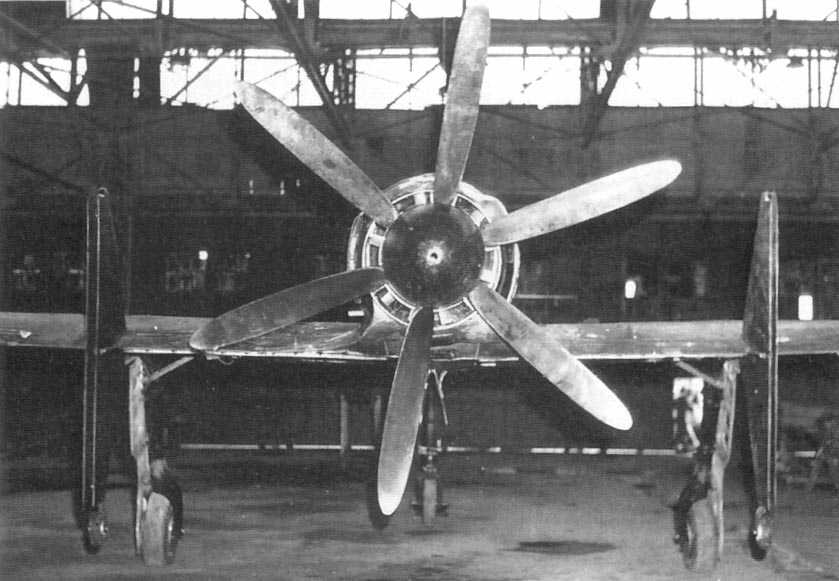
The prop is a single 6-bladed unit. No contra-props. Surpised to see no evidence of an ejector seat of any kind. Maybe prop jettison?
Was always surprised on the quoted top speed of 466MPH. Would think 400-430 would be more realistic. Especially in armed combat production versions.
Gibbage,
I already made a XP-56 for FSX.
 
Wow Tim, Graet choice! My FSX rig is currently INOP, more motivation now for me to get it up and running again! Mike :wiggle:
 
That canard would have to act as a downward lifting surface same as a conventional horizontal stabilizer. It would have to counter the lift of the main wings.

Two were built, and only one flown -- just once for less than an hour, and that one is in the National Air and Space Museum. It was designed to be highly maneuverable, so perhaps it was.

Problem is that most of the data came from scale tests on gliders. One 45 minute test flight was hardly long enough to get a feel for the aircraft. The 466mph top speed was just an estimate. Given all the myriad of possible issues approaching speed limits, who knows what it really could have done.

Ken
 
The performance figures in Francillon's "Japanese Aircraft Of The Pacific War" are supposedly based on the three (3) test flight's conducted by Captain Tsuruno before war's end. They are very impressive..... max speed of 466 mph @ 28,545ft, cruise speed of 263 mph @ 13,125ft (perhaps a misprint? and should read 363?), climb to 26,245 ft in 10 min 40 seconds with a service ceiling of 39,370ft and range (without drop tank) of 529 miles. They compare very favorably with late war American aircraft.

But then I guess they should be given that the aircraft only weighed in at 4,928 kg loaded and was driven by an engine that produced 2,130hp @ take-off, 2,020hp at 1,180m and 1,160hp at 8,700m.

Still with the very high wing loading of 49.1 lb/sq ft, it's not going to be all that manoeuverable. As a comparison the Spitfire Mk.1 had a wing loading of 24 lb/sq ft;
the Hurricane Mk.1 - 21.9 lb/sq ft;
Type 0 Model 21 - 22 lb/sq ft
Type 0 Model 52 - 26.3 lb/sq ft
Ki-43-1a - 19 lb/sq ft
Ki-84-1a - 35.1 lb/sq ft
J2M3 - 35.1 lb/sq ft
P-51D - 39 lb/sq ft
 
I found three sources that said it was test flown once and another source saying three times. But, the sole source also specified the same dates as your source quoted. So, I'm thinking your source got it right.

You make an excellent point about wing loading. The other sources I read said it was primarily designed to intercept the B-29. To do that it needed high speed, but also an interceptor must climb fast.

Ken
 
And the Saab J-21!

Others that would fit are the XP-55 Ascender, XP-54 Swoose Goose and the Henschel P.75. ;)

Don't forget the Miles M.35....

1(437)(2).jpg

ae54.jpg


And Piglet, stay on the oddballs...... they are your calling card of the FS world... and great work on the 'Shinden' keep it up!
 
Pam,
See my prev. post. The canards, canard flap and elevators are at the end of a good sized moment arm, so the "small" size my not matter as much.
There is a trimtab set into the left elevator, and left aileron. So the elevator is an elevator in it's own right, not just a trimming surface.
 
Very cool.. thanks Tim.. looks like i got confused for a moment or four.. Appreciate the feedback :)..
 
That canard would have to act as a downward lifting surface same as a conventional horizontal stabilizer. It would have to counter the lift of the main wings.

Actually, just the opposite is true. For an aircraft that is naturally stable in pitch, the cg is ahead of the center of lift. Therefore, on a conventional tail aircraft, the horizontal tail would have to create a down force to balance out the moment between the wings center of lift and the cg. However, to counteract the same pitching moment on a canard aircraft the canard must produce lift. Also, on Rutan's aircraft he places the canard at such an angle of incidence that it will stall before the wing does. Once the canard stalls the natural pitching moment generated by the wings lift wrt to the cg will force the nose down and the canard will start flying again. I don't know if they did that with the Shinden, with regard to the relative angle of incidence, though.

Of course, I'm assuming the Shinden is naturally stable and not neutrally stable or slightly unstable. I suppose I should dig out all of my Japanese aircraft books and see what I have on it in that regard. I might even have one of their Maru Mechanics on it, or whatever those publications were called. I know I have them with regard to the Shoki and the Raiden.
 
Gibbage,
I already made a XP-56 for FSX.

Wow! Must of missed it! How about a P-55 then? Or an XP-67

View attachment 4035

I also agree that 466MPH is VERY generous. Thats assuming very good quality, and let me tell you, thats one thing late war Japanese aircraft were lacking. Massive engine problems and overall poor aircraft fitment ment that none of the late war stuff came anywhere near there rated speeds. Also, the P-56 was also predicted to be a 400+MPH aircraft and it never got anywhere near it, and thats WITH good quality engines and body. Honestly, I have yet to see any WWII aircraft and most modern meet its "predicted" performance.
 
Actually, just the opposite is true. For an aircraft that is naturally stable in pitch, the cg is ahead of the center of lift. Therefore, on a conventional tail aircraft, the horizontal tail would have to create a down force to balance out the moment between the wings center of lift and the cg. However, to counteract the same pitching moment on a canard aircraft the canard must produce lift. Also, on Rutan's aircraft he places the canard at such an angle of incidence that it will stall before the wing does. Once the canard stalls the natural pitching moment generated by the wings lift wrt to the cg will force the nose down and the canard will start flying again. I don't know if they did that with the Shinden, with regard to the relative angle of incidence, though.

Of course, I'm assuming the Shinden is naturally stable and not neutrally stable or slightly unstable. I suppose I should dig out all of my Japanese aircraft books and see what I have on it in that regard. I might even have one of their Maru Mechanics on it, or whatever those publications were called. I know I have them with regard to the Shoki and the Raiden.

Interesting comments. I will have to study this further.

Cheers,

Ken
 
OK, I checked my Japanese pubs, and the test/developmental plane I have most of the info on is the A7M2, the Zero Replacement. Which doesn't help you, but helps me, since I just picked up the 1/48 model kit of it.:)

I do have the Shinden data from the Volume 2 issue of World War II Design With Precision, but based on the comments I've seen here, it seems you already have that data. Although I did end up looking at the Volume with all of the test/development aircraft and there were so many cool Japanese combat aircraft in development at the end of the war. The Ki-88, think a Tony crossed with an Airacobra, is a great looking plane, as were many of their twin engine fighters, like the Ki-83. Anyway, I digress. Keep up the great work Tim.
 
Back
Top