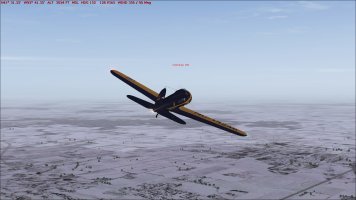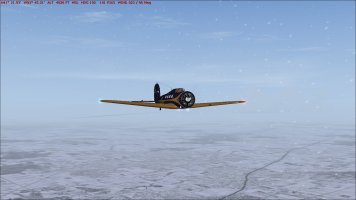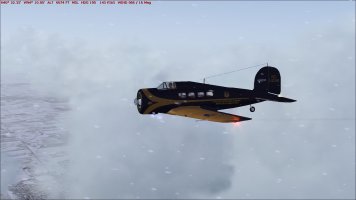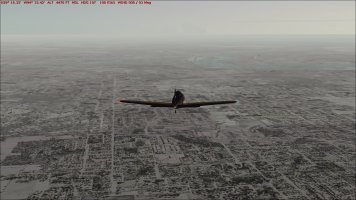
• There seems to be an uptick in Political comments in recent months. Those of us who are long time members of the site know that Political and Religious content has been banned for years. Nothing has changed. Please leave all political and religious comments out of the forums.

    If you recently joined the forums you were not presented with this restriction in the terms of service. This was due to a conversion error when we went from vBulletin to Xenforo. We have updated our terms of service to reflect these corrections.

    Please note any post refering to a politician will be considered political even if it is intended to be humor. Our experience is these topics have a way of dividing the forums and causing deep resentment among members. It is a poison to the community. We appreciate compliance with the rules.

    The Staff of SOH

  • Please see the most recent updates in the "Where did the .com name go?" thread. Posts number 16 and 17.

    Post 16 Update

    Post 17 Warning

**The OFFICIAL All Sims Air Tour Thread**

Onwards, ever onwards, and that low level clag seems to be all OVER the Southern States just now. It surely can't be like that all the time, can it? The times I've spent in N Carolina have always seen CAVU skies.

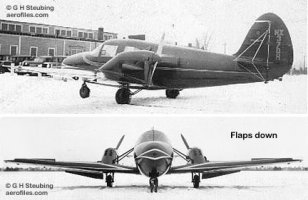
After flying one weird American twin, the Vega Starliner, I've gone for another on Leg 16 to Birmingham Al. the Miller HM-4 Arovel. No, I haven't clue about it either, and nor does anyone else! I can't find a thing about its flight performance anywhere to setup its profile in FST, so I gave it the same numbers as the Starliner. It was about the same size, maybe a bit smaller, carried 3 pax and a pilot, and was a twin too, even if the engines faced backwards!

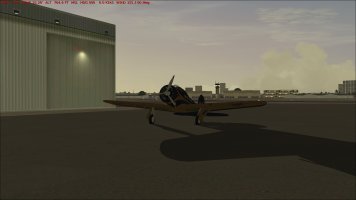
Here it is parked up at Memphis ready for the trip east.
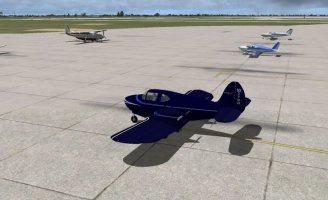
Leg 16-a.jpg

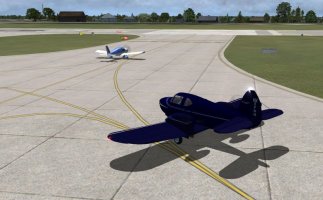
With my usual luck the Active Sky wind was from the north so I was faced with a LONG taxi to the south end of the 36L runway, so off I went. As I started up a PA28 taxied out ahead of me so I thought I'd follow him, like the C208 I followed inbound.

But when we got to the north end of 18R, the same runway I planned to use, he turned off for a downwind take-off! :oops: Don't the AI aircraft take the stated wind direction into consideration? It took me an age to get to the south end of course and in that time the PA28 took off and overflew me.
Leg 16-b.jpg

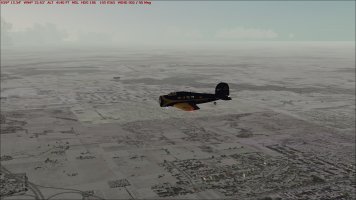
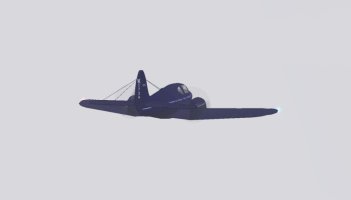
I took-off, OK in the CORRECT direction, and the HM-4 seemed to fly quite nicely, but wasn't that quick. Running at about 75% manifold pressure I was cruising at 120 kts at my intended altitude of 5000 ft, but that didn't last long as this happened...............
Leg 16-d.jpg

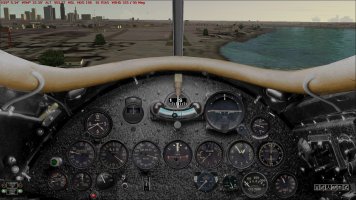
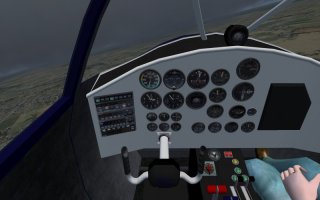
Checking the met again it looked as if the cloud had really come down since I was at Flight Ops checking it earlier, so I came down to 2000 ft and back into VFR land. The HM-4 had quite a good panel, fine for IFR stuff, but the idea of the Tour was to SEE the USA of course, so I stayed low.
Leg 16-c.jpg

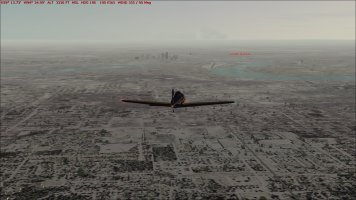
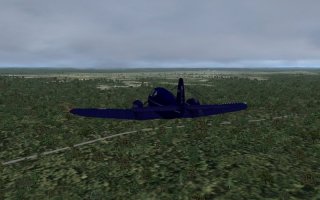
Much of the time I was flying over quite dense forests, as on leg 15, but now and then there was a clearing giving way to a small township. Oh, they're all cities in the US, aren't they, sorry?
Leg 16-e.jpg

There was a hefty sized Military Ops area en route, but luckily their restrictions started at around 7000 ft and I was not going anywhere near that high! Heading further south east I crossed a pretty large river, which turned out to be the Black Warrior River, which I'd never heard of before, but it was pretty large.
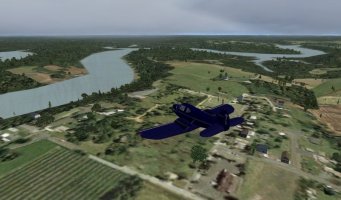
Leg 16-f.jpg

Birmingham itself stretched quite a way south of downtown, which I could just see on the horizon, and the ground was getting a tad hillier too, which worried me a tad as I was so low, but I cleared them OK. One thing characterised the area that I'd not seen before and that were these long corridors of felled trees with power lines running down the middle.
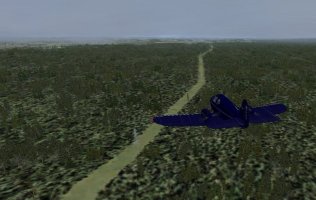
Leg 16-g.jpg

My waypoint north of Bessemer National Airport was right on top of a bit of high ground and I just cleared it!
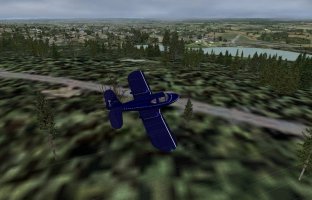
Leg 16-h.jpg

Lining up on KEKY's 23 runway went OK, and as usual there were trees right in front of me, this time a whole forest of them!
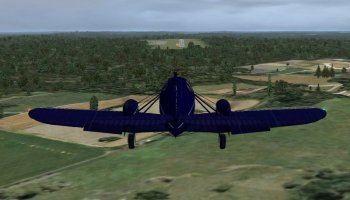
Leg 16-i.jpg

Landing went fine, the HM-4 was easily able to get down quite softly with a bit of throttle and stick control, which was nice and I taxied off to parking. For the pervious 20 minutes or so it had been raining quite strongly and I was looking forward to coffee and buns in the FBO, but not only there wasn't an FBO, there were no buildings at ALL! Such a pity that FSX left so many basic requirements off the scenery, and try as I might, I could not find any add-on scenery for this field. :(

Parking up was easy, only two other aircraft were visible, and I was soon calling for a cab to take me to civilisation!
Leg 16-j.jpg

The flight went pretty well and took exactly 1.5 hrs, giving me an average speed of 129 kts, not so bad, but the fuel burn was ridiculous!
The HM-4 only held 60 galls when full of fuel, which I just didn't believe, and burned only 16 galls en route! That gave a burn rate of 0.8 galls/nm. and I've seen motor gliders with heavier fuel burn rates!

I'll fly something a bit more conventional next time I think, this weirdness can be carried too far.
 
The Miller--
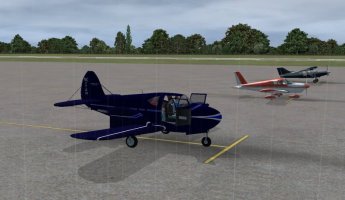
HM-4 Aerovel aka Moonship (Aerovel Corp) 1939 = 4pClwM rg; two 125hp Menasco C-4 pushers; span: 38'0" length: 26'0" v: 170/150/x. Planned as a feeder airliner and crew trainer. Vidal resin-coated plywood over steel-tube fuselage; tricycle gear. POP: 1 [NX370H]. Failed to attract buyers and was eventually donated to a trades school. (Courtesy of Aerofiles.com)
1936: (Howell W) Miller Aviation Corp, Springfield MA. 1938: Merger with Tri-American Aviation (Leigh Wade & Edward Connerton), aka Military Aviation Co, Springfield. 1939: Subcontractor for Aerovel Corp (A E Archbold, Harold Moon), Springfield. 1939: Subcontractor for Summit Aeronautical Corp (Westfield Aircraft Co), Westfield MA. 1940: Miller to P&W Corp as research engr.
The same "Pete" Miller that worked for the Granville Brothers ad designed a fat fast racer.
 
the Miller HM-4 Arovel. No, I haven't clue about it either

From what little I've read it was a nice airplane, but there were many alternatives on the market already in production. Miller built the plane with his own money (he had been an engineer with the Granville Brothers) hoping to get financing to start a production line. Eventual fate unknown, probably scrapped.

miller-hm4_.jpg
 
I've been doing a repaint for the aircraft I want to fly for my next few legs, and it's a native FSX model, with the .DDS texture format.

What an utter PAIN it is doing repaints like this!!! :oops: Why did the FSX designers have to make the textures upside down, with the right hand side textures viewed from INSIDE the airframe etc etc.?

If it ain't broke, DON'T fix it!!!

I've got it done, but in FS9 I could have managed it in about 15 mins, in FSX it took 2-3 HOURS.
 
Had to redo a number of times when I did the repaint of the Chipmunk for the Austalia Rally. I agree that it sure can be confusing to repaint.
 
It depends on how the developer/modeller chose to do it. It's all down to how the 'mapping' was done and how/where it was placed and it cannot simply be blamed on a difference between FS9 and FSX methodology. There are far bigger issues to get mad about like when the texture sheet for one part of a fuselage is at a slightly different scale to an adjoining texture sheet and you can never get a 'cheat line' or text to match up between the two sheets because one sheet is scaled 1.54627% larger/smaller than the adjoining sheet!

Another pet peeve of mine is where the modeller gets lazy when doing the mapping and starts dropping multiple parts on the same four square inches of the texture sheet so that they all overlap and pick up the same paint colour when there is oodles of space on the texture sheet to lay out every part in it's own space and then things can be painted correctly. I cursed up hill and down dale when painting the Virtavia C-17A. It was fine if you were just painting an all over low-vis grey but if you wanted to paint something that was actually interesting, or god forbid, a camo pattern you were sh!t out of luck! I made a whole post about that here: https://sim-outhouse.org/sohforums/...17a-globemaster-iii-owners-fsx-or-p3d.163740/
 
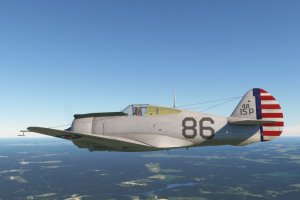
For the Richmond to Frederick stage I stepped outside the golden age types I had stuck to thus far, because I needed to test a few cfg tweaks I had made to the new Restauravia Hawk 75.

stage26.jpg

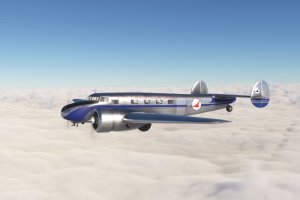
Then on to Pittsburgh, switching to the Just Flight Electra. This flight over the mountains promised almost the only interesting scenery of the whole tour. But, this afternoon's weather forced me to go find VFR on top.

stage27.jpg

It was a fun trip nonetheless. I had forgotten how much fun that plane is.
 
11th. Jan (Although this report written on the 12th.)

(KANE) → (KMCW) → (KDSM) → (KMKC)

FS9/2004

Callum promised us a surprise in Minneapolis, he had friends in the aviation industry there, and boy was he right.
There she was sitting outside the hanger fuelled and ready to go.
We all agreed some speed and luxury would help us on our way like nothing else.
Checks complete Callum powered her up.
Beautiful aromatic pollution followed:
2 Spart start.jpg

The met report was good and bad, strong northerlies at 8000’ 25 to 33 Kts (good tailwind) but overcast at 1100’ (bad, but we planned to cruise above at 8000’ and the met for Mason City and Des Moines had the cloud base at around 2600’, Kansas City clear).
The plan was touch and gos in Mason City and Des Moines and full stop and overnight in Kansas City.
Take off much twitchier than expected, the 450H.P. of the Wasp jr. radial lifted this plane up even before the tail lifted, nose pointing skyward, Callum overcompensated a bit pushing the stick forward and bouncing the main wheels off the tarmac. After the bounce he got it right with gentle stick forward so we climbed safely at 1000 ft. per minute. Gear up, flaps up and those big landing lights swivelling back up into the wings.
4 spart t off.jpg

Remembering to lean the mixture as we climbed up through the overcast we reached 8000’ in around 10 minutes. The airspeed showed 200 m.p.h. the GPS a ground speed of 224 Kts. That 30Kts tailwind sure helping. The panel very well equipped, with carb heat and pitot switches to combat ice. An outside temp. gauge the only addition I would have liked. The met forecast -13C at 8000’.
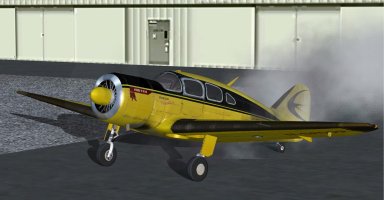
The Spartan a thing of beauty, the sinuous rounded lines screamed 1930s Art Deco:
5 Cruise.jpg

6 beaut.jpg

Sooner than expected it was time to descend for Mason City, automated weather confirmed the surface wind 311 degrees at 8 knots and, to our relief, overcast at 2700’ (Mason City altitude 1213’).
Callum took the Spartan down on a gentle circuit for rwy 30:
7 Final rwy 300.jpg

A good touch and go followed:
8 touch.jpg

9 and go.jpg

No sooner had we climbed back up to 8000’ than it was time to descend again for Des Moines.
A real human from ATC cleared us touch and go rwy 31. Popping out from the overcast it was nice to see most of the snow gone.
12 going to final des m.jpg

Callum did another smooth touch and go:
13 t a g des m.jpg

We climbed away and once again up to 8000’ turning onto a heading 205 for Kansas City.

The weather was clearing with good visibility and the flight uneventful, smooth fast and comfortable. Fuel consumption not a problem, we had filled to 99.3% capacity (667 Lbs) in Minneapolis and arrived in Kansas City with 62% still on board. Pay load not a problem either; us and baggage amounted to 640 lbs and the Spartan could have taken more.

The only oddity was the increase in our weight, at the start of the tour we had calculated 170 Lbs each plus 33 Lbs for Suzanne’s make up case (total 543 Lbs) now her make-up case and grown by 124 Lbs. What on earth did she have in there?

Descent and approach to (KMKC) Wheeler Downtown smooth and gentle:
13 Final (KMKC).jpg

The only problem: Not wanting to say goodbye to the Spartan. Maybe we could keep it at least to Tulsa, it’s spiritual home and birth place.
 
KINT>W03>KMQI>KFFA>KRIC>KFDK

With thanks to falcon for setting the stage it is time for the Model 75 to put on the AAC uniform for the trip north ... but first we must travel east to the coast and stop-in where it all began. First Flight is a special place and ended up spending a couple hours visiting (plan on doing the same in Dayton).

Leaving Kill Devil Hills the route up the coast and inland to Richmond takes in some nice views but soon past Dulles Approach says hello and the traffic starts to build. Clearance is given but still a good idea to keep your eyes open. At the same time below is the first snow since Iowa and Frederick is a welcome sight.

Time to find a spot in a warm hanger for the night.

NAT_13.jpg

NAT_14.jpg

NAT_15.jpg
 
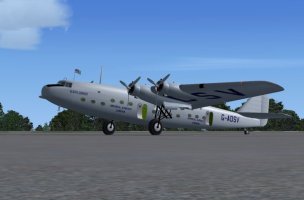
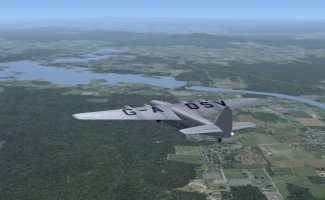
I've gone to the other end of the scale for my next leg, both in size, conventionality and country of origin. I've plumped for an Armstrong Whitworth Ensign Mk 2, as flown by Imperial Airways after the HP42 which I flew on an earlier leg, and it couldn't look more different!

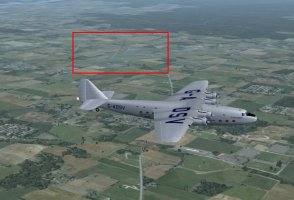
The Ensign carried 40 pax maximum, and a flight crew of 5, and was a large aeroplane, with a 123 ft wingspan, and the main wheels were 6 ft in dia. at the time the largest aircraft wheels anywhere! Compared to the HP42, it was a million times more streamlined, but was sadly well underpowered. Originally fitted with four AW Tiger IXs of 850 bhp each, all of the 14 Ensigns built were upgraded to use 950 bhp Wright Cyclones, but even then they were hardly overpowered. I repainted the FSX model as an updated Mk 1, G-ADSV, named 'Explorer', which seemed to suit our Tour better than some of the other Ensign names.

Just as with the HP42, the FSX Ensign flies its flag above the cockpit when the parking brakes are on. :)

Leg 17-a.jpg

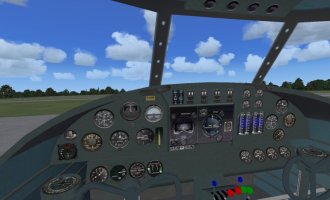
The Ensign's cockpit is very well portrayed and works well in 3D and 2D versions too. It's got a full radio stack, aliased from the contemporary DC3, and numerous external views as well. It also has the slowest operating landing gear ever! It takes a whole minute to extend and even longer to retract, so I had to ensure I had the gear down early before lining up for landing!

Leg 17-b.jpg

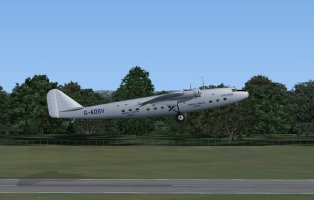
I was a little worried about such a large and underpowered aeroplane being able to take-off at Birmingham, but I needn't have worried, with two notches of flap Explorer was up and away by the 3/4 mark, no trouble.

Leg 17-c.jpg

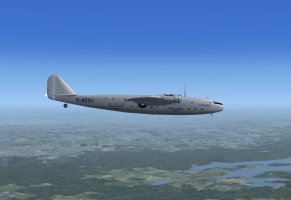
In level flight at my 5000 ft cruise altitude, she flew at 180+ kts. on 2 psi boost, but only after I'd tweaked the .cfg file settings to lessen the drag factors. And you can just notice that she flies nose-down, and this was a characteristic of almost all AW built aircraft of the period, most notably the Whitley bomber for the RAF. AW designed the wings with a high incidence angle to help with shorter take-off runs on grass fields, resulting in the nose-down pitch in normal flight. But she certainly looks sleek in this view.

Leg 17-d.jpg

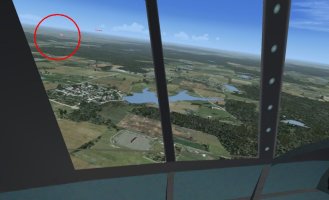
There weren't too many notable geographic features I could spot en route to Atlanta, but one large river was the Coosa River, which I'd never heard of of course, but it looked pretty impressive.

Leg 17-e.jpg

After turning a little more south east I passed over Talladega Muni. field, and in the RW it's right next door to the Raceway there, but for reasons best known to the designers FSX totally ignores the existence of the race track, and in the RW it's much more obvious than the airfield!

Leg 17-f.jpg

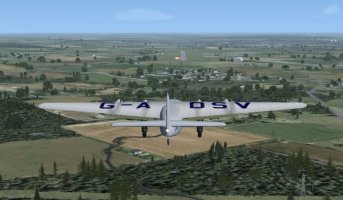
As the wind was northerly I had to drop down to the south a distance and do a downwind leg before turning on base for the 31 runway at KFFC and as I turned I could spot the PAPI lights over my left shoulder.

Leg 17-g.jpg

Lining up went nicely, after I'd remembered the slow acting main gear, and the Ensign was very stable on the approach, but as with some other types slowing down wasn't easy, and I had the throttle fully closed for much of the time too.

Leg 17-h.jpg

Just because I could I took a look from the Tower at KFFC with this result. The Ensign looks a large aeroplane even at that distance!

Leg 17-i.jpg

My landing went pretty well, on centre line OK, but some distance along the tarmac, and the Ensign's brakes JUST managed to stop me before going off the end! I'll have to watch that as I plan to use the Ensign on a few more legs yet.

Sadly my graphics software screwed up the pic I took when I parked up, so you'll just have to imagine that. Once again there are very few buildings at KFFC and I made sure I parked next to one of them. :)

The flight took about 1.5 hrs, and I averaged 182 kts. quite commendable for an 'under powered' aircraft, and I had over 1000 gallons of fuel left, almost enough to fly to another country, let alone another state.
 
Leg 11: Colonel James Jabara Airport (KAAO) to Tulsa International (KTUL)

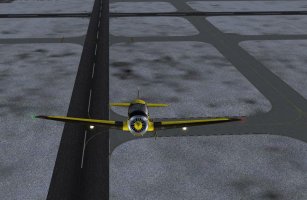
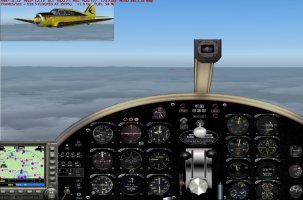
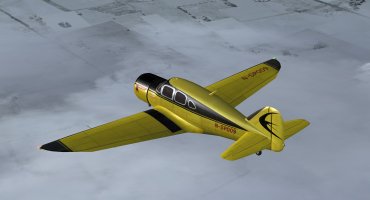
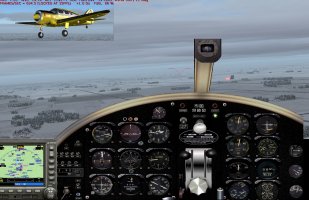
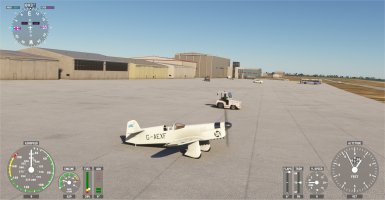
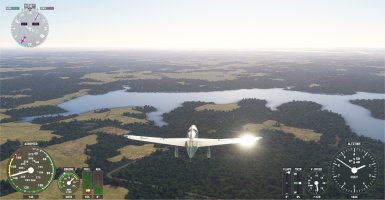
Flying the Percival Mew Gull in MSFS 2020. Using Active Sky FS for weather and Little Navmap for navigation. Using FSLTL for AI traffic.

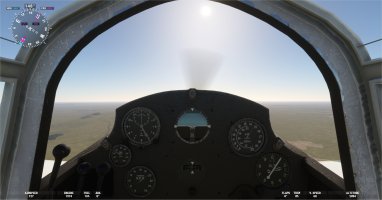
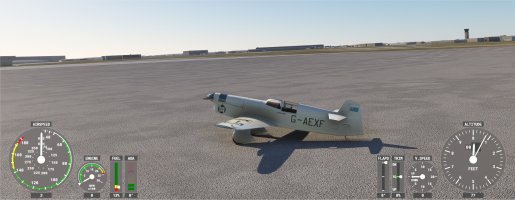
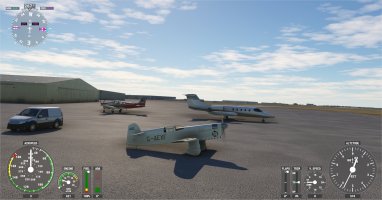
01 engine started quiet ramp.jpg
Engine started on the quiet ramp at KAAO. 20% fuel on board.

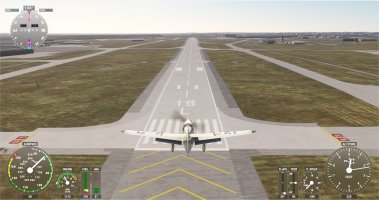
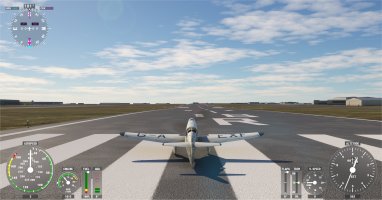
02 takeoff 18.jpg
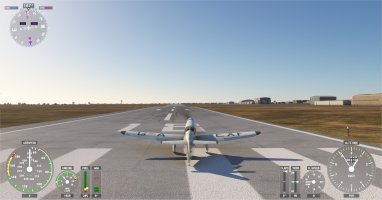
Lined up for takeoff on runway 18.

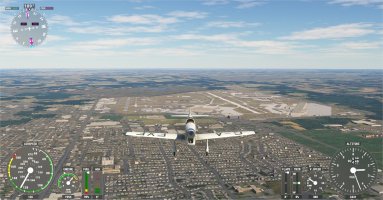
03 on the way.jpg
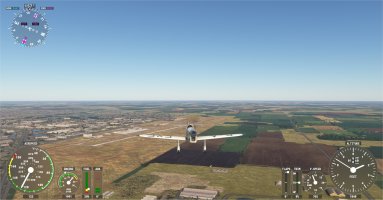
On the way. A beautiful day to go flying.

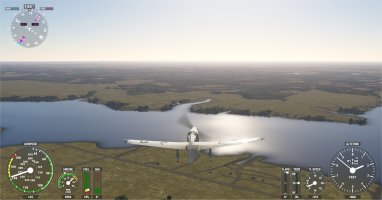
04 over Winfield City lake.jpg
Flying over Winfield City Lake.

05 half way there.jpg
Half way there. Great flying weather.

06 over Birch reservoir.jpg
Now over Birch Reservoir. The sunlight gleaming on my wing is cool!

07 airport in sight.jpg
Airport in sight ahead on the right.

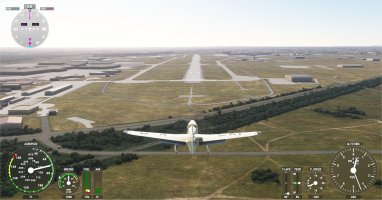
08 straight in to 18L.jpg
Wind direction indicated a straight in approach to runway 18L. Tulsa International is so big that runway 18R is out of sight on the right.

09 landing 18L.jpg
Easy landing on 18L.

10 parked very empty ramp.jpg
Parked on a very empty ramp. Engine stopped with 13% fuel on board. After landing I found out that the general aviation area is over by runway 18R. I will taxi over there and fully refuel before the next flight to Fort Worth Meacham International (KFTW)

By my somewhat rough calculations I flew and taxied 1687 nautical miles so far using 75.7 gallons of fuel. That is 22.3 nm per gallon of fuel. I will have to add up the times of the flights and figure out how many gallons per hour. I will post that with the next report.

Here is some information on the Mew Gull engine:

Engine Type: de Havilland Gipsy Six R
Configuration: 6-cylinder, air-cooled, inverted inline piston engine
Displacement: 9.186 liters (560.6 cubic inches)
Power Output:
~230 hp (Gipsy Six R)
Performance:
Rated at 2,350 rpm for takeoff power.
Uses downdraught carburetors.

The Engine in a Racing Context:
The "Gipsy Six R" was a specific racing variant for the DH.88 Comet and also used in the Mew Gull, offering more power for events like the King's Cup. With the 230 hp Gipsy Six R and a variable-pitch propeller, the Mew Gull achieved record speeds of 236.25 mph in the 1938 King's Cup (a 1,012-mile event), coming in first and setting a British class record which still stands.
 
Last edited:
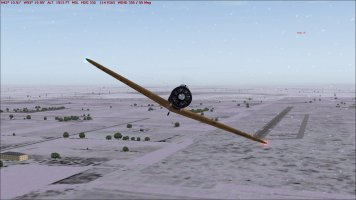
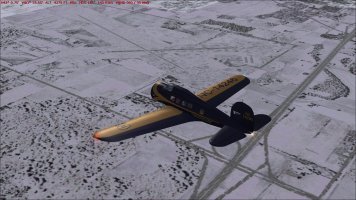
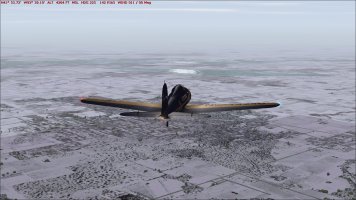
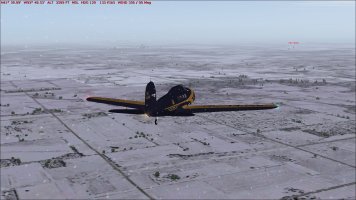
More of the flat midwest, though I think I saw a couple of hills along the way. Not sure since there was intermittent snow and occasional low clouds most of the trip.

Departing KMCWkmcw.jpg

KAMW, Ames Municipal Airport in, oddly enough, Ames, Iowa. Opened in 1943, in 2023 it was officially renamed James Herman Banning Ames Municipal Airport in honor of the first African American to obtain a pilots license. It averages over 30,000 operations a year and since 1962, the earliest the NTSB has in their database, has had no fatal accidents.
kamw.jpg

Twenty miles to KDSM
20mi.jpg

KDSM in sight
kdsm1.jpg

128 miles in just under an hour
kdsm2.jpg

Stille early, maybe we should do the next leg
kdsm3.jpg

kdsm4.jpg

"I'm going to Kansas City, Kansas City here I come...." Wilbert Harrison
kdsm5.jpg

150 miles to go150togo.jpg

Snow again
snow-again.jpg

to be continued
 
Hey, I can't do IFR here
weather2.jpg

KMKC ahead
kmkc.jpg

KMCI, Kansas City International Airport, off to the west. Opened in 1972, it was originally called Mid-Continent International Airport; built to replace the Kansas City Industrial Airport ...which was built to replace the Fairfax Municipal Airport which had been virtually destroyed in a flood in 1951.
kmci.jpg

Almost there
kmkc2.jpg

kmkc3.jpg

308 miles total from KCMW in 2 hours; calculated the fuel well, landed with 13%.
downkmkc.jpg
 
(KMKC) Kansas City → (KAAO) Wichita
13th. January
FS9/2004

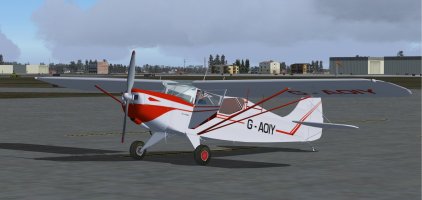
A busy day for us, time to make hay while the sun shines. After the Spartan something much more accessible for the majority of aviation devotees.
The Auster J5V, basically a pre II war design, but this model fitted with a Lycoming flat four.
1 Auster.jpg

Not glamorous but able to take four and our 680 lbs pay load plus 75% fuel (180Lbs)
I was taking command, some 165 n.m. to Wichita (KAAO) Col. Jabara. We expected a 90kts cruise so flight time of 1hr. 50Mins.
Excellent ground handling and a well featured panel. Cleared to hold at rwy 19:
2 holding 19.jpg

3 t off clear.jpg

Take off safe and predictable, gentle climb and turning onto 240 heading:
4 heading 240.jpg

We climbed to 3000’ but encountered a 250 headwind at 15 kts, so descended to 2500’, the wind here 187 at 8 kts.
The Auster had no autopilot, not a bad thing as trimming to a steady level flight easy.
We were chugging along at a ground speed of 91 kts (airspeed of 110 m.p.h.)
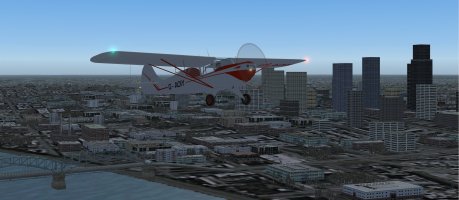
A very steady relaxed plane to fly, but it did blur that fine distinction between relaxation and boredom. Plenty of time to look at the flat featureless landscape. The only diversion checking the map and matching it up with ground landmarks, here over Pomona lake/reservoir:
5 Pomona lake.jpg

Finally (KAAO) Jabarra in sight. Not that easy as Wichita has literally dozens of airfields; we would be just below the approach flight path for McConnel AFB, F16s or C17s chewing our rear. If that was not enough both Beech Factory field and Cessna Aircraft airfield just a mile or two away.
Automated weather gave us ground conditions at Jabarra; wind 203 at 10Kts, runway 18 it was then.
6 visual.jpg

7 final.jpg

I would recommend the Auster for tail wheel training, everything predictable and gentle:
8 landed.jpg

Easy to taxi to parking. We shut down and decamped:
9 shut down.jpg

Only 11:05 the flight took 1hr. and 50 mins. The weather too good to waste, time to find something more exciting for the next leg/s.
 
Leg 12: Tulsa International (KTUL) to Fort Worth Meacham International (KFTW)

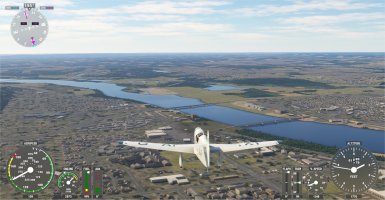
Flying the Percival Mew Gull in MSFS 2020. Using Active Sky FS for weather and Little Navmap for navigation. Using FSLTL for AI traffic.

01 engine started.jpg
Engine started next to a few aircraft on the ramp at Tulsa. Refueled for the first time on this Tour. 100% fuel on board.

02 takeoff 18R.jpg
Lined up for takeoff on runway 18R.

03 Tulsa Intl is huge.jpg
On the way. Tulsa International behind me is a huge airport.

04 leaving Tulsa bridges.jpg
Leaving the Tulsa area. I resisted the temptation to try flying under one or both of those bridges below.

05 half way airliner.jpg
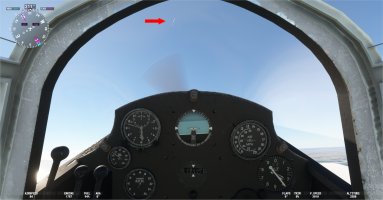
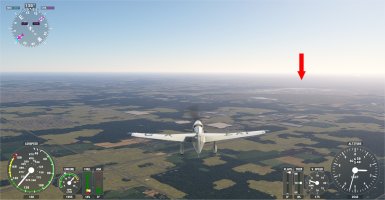
A bit more than half way there. Spotted this airliner way high above me.

06 passing KDTO.jpg
Denton Municipal Airport (KDTO) was directly in my flight path. The tower appreciated my banking left and going around the airport.

07 airliner departing KAFW.jpg
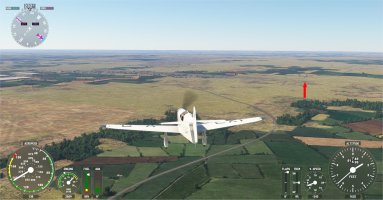
Next I passed to the right of Fort Worth Alliance airport (KAFW) on the way to getting lined up for a straight in approach on runway 16 at Fort Worth Meacham International (KFTW). Note the airliner that just took off from KAFW. Keeping my eyes peeled on the approach to the airport here in Texas.

08 airport ahead.jpg
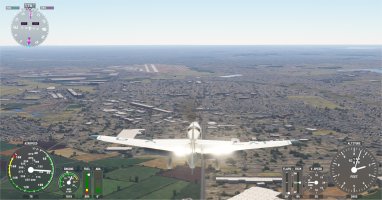
The airport is ahead. Wind direction indicates a straight in final for runway 16.

09 short final 16.jpg
Short final for runway 16. My sink rate was higher than expected while I was snapping this picture with my camera. I had to add a burst of throttle to safely make the runway. But landed safely after all.

10 parked at KFTW.jpg
Parked in the line at Fort Worth Meacham International (KFTW). Have 87% fuel remaining after shutting down the engine. It is a good thing that I did not try to fly here from Tulsa without refueling. I would have been on fumes if I was lucky.

This was the longest leg so far on the Air Tour. Next stop is Shreveport Downtown (KDTN) in Louisiana.
 
Back
Top