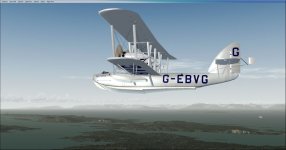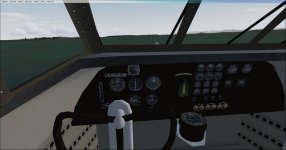
Wombat and others , I forgot to mention there are starter buttons, they are above the engine instruments below the coaming, you just have to drop the seat view down a notch to see them and use them. In my humble opinion that also approximates the view from the pilots seat, they sat pretty low which is understandable it was an open cockpit.
A couple of small things:
I am aware the boost gauges whilst operating are giving incorrect readings, but I am not so sure, the Pegasus engine was a derivative of the earlier Jupiter by Bristol, the bore and cylinders got bigger with the Pegasus and there was a supercharger of sorts but it basically only kept manifold pressure up not over-boosted, so they may be right after all, in other words it is reading like an unsupercharged MP gauge. I am looking at the air file but any form of detailed performance data on the engine is very hard to find. The engine RPM is also not capable of going out to the range on the dial the engine RPM is nonetheless correct. The reason I am also looking at the air file is the loss of speed and lift in the turn which to fly level at all up weight requires power to be increased and back stick. One curious feature is that the relevant engine gauges for the aircraft are situated on the relevant strut, I left those in situ because that is what the Calcutta had as well but I am sure that they had three dial cluster for all engines in the panel because Shorts were very advanced and good at complex systems. They did not stint on electrical circuits where they could use them and the cabin and cockpit had lots of lights fitted and other Short aircraft display similar advanced or standard today cockpit layouts.
I am pretty certain with a few variations here and there this is what the cockpit of the Calcutta/Rangoon would have been like. It was designed as a one pilot aeroplane with a radio operator below and behind the captain in a form of short cubicle outside the cabin door.
I managed to track down some first hand accounts of flights in this aircraft from the period, the best being the 1934 formation that went from Basra to Australia. It seems 80 knots was the best speed they achieved and they were short sectors, took a few weeks. They stopped at a lot of places I had never heard off. If I can distill any wisdom or operating notes I will revise the notes and checks and post them as well.