Okay, I'm not sure how long-winded this will or will not be, or how much sense it will make, but I'll try to get some of my thoughts down on the subject.
Going back to the beginning, Mustangs entered the racing scene as soon as the Cleveland Air Races re-opened again in 1946, following the end of WWII. During the late-half the 40's quite a number of P-51D's and K's were purchased for racing use. These aircraft were bought surplus straight from the U.S. Government, and with the exception of having the guns and gunsights removed, were bone-stock. With these aircraft, the armor plates were removed, the bomb/drop tank shackles were removed, and the fuselage tanks were likely removed, but other than that, they largely were the same aircraft as produced for the military. Depending on how much attention to detail and how much the term authenticity means to you, and I know and understand that it varies quite largely from one person to the next, the WWII variant models aren't the greatest match for even these examples, as they have the guns, the aerial antenna, the bomb shackles, the armor plate, and the fuselage fuel tank all in place, and these were all items that were quick to be removed due to drag and weight that wasn't needed. I have mentioned a few times that I would like to put together a Cleveland Air Racers P-51D and P-51K product, and do intend to do so (whether it has or will have the interest of anyone else, I don't know).
As the years progressed, owners began to modify their Mustangs much more so, with all sorts of various interiors (often matching the two-tone tuck-n-roll upholstery interiors popular in the cars of the time), and had various new instrument panels and avionics fitted, and rear seats installed, all often in an effort to make the Mustang into an executive/high-class type mode of transport. So by the start of the Reno Air Races, most all of the Mustangs flying at the time, even before those which were to be modified and used for racing at Reno, were highly modified aircraft, with completely different interiors and various different exterior modifications. Throughout the years of Reno Air Racing, the amount and the extent of the modifications explored with the P-51D airframe, has been minor all the way to the definition of extreme. Some Reno participants have been called 'stock' Mustangs, because compared to some others, they could be considered as such, since they still retain the same wing, fuselage, tail, and canopy design (though the interiors are never "stock-WWII"), and the Merlins fitted are often "racing-Merlins", those that have been modified through the formula of getting the most power, and reliability at high power, out of them (which consists of merging specific parts from various different production models of the Merlin, including certain parts from the transport Merlins). So that is the more stock category of Reno racers. Then you get some that still look rather stock, but they might have a re-designed radiator scoop, or a more sleek canopy, or special wing tips, or more aerodynamic fuselage-to-wing fillets, etc., all with the goal of getting more speed. From there, then there have been those Mustangs that have had the entire back/spine of the aircraft removed, and had a new spine and canopy designed for better aerodynamics (and there are a number of different types of these designs/modifications that have been used over the years). Taking this ever further still, a few examples have actually had the belly scoop removed altogether, learjet wings fitted, etc.
I have often been asked a certain question about the various P-51D and K models that Warbirdsim have covered, and that is, "what model best suits this paint scheme?" Sometimes, with luck, there has been a model that I've made that suits that particular Mustang that someone wants to make a repaint of, very, very closely. However, you'll never be able to find a Mustang out there that perfectly matches another, and through the various P-51D/K products I have worked on, the aim is always to pick a specific example, and model it, then move onto another, study that one, and then do all that I can to match it, and so on and so forth - whether it is due to production model changes, field-modifications, or post-war civilian or resto modifications, each ends up unique. The reason I bring this up, is that of the models I have made, I can't put a finger on any one of them, just as they are, and say it is a perfect match for a Reno air racing scheme, it's just how it is.
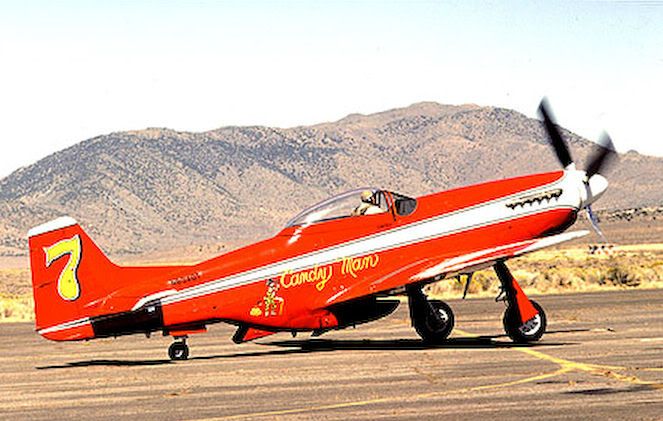
I will say, however, that a couple of the Warbirdsim P-51D's covered in the Restored Part 2 product, are former air racers that competed at Reno decades ago, those being the USAF FF-704 ("Thunderbird") example, and "Moose/Candyman" (which is actually the same aircraft as in the photo that Joseph posted), and despite not perfectly resembling the way they looked as Reno air racers, do still carry evidence from those days. However, both have also been restored since those days, and as depicted, have a lot more of the military hardware added back to the airframes than they had when they were racers. (The prop blades fitted to FF-704, and as depicted on the Warbirdsim example, are from a P-51H, and were added to the aircraft in its Reno years, for added thrust - something that a few other Reno participants also did - and those prop blades still remain on the aircraft today). If you do want to make some Reno air racing schemes, I would personally recommend the model for "Moose/Candyman" from the "Restored Part 2" product, or the "Vintage Wings of Canada" or the "Ferocious Frankie" models from "Restored Part 1". But this is hardly a reason to go out and buy those, unless there would be other reasons to pursue. You can use the paint kit for Little Friends I on the Restored variants, but it requires a few specific changes/additions to the textures (mainly just centering around the exhaust stacks and gun bays).
Probably the most stock P-51D that has raced at Reno, is "Geraldine", which competed in either 2010, 2011, or both (I forget). Those that know this aircraft, know that it is one of the most stock-to-WWII condition P-51D's out there. For the races, the guns and the bomb shackles were removed, and it was able to post some good times competing in the Bronze class (where the aircraft aren't pushed to their limits, and are usually quite stock in configuration). The amount of probable interest in it probably wouldn't warrant the time that would be invested in it, but I have been wanting to make a true to real-life reproduction of "Geraldine", and I have thought about including the aircraft as it is in its very stock military form, and also in the form it has taken on when competing at Reno, complete with the big racing number stickers on the sides.
Another idea I have been floating around for a while now, is re-making the Acceleration Mustang racers the way that Warbirdsim would have done them. You'd get the same cockpit configuration and panel configuration, most of the same (or similar) paint schemes, racing scoop, and racing wing tips, but all done 100% more accurately, since it would be all based on the already accurately-modeled Warbirdsim P-51D's to begin with (exterior and VC). If you take a flight in one of the Warbirdsim P-51D's, and then go and fly one of the Acceleration P-51's, the Acceleration model suddenly looks like one of those 1/2 or 3/4-scale replicas, where the proportions are off.