• There seems to be an uptick in Political comments in recent months. Those of us who are long time members of the site know that Political and Religious content has been banned for years. Nothing has changed. Please leave all political and religious comments out of the forums.

    If you recently joined the forums you were not presented with this restriction in the terms of service. This was due to a conversion error when we went from vBulletin to Xenforo. We have updated our terms of service to reflect these corrections.

    Please note any post refering to a politician will be considered political even if it is intended to be humor. Our experience is these topics have a way of dividing the forums and causing deep resentment among members. It is a poison to the community. We appreciate compliance with the rules.

    The Staff of SOH

  • Please see the most recent updates in the "Where did the .com name go?" thread. Posts number 16 and 17.

    Post 16 Update

    Post 17 Warning

welllllllllllllllllllllllllllllllllllllll......... ....

About P-36's at Pearl Harbor, there is the great story of Phil Rasmussen, who jumped into is P-36 and got airborne, while still wearing his pajamas - something that has been replicated in a P-36 display at the Air Force Museum. One of the Zeros shot down that day, was to his credit.

http://www.flickr.com/photos/afmuseum/4077483711/sizes/o/

Thanks for the picture John, when I look at it, I think the Japanese pilots were not shot, but more likely blinded by reflections on the highly polished aircraft and crashed :d

Cheers,
Huub
 
I know.. .. I was typing as you replied.. sorry.. :jump:

Don't worry Brett, I guess your explanation was a good addition to my one-liner ;)

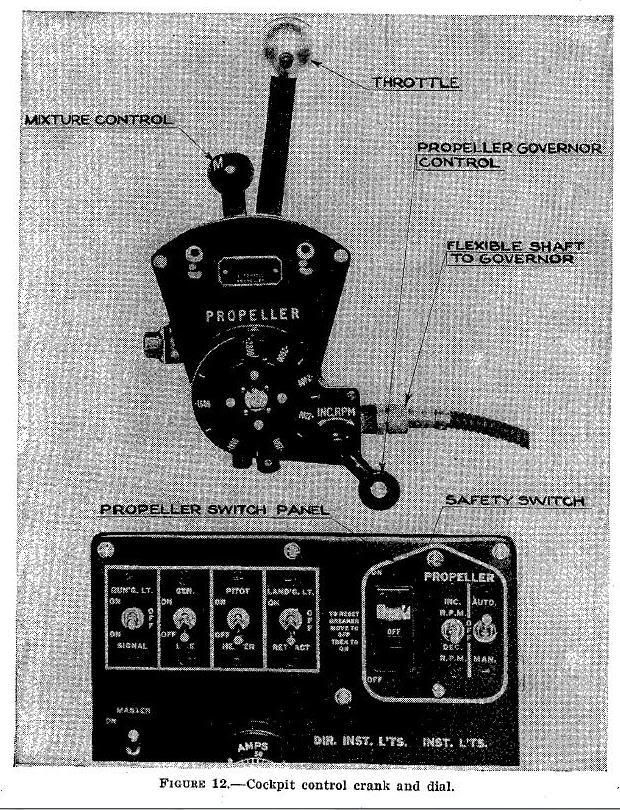
John, actually the propeller control for the Curtiss-Wright S-5315-C works slightly different than on the P-40s and P47s. Control is fully electric.With the crack you can adjust the rpm setting, which you can read on the large dial. You can switch to "manual" which gives you direct control over the pitch, however you will only notice this is increase of decrease of rpm. As "increase rpm" will just decrease the pitch and visa versa

Source: The 1940 US Air Corps technical note "Propellers" as is the source of the picture below.

C-5315-S.jpg


Cheers,
Huub
 
::ROFLMAO:: You guys are awesome, and i'm getting more senile by the moment..
yes, there IS a four position lever on the side of the throttle body, but the pilot tips on it show its movement in percentages of degrees, then theres a throttle on top next to the mixture lever.. therin lay my confusion.. if its only a four position switch, why is it incremented in degrees ( in the pilot tips) and if it isnt a throttle, why is there a mixture knob next to it?? ::lol:; i'm so confused..
either way, right now, the plane flies great. not quite what i'm happy with, but pretty good none the less..
Huub.. will take a look at that PM as soon as it comes through.. thank you :) :)
Pam
 
Thank you for the illustration, and the information Huub! I had not seen that configuration before, which is definitely an earlier setup. I see that instead of one four-position toggle switch, the functions are split between two individual switches, on the electrical panel.

Pam, this is what I was referring to - in this photo, of The Fighter Collection Hawk 75/P-36, you can see the typical engine controls, with manual prop lever, and then below it, circled, same as in Huub's illustration, there is an RPM Increase/Off/Decrease electrical switch, as well as an RPM Auto/Manual switch at the right of it. Later on, these two switches were combined into one, with four positions covering all of the functions, in later aircraft like the P-40, that I am more familiar with.

In the sim, the prop lever will read by percentage when you hover the mouse over it - that is in the code - but you will want to, within the flight dynamics, set it up so that you are getting proper RPM read-outs on the gauge, and that those will give you the proper results in the end.

I really don't think the electrical switches are used too often, at all, in regular operation. I think most pilots are used to, and simply use the prop lever to make changes in RPM. However, it would appear by this photo, that the last pilot to fly it, was using the electrical Increase/Decrease switch to control the RPM, as the switch next to it, is selected in Manual operation (down). If it were up, then it would indicate that the pilot was using the prop lever.
 
wellll, for clarification and just so everyone understands a bit of where my confusion lay, heres the translation from the French manual :d Enjoy ::LOL:::


(B) The propeller can operate:
- With no fixed whose variation is controlled directly by the driver.
- With no system now automatically variable constant. The scheme is chosen by the driver using a control crank rotating disc graduated in revolutions per minute. The order total includes:
- A switch with two positions: Automatic - manual
- A 3-position switch: not increased - not decreased - neutral
- a crank adjustment system is running at constant speed.


d. Preparation for flight

(1) Take-off
1. Blend - adjusts the rich
2. Carburetor - cold air - unless it freezes, and in this case, just to keep the heat icing. Temperature 30 ° to 35 ° C.
3. Propeller: Set at 2700 -
4. Propeller control to automatic
5. Manifold pressure 1085 mm max.
6. Cowl flaps: open
7. Cylinder head temperature 260 ° C max.

(2) Ascent and high speed
1. Propeller: Set at 2550 (automatic)
2. Maximum pressure of the tubing
Altitude in m Manifold pressure
of 0-500 m 890 mm
of 500-1500 m 860mm
from 1500 to 2500 m 850mm
Above 2500 m 840mm
3. Cowl flaps open (enough to allow the cylinder temperature to below the limit)
4. Maximum temperature 260 ° C slide
5. Mixture, adjust by turning the propeller not fixed. The best setting corresponds to a gain in rpm approximately equal to two thirds of the gain maximum.


as you can see, it isnt exactly clear... :)
Pam


I really don't think the electrical switches are used too often, at all, in regular operation. I think most pilots are used to, and simply use the prop lever to make changes in RPM. However, it would appear by this photo, that the last pilot to fly it, was using the electrical Increase/Decrease switch to control the RPM, as the switch next to it, is selected in Manual operation (down). If it were up, then it would indicate that the pilot was using the prop lever.

Bomber: Thats the identical throttle body we use in the model.. got a pm coming yur way..
 
I see - that poor translation even could leave some contradictory information, if you try reading it word for word. :d

The RPM settings that I can pick out, definitely seem to match that of the R-1830-type engine. This is what I've got for the R-1830, just for reference:

Max Power: 48" Manifold Pressure/2700 RPM
Take Off Power: 40-48" Manifold Pressure/2700 RPM
Normal Climb Power: 40" Manifold Pressure/2550 RPM
Normal Cruise Power: 30-34" Manifold Pressure/2000-2250 RPM
Landing:2550 RPM Set (This is an assumption, given that usually you set the prop for climb on approach, just in-case of a go-around)
 
sadly, the manual is for the model 75-A with a 900 hp motor in it. the model that we are making is the model 75-A3 with a 1250 hp motor in it, but, all the sttings remain the same ( fortunately ), as i've modeled this engine in another aircraft before ( the grumman Goose ) and will again ( cant say :) )
 
Ahhh.. it's a type of hybrid ..

There are three types of propeller where the blade-pitch can change;

1) Adjustable pitch, where a pitch is set on the ground and remains unchanged during flight.

2) Controlable-pitch, where the pilot has firect control over the blade-pitch.

3) Constant-speed, where the pilot select an RPM, and the blade-pitch changes as needed to maintain that RPM.

Adjustable pitch props are still common, and are showing up on mant Light-Sport aircraft. They pretty much allow you to decide whether you want a climb-prop, or a cruise-prop, before taking off.

Controlable-pitch props are all but gone now. There's no point in tasking a pilot with trying to manage RPM, when a constant-speed prop does it very well.

From the looks of that description.. this prop could be either constant-speed, or controlable-pitch.

It's moot though, for MSFS, as controlable-pitch props cannot be modeled. Only fixed-pitch, or constant-speed... Although, it wouldn't surprise me if some XML guru found a way to model controlable-pitch.

For clarification.. none of these systems allow for engine RPM , and prop RPM to differ. A lot of the constant-speed prop confusion centers around the idea that a throttle controls engine RPM, and the prop-control controls prop-rpm. They're mechanically the same at all times.
 
right now, due to the rpm gauge all i have is manifold pressure, and its within those ranges you have given.. afraid i'm not qualified to work on a gauge ( its too far beyond my undersanding )but all the numbers are in place so it should be a matter of the gauge engineer setting his programming up to decipher them correctly. If the gauge engineer is reading this and needs me to do something PLEASE PM me.. I will do ANYTHING i have too to make this plane right..
love you guys..
Pam
 
There were 39 P-36s stationed at Pearl Habour, from which 5 succeeded to take off. They were credited to shoot down 2 Zero's.

Cheers,
Huub


I didnt know that either. Thanks for that Huub. Again, the amazing aircraft history professor...


Sounds like you have been working hard Pam. Awesome. Great screenshot as well.


Bill
 
addressing the question of P-36s with the Far East Air Force/Philippines on Dec 7th. There were none... I too was of the assumption that they were there:

http://www.statemaster.com/encyclopedia/U.S.-Far-East-Air-Force

P-35 Seversky however were there and came about from an intercepted sale to Sweden...

http://en.wikipedia.org/wiki/Far_East_Air_Force_(United_States)

Also here is a great account of the P-36s in action over Oahu on Dec. 7th by one of the best Pearl Harbor historians David Aiken.

http://findarticles.com/p/articles/mi_qa3897/is_200210/ai_n9121096/


Other minutae....
Frances "Gabby" Gabreski of ETO fame was @ Wheeler on Dec 7th and did get up around noon only to abort a mission after taking friendly fire while flying over Pearl Harbor/ Hickam at 5000 ft... **What were they thinking!?! **

Citing Flight Journal June 2007 p24 "Ghosts of Pearl Harbor" also by David Aiken ... I just happen to own that issue... hmm wonder why. ;^)

A P-36 piloted by John Dains was downed by friendly fire from Schofield Barracks near the end of the attack. A little known fact.... John Dains scored the first American victory in World War 2... shooting down a Val that had been strafing the cars on the way to Haleiwa and then the airfield itself.... the plane downed just east of the village of Kaaawa. Downed before Welch and Taylor had downed any aircraft.

Dains earlier had switched planes as he had flown his first 2 sorties in the Haleiwa P-40 as he was among the Welch and Taylor group to beeline to Haleiwa at the beginning of the attack. After the 2nd sortie he had switched to a P-36.

After taking the BAR and small arms fire from Schofield ... Dains crashed and burned in a pineapple field just short of Wheeler.
 
So I have learned something new today as well ;)

Below a link to an overview of all US aircrafts at Pearl Habour in December 1941:

http://www.ww2pacific.com/aaf41.html

The B-17s are registed as "heavy bomber" while in this period of the war I think they were still mainly used al long range maritime patrol aircrafts.

Cheers,
Huub
 
addressing the question of P-36s with the Far East Air Force/Philippines on Dec 7th. There were none... I too was of the assumption that they were there:

http://www.statemaster.com/encyclopedia/U.S.-Far-East-Air-Force

P-35 Seversky however were there and came about from an intercepted sale to Sweden...

http://en.wikipedia.org/wiki/Far_East_Air_Force_(United_States)

Also here is a great account of the P-36s in action over Oahu on Dec. 7th by one of the best Pearl Harbor historians David Aiken.


http://findarticles.com/p/articles/mi_qa3897/is_200210/ai_n9121096/


Other minutae....
Frances "Gabby" Gabreski of ETO fame was @ Wheeler on Dec 7th and did get up around noon only to abort a mission after taking friendly fire while flying over Pearl Harbor/ Hickam at 5000 ft... **What were they thinking!?! **

Citing Flight Journal June 2007 p24 "Ghosts of Pearl Harbor" also by David Aiken ... I just happen to own that issue... hmm wonder why. ;^)

A P-36 piloted by John Dains was downed by friendly fire from Schofield Barracks near the end of the attack. A little known fact.... John Dains scored the first American victory in World War 2... shooting down a Val that had been strafing the cars on the way to Haleiwa and then the airfield itself.... the plane downed just east of the village of Kaaawa. Downed before Welch and Taylor had downed any aircraft.

Dains earlier had switched planes as he had flown his first 2 sorties in the Haleiwa P-40 as he was among the Welch and Taylor group to beeline to Haleiwa at the beginning of the attack. After the 2nd sortie he had switched to a P-36.

After taking the BAR and small arms fire from Schofield ... Dains crashed and burned in a pineapple field just short of Wheeler.


Pedantically speaking, America didn't declare War on Japan until Dec 8th, so none of the victories on Dec 7th by American pilots are `War` victories... Ten American pilots flew with RAF Fighter Command between July and October 1940 so they predate Pearl Harbor by well over a year, and were indisputably in a declared War, and did not surrender their Nationalities so remained American combatants whatever the state of Neutrality existing in the USA at the time.

Billy Fiske is sometimes acknowledged to have been the first US pilot to score a victory during the Second World War although his single victory prior to his crash on the 16th August 1940 was unconfirmed.
Officially, Lance Cleo Wade is the first American to score a victory - he shot down two Fiat CR-42s on the 18th November, 1941 while flying Hurricanes for the RAF in Egypt.

WWII did not begin in December 1941, it began on the 1st September 1939.
 
Well, very few wars in history have been formally declared. Usually it's been assumed by both sides that the war has begun when one side starts shooting at the other. A declaration follows, at some point, if ever, when there is time to officially formalize the existing event so the politicians and paper pushers are happy. Don't you remember the words of the President's famous speech to congress? He said he would ask congress to declare that “a state of war has existed”. They did, so that means the war started when the shooting started, which the participants already kind of knew.

It's kind of like the air raid warning system put in place at Port Mreseby in the early days of the Pacific War. They used a set of flags. Green meant "all clear", yellow meant "incoming raid", and red meant "planes overhead". The new guys were told that this was a fool proof system because if you didn't notice the flags, you wouldn't miss the bombs exploding on the airfield!

Interesting about the non-P-36s in the Philippines. I guess we were thinking of P-35s!

In any case, I can't wait for this P-36 to be delivered!
 
It should be a good one.. I passed off the final version of the FDE to Dean a couple days ago. Hes having his in house FDE guy go over it and make changes according to their needs, so it shouldnt be too much longer now..
 
Back
Top