There are a couple of places I can think of.
North of the city is the Marne river. It marks the farthest point of advance of the German Army in its attempt in 1914 to encircle Paris from the north and west. French General Gallieni - one of the oldest generals in the French Army - used two of the newest inventions - the airplane and the motor car - to save Paris. He, in company with only a very few other French generals, believed the information provided by French pilots and observers who reported the Germany Army was turning south-east prematurely in its attempt to encircle Paris. It was presenting its right flank to an enterprising enemy who could take advantage of this weakness. Gallieni took them at their word and mobilized every available vehicle - including all of Paris' taxicabs - as troop transports and rushed as many men as he could to French positions along the Marne river, where they stopped the German advance within (I think) 30 miles of the capital. The Germans almost did it. The battle is famous because it more or less ended the war of maneuver that WWI in the West had been up to that point and ushered in trench warfare on a massive scale on the Western Front.
There is a forest about 60 miles to the northeast of Paris, the Forest of Coucy, that was the location for the Paris Kanone, or Kaiser Wilhelm Kanone - what the press called the Paris Gun. This thing could shoot about 75 miles and did drop shells into Paris at the rate of one about one every 15 minutes - 21 were fired on the first day. The barrels - which were tremendously long, and required a sort of trestle to hold them straight - could fire only 75 projectiles accurately (on a city-sized target, that is) before they had to be removed, sent back to Krupp, and rebored and new ammo provided. It was a most remarkable achievement for that time period, and still ranks as one of the longest-ranged and strongest artillery pieces ever constructed. Dad tended 12-inch and 16-inch coast defense guns before he switched to the field artillery later in WWII - the Paris Gun was still a topic of some discussion in their training.
So there are a couple of unusual places for you to think about.
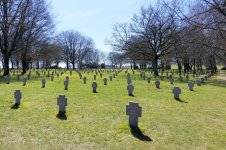
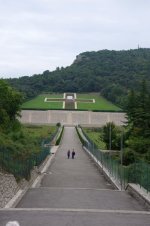
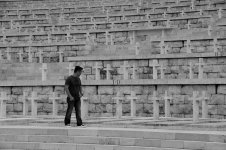
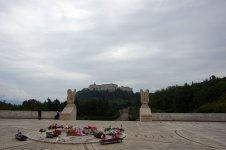
France is not a large country - no European country is large compared to the US - so there are many, many other places that would be of intense interest to a WWI buff like me if I were short on time. To me, as an American, no trip to France would be complete without seeing the Argonne Forest (where they have located the exact site where Sgt York won his Medal of Honor), Chateau-Thierry, and St-Mihiel. Verdun is the site of a MASSIVE French memorial and ossuary - where bones that still turn up from the battlefield are taken for custody. It's quite beautiful on the inside. It's surrounded by an equally massive cemetery of France's dead, most of them from that battle. There is a hill there called Mort Homme (Dead Man's Hill) - Cote 304. I thought Dad was pulling my leg about this story until I found it is true. The hill has two summits. Both were fought over incredibly fiercely and changed hands multiple times. So much steel and lead were fired into that ground, and remain embedded in the soil, a compass held in the hand on Mort Homme will not point to magnetic North. Technically Cote 304 no longest exists because about 7 meters of soil was blasted clean off the top of the hill. It's hard to believe two armies could fight like that over a piece of ground - but they did.




 Besides...that gives me an excuse to go back some year!