Hi Browncoat
I intend to stop before the D-22 mark so I wasn't clear in what I wrote. Actually there is little external difference between the D-15 and D-22 Marks, except for the switch from the Curtiss prop to the Hamilton Standard prop. Similarly there is little external difference between the D-2 to D-11.
P-47B: Variants weren't considered to be combat ready. There were a number of problems which had yet to be worked out. Fuselage was 8" shorter than later C and D variants, so CG was slightly off, meaning poorer maneuverability. No provision for carrying drop tanks or bombs. No "Paddle Blade" propeller, so inferior speed and climbing performance, fabric covered control surfaces were vulnerable to fluttering or locking up at high speeds. They were relegated to training only.
Engine: Pratt & Whitney R-2800-21
Horsepower: 2000
Max Speed: 429 mph at 27,800ft
Ceiling: 42,000ft
Span: 40ft 9.25in
Length: 35ft 4in
Range: 550 miles at 25,000ft, 835 miles at 10,000ft
P-47C: Strengthened all-metal control surfaces, upgraded turbosupercharger regulator, and a short vertical radio mast. Otherwise similar to the P-47B-15. No emergency war boost. These weren't considered combat ready. 57 produced.
P-47C-1: Visually identical to the early P-47D blocks (i.e., "razorback" fuselage) due fuselage extension. Slight improvements to oil cooler exhaust, fixes to brakes, strengthened landing gear, and redesigned rudder and elevator balance. Otherwise like the P-47C. 55 built.
Engine: Pratt & Whitney R-2800-21
Horsepower: 2000
Max Speed: 433 mph at 30,000ft
Ceiling: 42,000ft
Span: 40ft 9.25in
Length: 36ft 1in
Range: 400 miles at 25,000ft, 835 miles at 10,000ft
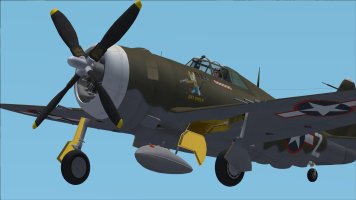
The P-47C variants, especially the P-47C-2 and C-5, are historically important since they were the first P-47s to see combat. This will be the first release.
P-47C-2: As above, but centerline hardpoint for a 205 U.S. gallon external (for ferrying - not droppable) fuel tank. Unreliable radios. Saw combat with 4th, 56th and 78th Fighter Groups from bases in England. 128 built. In England, they were field upgraded to C-5 standards.
P-47C-5RE: As above, but R-2800-59 engine with water-methanol injection (WEP of 2,300 hp (1,716 kW)). Some had the mast antenna replaced with whip antenna. More reliable British radio replaced American equipment. Field modifications gave the plane a bulged belly, allowing a 75 gallon external tank to be dropped. Pressurized drop tanks allowed extended range, starting on 30 July 1943 (a raid on Kassel, Germany). This was the first P-47 variant along with the C-2's already in England, to see combat in large numbers. 362 built.
P-47D-RA: Identical to P-47C-2. 110 built. The -RA designation indicated planes built at Republic's Evansville, IN plant, as opposed to their Buffalo, NY or Farmingdale, NY locations, which carried the RE designation
P-47D-1-RE: Extra engine cowl flaps added for improved airflow around the engine, so improve engine cooling. 105 built.
P-47D-2 (-RE and –RA): Turbocharger shroud removed. Otherwise identical to D-1 variant.
P-47D-3-RA: Trivial changes to D-2.
P-47D-4-RA: Virtually identical to D-5 variant, but with less effective turbocharger performance. 200 built (D-3 and D-4 variants).
P-47D-5-RE: Fitted with GE C-21 supercharger and regulator, with provision for water injection, allowing for short periods of increased power. The centerline keel for carrying 500 lb. bomb or drop tank became factory standard instead of being field retrofitted. 300 built.
P-47D-6-RE: Minor changes to electrical system. 350 built.
P-47D-10-RE: Pratt & Whitney R-2800-63 engine (2,300 hp). 250 built.
P-47D-11 (-RE and –RA): Electrically-powered water pump linked to the throttle, so no need to toggle WEP. 650 were built.
The D-2 to D-11 blocks externally were practically identical visually. Something in this range will be the second release.
P-47D-15 (-RE, -RA): Stronger wings and for the first time, the wings were fitted with under-wing pylons that could carry two 108 U.S. gallon drop tanks, or up to 2,000 lbs. of bombs. 653 built. The lower 2 cowl flaps were trimmed back in the shape that was retained for all the future P-47 production
P-47D-16 (RE and RA): As above, but minor changes to fuel system. 283 built.
P-47D-20 (RE and RA): Fitted with "universal wing" allowing for quick switches between different payloads. Slightly different underwing pylons. 487 built.
P-47D-21 (RE and RA): Identical to D-20 except that a button on the throttle controlled water injection system. 487 built.
The D-15 to D-21 blocks were also externally identical visually. Something in this range will be the third and last release.
P-47D-22-RE (Farmingdale production): D-22-RE built at the Farmingdale plant were fitted with the Hamilton Standard Hydromatic 244E50-65 propeller, which had wider, longer propeller blades, allowing for improved aircraft performance. Models for this block and forward are already available for CFS2.