• There seems to be an uptick in Political comments in recent months. Those of us who are long time members of the site know that Political and Religious content has been banned for years. Nothing has changed. Please leave all political and religious comments out of the forums.

    If you recently joined the forums you were not presented with this restriction in the terms of service. This was due to a conversion error when we went from vBulletin to Xenforo. We have updated our terms of service to reflect these corrections.

    Please note any post refering to a politician will be considered political even if it is intended to be humor. Our experience is these topics have a way of dividing the forums and causing deep resentment among members. It is a poison to the community. We appreciate compliance with the rules.

    The Staff of SOH

  • Please see the most recent updates in the "Where did the .com name go?" thread. Posts number 16 and 17.

    Post 16 Update

    Post 17 Warning

The OZX Grumman Goose HD Redux Now Released!

One of the main problems i have with props is fsx itself. As you know, theres three kinds of props. Fixed, variable pitch,and constant speed. But FSX only accounts for fixed and constant speed, so we have to fudge it when we have a prop like on the goose thats variable pitch, but direct drive off the engine. It's not difficult to fudge it, but i worry that the accuracy of it suffers..
Based on the checklists, which state to set climb/cruise power based on MP and RPM, I always figured it was a constant speed system.

It is pretty extreme, but don't know how many degrees. If I had to guess, i'd say between 15-20! I wish i knew how to make videos - i'd show you. I thought at first I thought it must be the yoke calibration, but it's the same if i move the VC lever.
And in addition of changes with lift and accelerated slipstream, the pitch changes are due to the vertical position of the engines. They're WAY above the center of gravity, so any unbalanced increase in drag (bringing the props forward - high rpm, or a reduction of power causing 'disking' of the blades) or unbalanced increase in thrust (an application of power) will theoretically cause a fairly big pitching moment. It should pitch down with an application of power, and pitch up with a reduction I guess just based on this concept - but there are other aerodynamic factors (tail shape and downforce, etc) built in by Grumman to balance all this. Yes, theres a lot of weight up on the wing with the fuel and engines and all...but the center of gravity has to be much lower than the center of thrust because of all the plane 'hanging' below...kind of a keel effect. Simplified, think of the goose as a pendulum, 'hanging' on the wing. With any change in rotational velocity, any object wants to rotate around its CG, and the Goose has some odd characteristics with wing/engine position. I'd expect it to act funny. ;)

The other big thing is the simple fact that in real life, you never make huge, fast power adjustments unless something is going seriously wrong. All power and prop adjustments should be nice and slow. Making fast power adjustments in any high performance radial, in addition to shock-cooling / asymmetric-heating, will screw up engine counterweight balancing and really tear it up.
 
I'm pretty sure that FSX only allows for the two prop-types (fixed and constant-speed).. Under "normal" circumstances.. the constant-speed prop is modeled very accurately... at least it is on small, piston aircraft. I can't speak for turbo-props.

Honestly ? I think the flight model was built in theory, to be open-ended.. but it sure seems to get goofy, the further away you get from a C172 model..

The parameters you can edit for, say engines and props (in the cfg file), just don't behave predictably. I've made a pretty in-depth study of the AIR files trying to solve this... and I quickly learned that it's a lot of "black box" stuff.. nebulous tables and bizarre interactions between lif/drag/thrust/pitch/yaw/bank.. that seem to befuddle us, as we try to put engines in things like the Goose. Having too small an engine (either by cfg parameters like displacement and compression.. or by too heavy an airframe), result in odd prop behavior, that reveals the FSX flight-model shortcomings. This is why I don't feel so guilty for eventually resorting to [Flight Tuning] adjustments.

The only real useful mods I've gotten out of AIR files.. is for things like gear drag, and engine readings (CHT EGT Oil-pressure, etc.). ANY parameter IN the cfg file, overrides the AIR file, anyway... *argh*

As for this Goose.. I just "pretend", that it's all about big, old ornery engines, and antique prop mechanisms.. like it's devevloped it's own personality (lord knows even a C172 can do that), and chock it up to more pilot work, keeping it airborne, and in one piece ..LOL It keeps you on your toes, and it's fun..
 
Yeahhh, had a suspicion about that.. i thought i'd fixed it in the final release ( which is actually going to be the fde thats coming out with the update ), but i'll run some tests on it today to make sure. My suspicion is that the lift table is incorrect because so muxch of what MS did was, and to be honest, i dont like going into the data tables because they can be a nightmare, but i can recalculate the the coefficients and the MAC and those things and see where that takes us. Might have to come in a future update though (and there will be more ). Wont leave ya'll hanging.. I promise..
Pam
 
Is this thing airworthy lol?

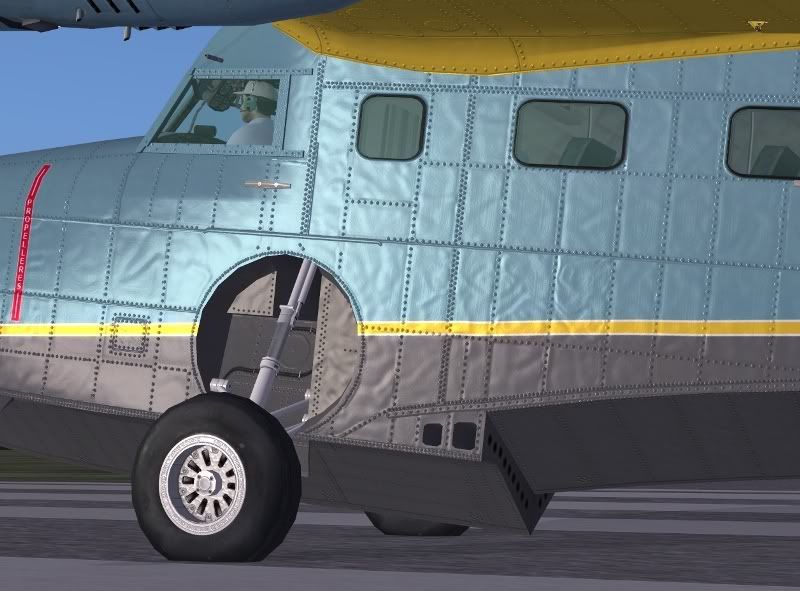
Look at that detail!!

Untitled-7.jpg
 
Based on the checklists, which state to set climb/cruise power based on MP and RPM, I always figured it was a constant speed system.
Nope.. it'svariable pitch, bolted directly to the shaft. So you have variable pitch and speed. What i try to do at this time is simply use tyhe parts of the constant speed settings that i need and set the rest to zero.. It can get weird though..
 
These screenys don't do justice but I like the detail such as weathered paint on leading edges of the wings. Colorful hi-viz paints are ideal for this bird. :medals::ernae::applause: Many thanks.

Take your time on that FDE upgrade.:guinness:
 
Just letting you know guys, the patch will include:

- Sound fix
- The Flight model for the 450hp version, somewhere it took a wrong turn, so Pam corrected it
- Corrected hatch bump map
- Something else hopefully which I cannot disclose yet
 
Just letting you know guys, the patch will include:

- Sound fix
- The Flight model for the 450hp version, somewhere it took a wrong turn, so Pam corrected it
- Corrected hatch bump map
- Something else hopefully which I cannot disclose yet

Useable weight stations, and loadable min/max weights ?
 
Nope.. it'svariable pitch, bolted directly to the shaft. So you have variable pitch and speed. What i try to do at this time is simply use tyhe parts of the constant speed settings that i need and set the rest to zero.. It can get weird though..


Hmmm.. aside from some early, two-blade props.. the Goose was equiped with constant-speed props. There might have been rare exceptions.. but all 3-bladed versions were definately constant-speed props.
 
For the sake of clarity.. there are basically three types of propeller:

1) Fixed-pitch
2) Controllable-pitch
3) Contstant-speed

Controllable-pitch, and Constant-speed, are BOTH "variable" pitch propellers. The difference being that a constant-speed prop adjusts the pitch on its own, in order to maintain the pilot-selected RPM (constant-speed).

The controllable-pitch propleller is quite rare .. almost unseen today, aside from specific applications like some racing airplanes.

Any of these three prop-types can be bolted directly to the shaft, or have geared reduction.
 
Hi Pam,

First of all, I'm just trying to be helpful, but I think what Brett is saying is true. I just spoke to one of my flight instructors of long ago, and he has a friend in Canada who used to fly a Goose. From his email " nope they're constant speed systems on the Goose. The Pratt 985s are touchy little buggers and mountain flying as well as water ops would be a pain in the *** if it was just a controllable pitch prop with no governer. I dont want to even think about that! Sorry I dont know any airplanes up here that use that system."

Second, Jay, great news! I wish I had a bigger screen to see this detail without zooming in so much. Its hard to do a productive flight when you spend 90% of the time looking at the textures in awe. :applause:
 
@piperarcherpilot.
If you hadnt mentioned that governor i may have argued with ya ::lol:;.. I studied diagrams of it while working on the flight model, but became confused as it's still listed as a direct drive system. That classification is what told me it's a variable instead of constant speed. That would also explain engine rpm being stuck at 2700 rpm constantly..
 
For the sake of clarity.. there are basically three types of propeller:

1) Fixed-pitch
2) Controllable-pitch
3) Contstant-speed

Controllable-pitch, and Constant-speed, are BOTH "variable" pitch propellers. The difference being that a constant-speed prop adjusts the pitch on its own, in order to maintain the pilot-selected RPM (constant-speed).

The controllable-pitch propleller is quite rare .. almost unseen today, aside from specific applications like some racing airplanes.

Any of these three prop-types can be bolted directly to the shaft, or have geared reduction.

Brett
thanks for the clarification. It's obvious i've been working under an incorrect assumption. i'm still confused as to why, if the props are constant speed and therefore auto adjusting, theres a set of prop pitch levers on the overhead.. perhaps a throwback to when the plane used variable (controllable) pitch??
 
Useable weight stations, and loadable min/max weights ?
The stations will remain the same. They are in accordance with the original blueprints. If i can get an accurate report on the weights, i'll change them, but i just came from one site displaying a G-21G with radial engines, and stating it used a pt-6A turboprop engine.. So far, every site i've examined has given me different weight values, even airliners.net.
Sadly, i dont have the money needed to purchase the manual set which would give us the definitive numbers so i'll do my best with what i can find.
So far, the most accurate site ( they got the engine nomenclature right ) is http://www.luftfahrtmuseum.com/htmi/itf/goose.htm and i'll adjust for those weights..
 
@piperarcherpilot.
If you hadnt mentioned that governor i may have argued with ya ::lol:;.. I studied diagrams of it while working on the flight model, but became confused as it's still listed as a direct drive system. That classification is what told me it's a variable instead of constant speed. That would also explain engine rpm being stuck at 2700 rpm constantly..
No problem Pam! I've had my fair share of brain farts. And, yes, that would explain the 2700 issue if thats what its coded to try to govern at.

theres a set of prop pitch levers on the overhead.. perhaps a throwback to when the plane used variable (controllable) pitch??
Well, I think you're still thinking of the manual controllable pitch system. The overhead prop levers control prop RPM. The very basics of the constant speed system is that there's an engine driven propeller, usually direct drive from the crankshaft. In a twin engine plane, there are counterweights that try to force the prop blades to feather position. This way if an engine fails, the prop automatically feathers and reduces drag. Through a system of springs and centripetal weights, the the governor uses engine boosted oil pressure to oppose this action. When the pilot selects high RPM (low blade pitch), the blades go to the maximum RPM setting, in this case 2300 RPM, and as the airplane accelerates to cruise speed if nothing is done with the prop levers, the governor will automatically increase the pitch of the blades to maintain 2300 RPM. Basically, all the prop levers do is allow the pilot to select desired RPM and the blades will automatically adjust their pitch to keep the prop and engine at the selected RPM (within the governing range, usually somewhere around 1200-2700 rpm in a small twin). Normally, you use high pitch for takeoff to get the most power out of the props at slow speeds. After takeoff, you'll reduce RPM (biggest reason is noise) to a few hundred less, and then at cruise you normally make a power reduction (manifold pressure) and then bring the props back even further. In the goose, it probably goes something like (just guessing)-

T/O: Full power (max MP), 2300 RPM
Climb: 85% power, 2100 RPM
Cruise: 75%-55% power, 1800 - 1900 RPM

Of course in higher performance engines like these 450 hp radials, you have to be careful not to over-torque the engines by being at a low RPM and high power setting. There are Goose specific engine performance tables on this though and without a manual we dont know what they are specifically. No big deal though.
 
Goose Video

Watch in this video how he ensures the levers are all the way against the ceiling (high RPM) for takeoff (1:29), and after takeoff pulls the power back a little to climb power setting (2:21) and then moves the props back a little (setting climb RPM, slightly lower) and you can hear the engine RPM reduction (2:24).

http://www.youtube.com/watch?v=M8EpAE6W3wk

Always increase Props then Power for power application, and reduce Power then Props for power reduction to avoid damaging the engine.
 
Back
Top