-
Please see the most recent updates in the "Where did the .com name go?" thread. Posts number 16 and 17.
-
IMPORTANT DOWNLOADING INFORMATION - ALL MEMBERS PLEASE READ
Please see this thread for updates. Update Thread
SOH ADMINISTRATION
You are using an out of date browser. It may not display this or other websites correctly.
You should upgrade or use an alternative browser.
You should upgrade or use an alternative browser.
P-51D Mustang ‘Cadillac of the Skies’ for FSX Part 1 Restored - OUT NOW!
- Thread starter WarBert
- Start date

Bomber_12th
SOH-CM-2025
Hi Ron, that is correct. The Mustangs that come equipped by default with a gun sight, do actually have a K-14 in the real restoration, and those that don't have a gun sight, have never had one installed in the restoration. For those actual variants that do have a K-14 installed, it is rather common to see them at one point, without the gun sight, and at other times, with the gun sight - it all depends on the flight conditions or air show. For aerobatic display, especially, it is favored to remove the sight beforehand, for safety in added visibility. It also helps to have it removed for long-distance VFR flight. For authentic display, it is a nice addition to have installed.<?xml:namespace prefix = o ns = "urn:schemas-microsoft-com fficeffice" /><o></o>
<o></o>
The variants that don't have a gun sight installed, like Fragile But Agile and Ferocious Frankie, are some of the most aerobatically flown examples from within the product - thus it makes added sense that in the real aircraft, they never have a gun sight installed.<o></o>
fficeffice" /><o></o><o
></o>The variants that don't have a gun sight installed, like Fragile But Agile and Ferocious Frankie, are some of the most aerobatically flown examples from within the product - thus it makes added sense that in the real aircraft, they never have a gun sight installed.<o
></o>
Bomber_12th
SOH-CM-2025
I figured I'd repost my original thread on Upupa Epops, to this thread, so that it remains easily accessible. Through this variant, and Happy Jack's Go Buggy, even though they are restored types, they are the most complete and authentic representations, throughout, of a WWII P-51D that you can fly within a sim environment. With the exception of modern radios, they could otherwise be straight from the NAA factory, 1944/1945. The finish as seen on Upupa Epops, is extremely accurate to how the P-51D's looked when rolling out of the factory, brand new, with differences to the various metal panels a result of the manufacturing/treatment processes. When looking at the finish as seen on Happy Jack's Go Buggy, the bare metal was left in a overall patina, within the restoration, to match the look of an in-service example, the metal dulled to an almost overall sheen throughout the fuselage.
Warbirdsim P-51D-20NA 44-72364 "Upupa Epops"
The P-51D, 44-72364, cn 122-38823, known as ‘Upupa Epops’, owned and operated by the Flying Heritage Collection, based at Paine Field in Everett, WA, is one of the very few types remaining that actually saw combat service during WWII.
<?xml:namespace prefix = o ns = "urn:schemas-microsoft-comfficeffice" /><o></o>
44-72364 was delivered to the United States Army Air Force, fresh from the <?xml:namespace prefix = st1 ns = "urn:schemas-microsoft-comffice:smarttags" /><st1:City w:st="on"><st1lace w:st="on">Inglewood</st1lace></st1:City> factory, on January 26, 1945. Sent to <st1:country-region w:st="on">England</st1:country-region>, and allocated to the 352nd FS, of the 353rd FG, based in <st1lace w:st="on"><st1:City w:st="on">Raydon</st1:City>, <st1:country-region w:st="on">England</st1:country-region></st1lace>, the aircraft was assigned to Lt. Harrison B. “Bud” Tordoff, and entered combat for the first time on March 1, 1945. Bud had already accumulated one tour of combat duty, flying the P-47, when he returned fresh for a second tour, and was immediately assigned this aircraft. By this time in the war, for matters of potentially negative-propaganda, the Eighth Air Force required official approval before a name was to be painted on an aircraft. Not wanting to continue with the name he had originally given to his P-47 on his first tour, Bud used his background in ornithology, and figured he would give the officials a bit of a hard time, choosing “Upupa Epops”, the scientific name for the hoopoe. Bud liked the name for its silliness, and the bird’s bizarre appearance. While it likely caused some question in the mind of the official whose job it was to overlook the requests, the name was approved without comment. In the final six weeks of the war in Europe, Bud flew the aircraft in support of the daylight bombing raids against <st1:country-region w:st="on">Germany</st1:country-region> throughout occupied Europe and in support of missions for the Allied ground forces during the liberation of mainland <st1lace w:st="on">Europe</st1lace>. During this time, Bud shot down two Luftwaffe aircraft while flying Upupa Epops, including an Me 262, adding to his tally from his first combat tour, totaling.9 victories in all. With the war in Europe over, Bud was sent back to the <st1:country-region w:st="on">U.S.</st1:country-region>, while Upupa Epops stayed put in <st1lace w:st="on">Europe</st1lace>. Amongst many other P-51D’s that remained, the aircraft was sold to <st1:country-region w:st="on"><st1lace w:st="on">Sweden</st1lace></st1:country-region> in 1947, where it served until 1954. At this time it was bought by the <st1:country-region w:st="on"><st1lace w:st="on">Dominican Republic</st1lace></st1:country-region>, where it saw service until the early 1980’s! In 1984 the aircraft was bought and brought back into the <st1:country-region w:st="on"><st1lace w:st="on">U.S.</st1lace></st1:country-region>, and stored until being purchased in 1999, for what would become the Flying Heritage Collection. The aircraft was crated up and sent to West Pac Restorations, where an intensive restoration program was initiated - the airframe would not just be restored, but returned to the exact same standard as it was when it left the North American Aviation factory in late 1944, early 1945. The end result, setting a whole new benchmark in P-51 restorations, was rolled out in 2003, and delivered to the Flying Heritage Collection in its original factory-bare scheme. Upon arrival, it was painted once again in the exact, original colours of Lt. Tordoff’s ‘Upupa Epops’. Shortly there-after, in the summer of 2003, Bud was reunited with ‘his’ airplane, at the Flying Heritage Collection museum - the first time he had seen it since WWII. Upon detailed inspection, the restoration team knew they had done right, when Bud gave them his approval.
<o></o>
As an accurately restored P-51D-20NA variant, there are aspects of the exterior and the interior of the aircraft, which are different than any other variant of the P-51D. Starting with the P-51D-5 production model, North American Aviation would proceed to make hundreds of design changes, some significant, some minor, over the course of each new production block, ending with the P-51D-30. Many changes even occurred during the middle of a production block, added or revised right on the shop floor. This meant that even early-production P-51D-20’s were different than late-production P-51D-20’s. “Upupa Epops” is considered one of the late-production D-20’s. The most significant difference between early and late model D-20’s, was the ‘Zero Rail Launcher’ installation, which went into effect during D-20 production. As the NAA specifications outlined:
<o></o>
“The installation of electrical and structural provisions for the zero rail rocket launchers were made a permanent part of the airplane. This installation permits a total of ten rockets to be carried. An alternate arrangement, made possible by the removal of the mounts for the two inboard rockets and addition of bomb racks, allows either two 500-pound bombs or two long-range fuel tanks to be carried.
For firing the rockets, a firing button is mounted on the control stick. A Type A-1 control box assembly is mounted flush in the pilot's front switch box below the instrument panel. A four-position selector switch, with contacts for "SAFE," "ROCKETS," "BOTH BOMBS," and "BOMBS TRAIN," is provided. The wiring is arranged so that the rockets fire alternately from one side and then the other beginning with those outboard.
The forward center rocket mount on each wing covers the airplane jack point. It will be necessary, therefore to remove these two mounts to jack up the airplane. The jack point at the airplane centerline may be used without removing the mounts.
The center of gravity is kept forward to prevent an adverse movement of the airplane center of gravity with the ten 5-inch T-64 rockets in position. When mounted, the rocket fins clear those of adjacent rockets by about 1.25 inches.”
<o></o>
While these provisions were put in-place during late D-20 production, in late 1944, there is no evidence that any Mustangs were delivered to <st1lace w:st="on">Europe</st1lace> with rocket-launcher stubs installed, during WWII.
<o></o>
Furthermore, on the exterior of the aircraft, there were various differences in lower-cowling access panels, over the length of P-51D production. For 44-72364 this consisted of only one access panel, for connecting a ground-heater duct to the engine. (The P-51D-30, for example, had two additional access panels, one to access the oil drain, and another to access the fuel drain, without needing to remove the entire lower cowl panel).
<o></o>
Another key difference in the P-51D-20, from earlier P-51D models, was that it featured the first factory-installation of the computing K-14A gun sight and corresponding twist-throttle grip for adjusting the gun sight range. Up until D-20 production, P-51D’s were fitted with the reflector N-9 gun sight, fixed back-up ring-&-bead gun sight, and earlier-design ball-grip throttle lever. At this same time, a gun sight control box, for operating the new K-14, was installed on the inner right-side of the instrument panel shroud (later moved to the left side with the P-51D-30).
<o></o>
During the restoration process, “Upupa Epops” went through the same system of primer and paint applications as done originally at the factory, leaving a patchwork of yellows and greens throughout the interior. On the outer skins, where spot-welding occurred, each sheet was treated exactly as it was at the factory, to allow the metal to be at the proper state for spot-welding to occur. For specific lines of spot-welds, an acid etch cleaner was brushed onto the metal, just as it was done originally at the factory. As a result, the exterior skins bare the mark of these processes, creating the factory-blend of both polished and dull skins (in service, the cleanest skins would typically dull over time, leaving a more uniform-look to the fuselage). The wings, when assembled, were filled with putty, sanded smooth, primed, and then painted dull-silver, just as originally done at the factory (the ailerons, flaps, gear doors, and main wing tank panels, were left natural metal). This process was undertaken on every Mustang from the factory, in an effort to increase the effectiveness of the laminar-flow airfoil.
<o></o>
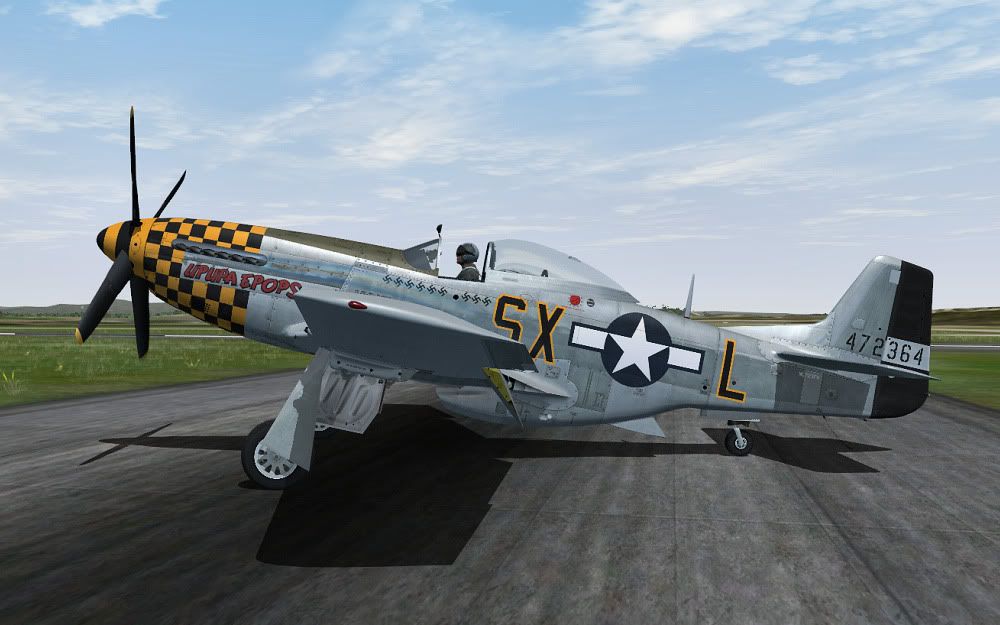
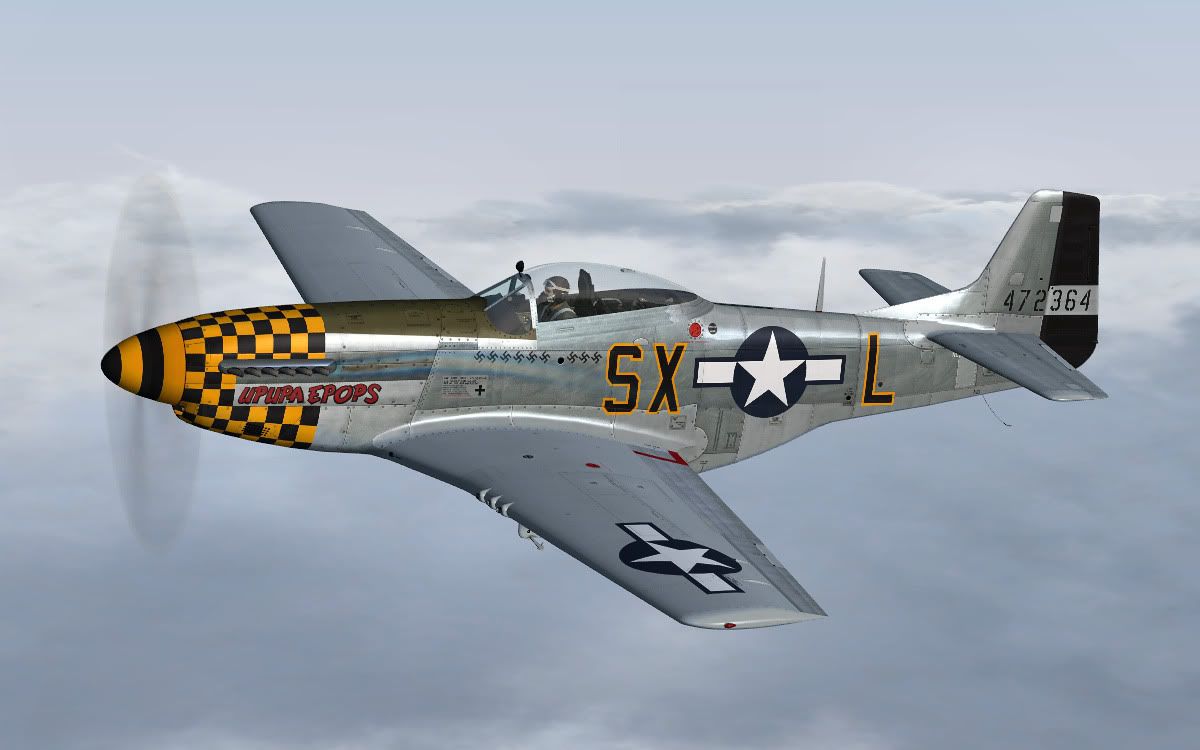
Here is the Warbirdsim recreation of the restored P-51D-20NA “Upupa Epops”. Note the varied finishes, distinct laminar airfoil, and Spitfire mirror installation specifically to this aircraft.
<o></o>
<o>
 </o>
</o>
<o></o>
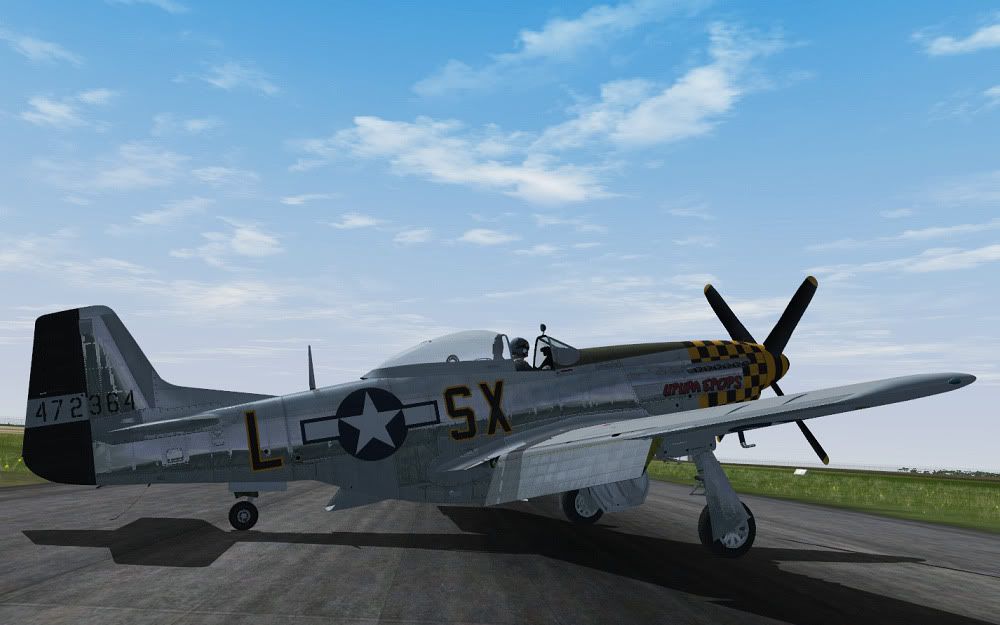
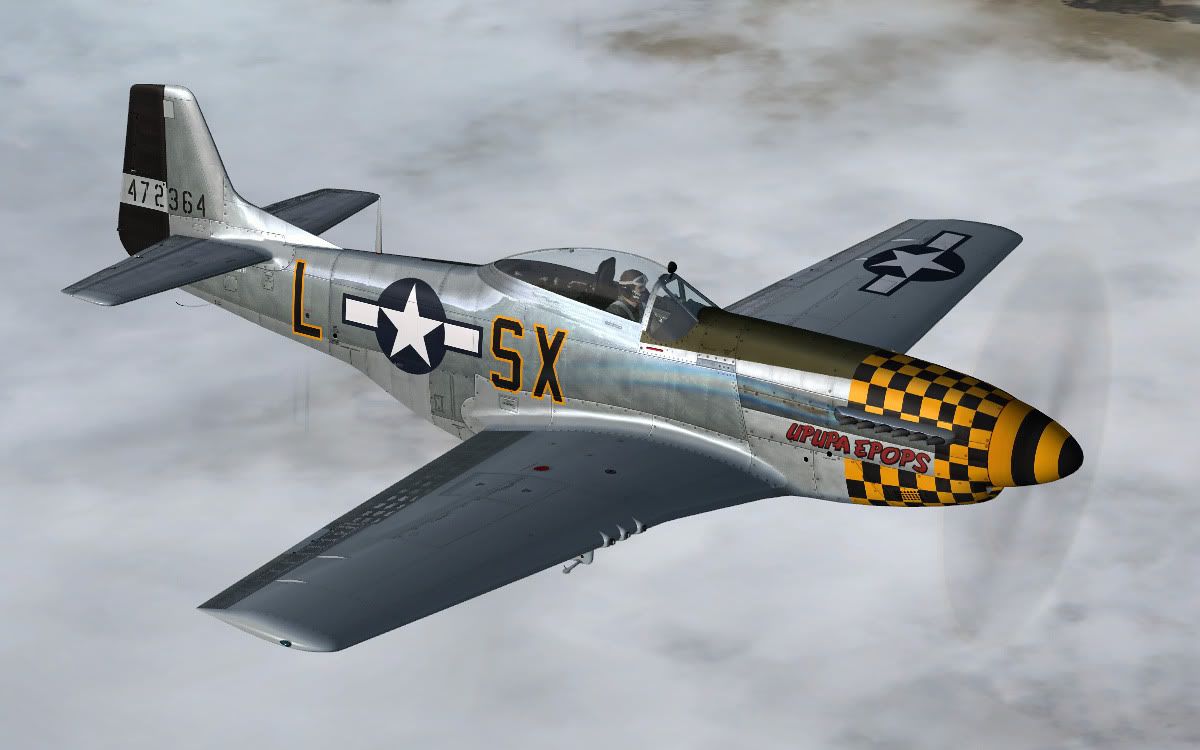
In this almost rear-quarter view, one can see the static-charge ground wire, under the tail, the pilot relief-tube exit, just in front of the base of the rudder, flaps fully deployed, coolant door fully open, and the pitot tube under the right wing.
<o></o>
<o>
 </o>
</o>
<o></o>
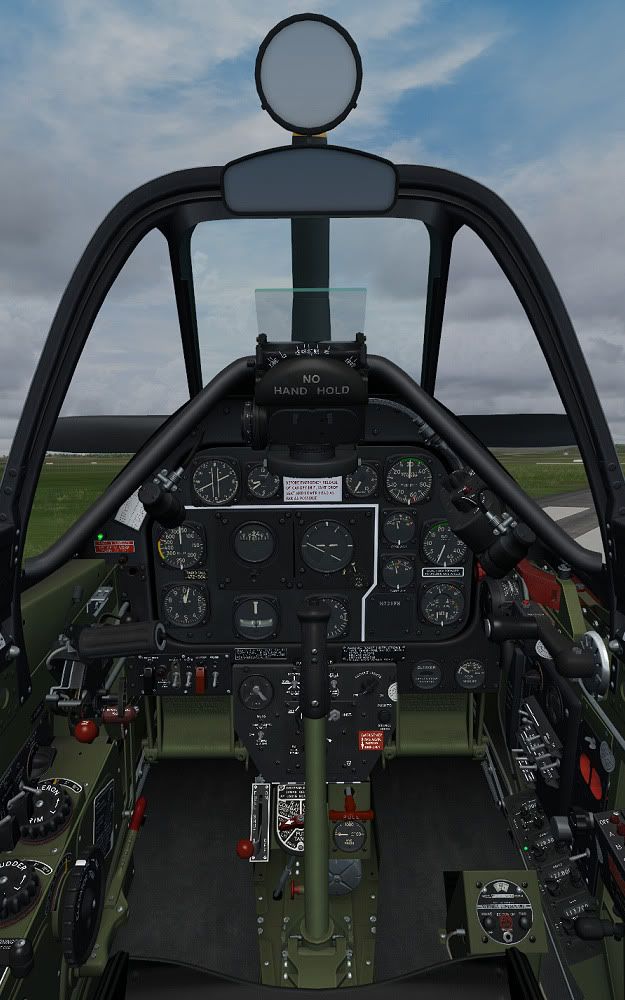
Here is an overall view of the late model D-20 cockpit, specifically as found on “Upupa Epops”. (The Spitfire mirror is distorted in this particular screenshot)
Note the early-mid P-51D gear indicator lights position on the instrument panel.
<o></o>
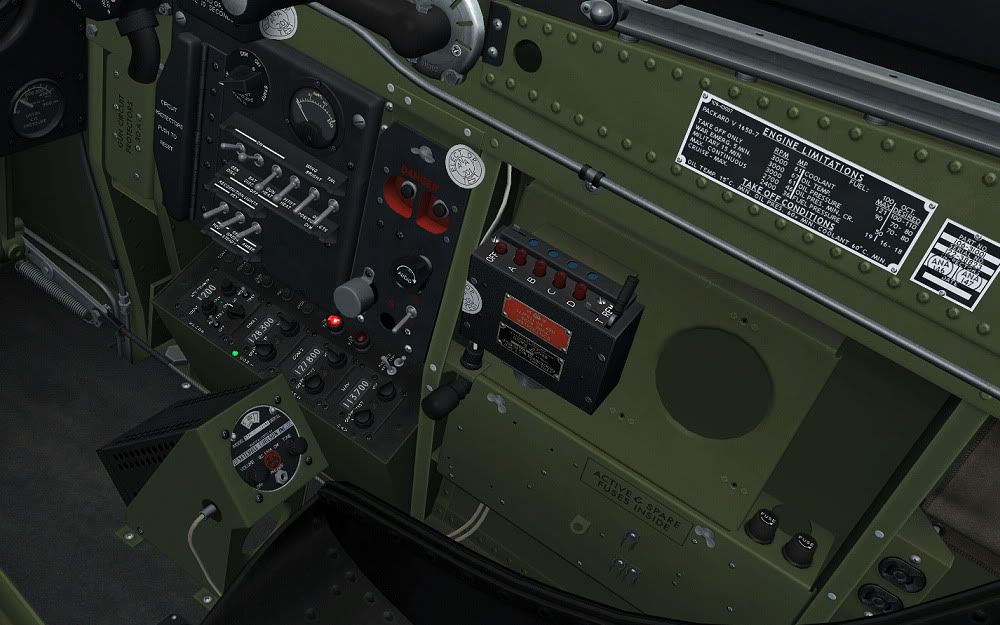
Along the right side of the cockpit a fully reproduced “Setchell Carlson, Inc.” Detrola receiver can be seen mounted to the floor, authentically reproduced Electrical-Operation Inspection stickers complete with NAA inspector stamp-marks, an accurately reproduced radio detonator panel with G-band controls, radio control box, fuse boxes with accurate stencils, the signal-light power receptacle, and authentically finished placards. All font-types throughout the cockpit, are completely authentic to those used on every given part, stencil, stamp, placard, gauge etc.
<o></o>
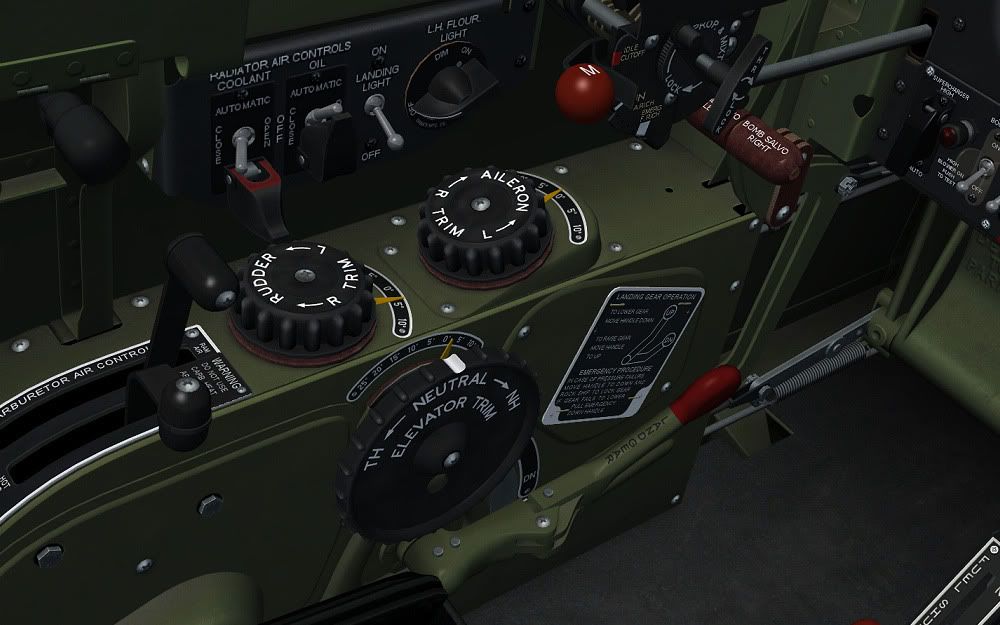
On the left side of the cockpit, one can see the main trim pedestal featuring all of the trim controls, flap and gear levers, carb-air controls, and bomb-salvo levers. Above this is the radiator air controls panel, and engine control unit. The brownish-maroon material, used in the bomb-salvo handles, and each trim-control base, is phenolic-resin, used as an early plastic. The landing gear placard is authentically attached via heavy staples, rather than rivets or screws.
<o></o>
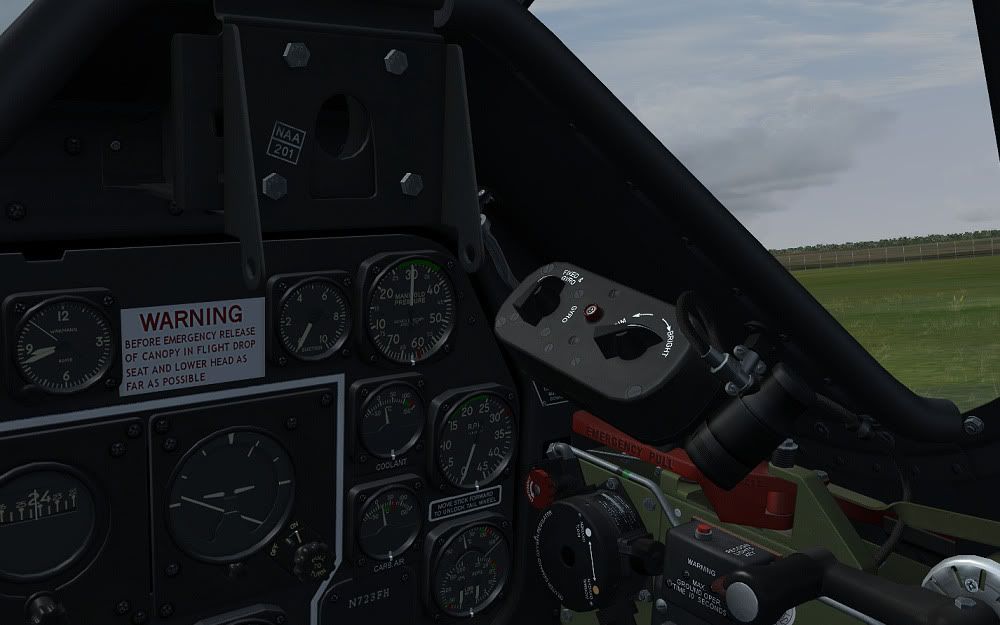
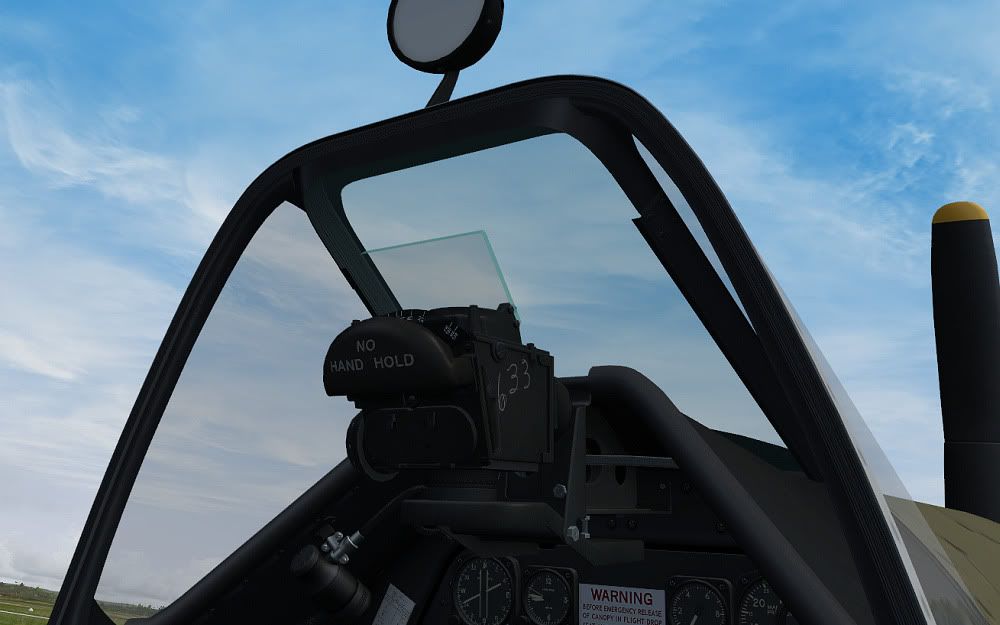
With the gun sight removed, the gun sight mounting bracket can be seen in more detail, complete with an authentic NAA inspection stamp applied (another detail straight from the restored aircraft). Also seen are the original instruments (with proper restrictions taped on), the K-14 gun sight control box, oxygen regulator, and the emergency canopy release handle.
<o></o>
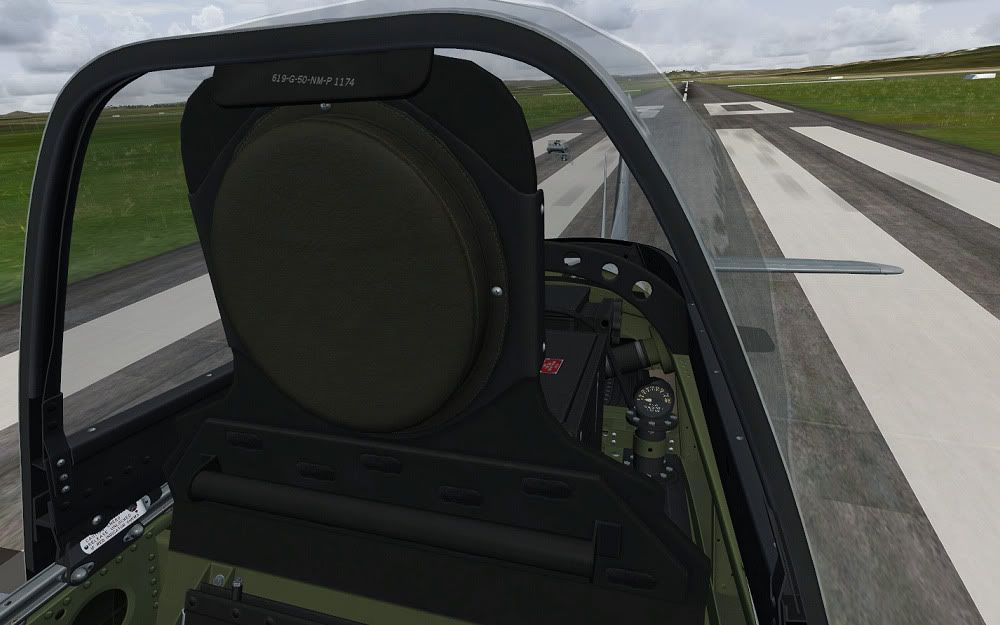
Looking back from the instrument panel, a limited view of the completely authentic rear cockpit can be seen. At the time this aircraft was produced, and as fully recreated within the restoration, the practice was to paint anything above the upper-decking of the cockpit, flat black, to reduce glare. Everything below this was left interior green. As a result, the armor plate was painted interior green, from its base, up to the upper-decking line, when the rest was painted flat black (The radio rack and the armor plate would eventually be finished entirely black, from the factory, on later models). Peaking around the armor plate, one can make out the fuselage fuel tank cell and gauge, the main radio set, battery, and fuel-line connection. The inside-mounted antenna wire-guide, as recreated from the restoration, is of the correct, early-design for the D-20.
<o></o>
With the gun sight installed, the power chord runs directly to the gun sight control box power receptacle. Like all of the details within the cockpit, the hand-scribed graffiti on the right side of the gun sight is copied exactly from that on the restored aircraft.
Some final exterior views...
Warbirdsim P-51D-20NA 44-72364 "Upupa Epops"
The P-51D, 44-72364, cn 122-38823, known as ‘Upupa Epops’, owned and operated by the Flying Heritage Collection, based at Paine Field in Everett, WA, is one of the very few types remaining that actually saw combat service during WWII.
<?xml:namespace prefix = o ns = "urn:schemas-microsoft-com
fficeffice" /><o></o>44-72364 was delivered to the United States Army Air Force, fresh from the <?xml:namespace prefix = st1 ns = "urn:schemas-microsoft-com
ffice:smarttags" /><st1:City w:st="on"><st1lace w:st="on">Inglewood</st1lace></st1:City> factory, on January 26, 1945. Sent to <st1:country-region w:st="on">England</st1:country-region>, and allocated to the 352nd FS, of the 353rd FG, based in <st1lace w:st="on"><st1:City w:st="on">Raydon</st1:City>, <st1:country-region w:st="on">England</st1:country-region></st1lace>, the aircraft was assigned to Lt. Harrison B. “Bud” Tordoff, and entered combat for the first time on March 1, 1945. Bud had already accumulated one tour of combat duty, flying the P-47, when he returned fresh for a second tour, and was immediately assigned this aircraft. By this time in the war, for matters of potentially negative-propaganda, the Eighth Air Force required official approval before a name was to be painted on an aircraft. Not wanting to continue with the name he had originally given to his P-47 on his first tour, Bud used his background in ornithology, and figured he would give the officials a bit of a hard time, choosing “Upupa Epops”, the scientific name for the hoopoe. Bud liked the name for its silliness, and the bird’s bizarre appearance. While it likely caused some question in the mind of the official whose job it was to overlook the requests, the name was approved without comment. In the final six weeks of the war in Europe, Bud flew the aircraft in support of the daylight bombing raids against <st1:country-region w:st="on">Germany</st1:country-region> throughout occupied Europe and in support of missions for the Allied ground forces during the liberation of mainland <st1lace w:st="on">Europe</st1lace>. During this time, Bud shot down two Luftwaffe aircraft while flying Upupa Epops, including an Me 262, adding to his tally from his first combat tour, totaling.9 victories in all. With the war in Europe over, Bud was sent back to the <st1:country-region w:st="on">U.S.</st1:country-region>, while Upupa Epops stayed put in <st1lace w:st="on">Europe</st1lace>. Amongst many other P-51D’s that remained, the aircraft was sold to <st1:country-region w:st="on"><st1lace w:st="on">Sweden</st1lace></st1:country-region> in 1947, where it served until 1954. At this time it was bought by the <st1:country-region w:st="on"><st1lace w:st="on">Dominican Republic</st1lace></st1:country-region>, where it saw service until the early 1980’s! In 1984 the aircraft was bought and brought back into the <st1:country-region w:st="on"><st1lace w:st="on">U.S.</st1lace></st1:country-region>, and stored until being purchased in 1999, for what would become the Flying Heritage Collection. The aircraft was crated up and sent to West Pac Restorations, where an intensive restoration program was initiated - the airframe would not just be restored, but returned to the exact same standard as it was when it left the North American Aviation factory in late 1944, early 1945. The end result, setting a whole new benchmark in P-51 restorations, was rolled out in 2003, and delivered to the Flying Heritage Collection in its original factory-bare scheme. Upon arrival, it was painted once again in the exact, original colours of Lt. Tordoff’s ‘Upupa Epops’. Shortly there-after, in the summer of 2003, Bud was reunited with ‘his’ airplane, at the Flying Heritage Collection museum - the first time he had seen it since WWII. Upon detailed inspection, the restoration team knew they had done right, when Bud gave them his approval.<o
></o>As an accurately restored P-51D-20NA variant, there are aspects of the exterior and the interior of the aircraft, which are different than any other variant of the P-51D. Starting with the P-51D-5 production model, North American Aviation would proceed to make hundreds of design changes, some significant, some minor, over the course of each new production block, ending with the P-51D-30. Many changes even occurred during the middle of a production block, added or revised right on the shop floor. This meant that even early-production P-51D-20’s were different than late-production P-51D-20’s. “Upupa Epops” is considered one of the late-production D-20’s. The most significant difference between early and late model D-20’s, was the ‘Zero Rail Launcher’ installation, which went into effect during D-20 production. As the NAA specifications outlined:
<o
></o>“The installation of electrical and structural provisions for the zero rail rocket launchers were made a permanent part of the airplane. This installation permits a total of ten rockets to be carried. An alternate arrangement, made possible by the removal of the mounts for the two inboard rockets and addition of bomb racks, allows either two 500-pound bombs or two long-range fuel tanks to be carried.
For firing the rockets, a firing button is mounted on the control stick. A Type A-1 control box assembly is mounted flush in the pilot's front switch box below the instrument panel. A four-position selector switch, with contacts for "SAFE," "ROCKETS," "BOTH BOMBS," and "BOMBS TRAIN," is provided. The wiring is arranged so that the rockets fire alternately from one side and then the other beginning with those outboard.
The forward center rocket mount on each wing covers the airplane jack point. It will be necessary, therefore to remove these two mounts to jack up the airplane. The jack point at the airplane centerline may be used without removing the mounts.
The center of gravity is kept forward to prevent an adverse movement of the airplane center of gravity with the ten 5-inch T-64 rockets in position. When mounted, the rocket fins clear those of adjacent rockets by about 1.25 inches.”
<o
></o>While these provisions were put in-place during late D-20 production, in late 1944, there is no evidence that any Mustangs were delivered to <st1
lace w:st="on">Europe</st1lace> with rocket-launcher stubs installed, during WWII.<o
></o>Furthermore, on the exterior of the aircraft, there were various differences in lower-cowling access panels, over the length of P-51D production. For 44-72364 this consisted of only one access panel, for connecting a ground-heater duct to the engine. (The P-51D-30, for example, had two additional access panels, one to access the oil drain, and another to access the fuel drain, without needing to remove the entire lower cowl panel).
<o
></o>Another key difference in the P-51D-20, from earlier P-51D models, was that it featured the first factory-installation of the computing K-14A gun sight and corresponding twist-throttle grip for adjusting the gun sight range. Up until D-20 production, P-51D’s were fitted with the reflector N-9 gun sight, fixed back-up ring-&-bead gun sight, and earlier-design ball-grip throttle lever. At this same time, a gun sight control box, for operating the new K-14, was installed on the inner right-side of the instrument panel shroud (later moved to the left side with the P-51D-30).
<o
></o>During the restoration process, “Upupa Epops” went through the same system of primer and paint applications as done originally at the factory, leaving a patchwork of yellows and greens throughout the interior. On the outer skins, where spot-welding occurred, each sheet was treated exactly as it was at the factory, to allow the metal to be at the proper state for spot-welding to occur. For specific lines of spot-welds, an acid etch cleaner was brushed onto the metal, just as it was done originally at the factory. As a result, the exterior skins bare the mark of these processes, creating the factory-blend of both polished and dull skins (in service, the cleanest skins would typically dull over time, leaving a more uniform-look to the fuselage). The wings, when assembled, were filled with putty, sanded smooth, primed, and then painted dull-silver, just as originally done at the factory (the ailerons, flaps, gear doors, and main wing tank panels, were left natural metal). This process was undertaken on every Mustang from the factory, in an effort to increase the effectiveness of the laminar-flow airfoil.
<o
></o>Here is the Warbirdsim recreation of the restored P-51D-20NA “Upupa Epops”. Note the varied finishes, distinct laminar airfoil, and Spitfire mirror installation specifically to this aircraft.
<o
></o><o
>
><o
></o>In this almost rear-quarter view, one can see the static-charge ground wire, under the tail, the pilot relief-tube exit, just in front of the base of the rudder, flaps fully deployed, coolant door fully open, and the pitot tube under the right wing.
<o
></o><o
>
><o
></o>Here is an overall view of the late model D-20 cockpit, specifically as found on “Upupa Epops”. (The Spitfire mirror is distorted in this particular screenshot)
Note the early-mid P-51D gear indicator lights position on the instrument panel.
<o
></o>Along the right side of the cockpit a fully reproduced “Setchell Carlson, Inc.” Detrola receiver can be seen mounted to the floor, authentically reproduced Electrical-Operation Inspection stickers complete with NAA inspector stamp-marks, an accurately reproduced radio detonator panel with G-band controls, radio control box, fuse boxes with accurate stencils, the signal-light power receptacle, and authentically finished placards. All font-types throughout the cockpit, are completely authentic to those used on every given part, stencil, stamp, placard, gauge etc.
<o
></o>On the left side of the cockpit, one can see the main trim pedestal featuring all of the trim controls, flap and gear levers, carb-air controls, and bomb-salvo levers. Above this is the radiator air controls panel, and engine control unit. The brownish-maroon material, used in the bomb-salvo handles, and each trim-control base, is phenolic-resin, used as an early plastic. The landing gear placard is authentically attached via heavy staples, rather than rivets or screws.
<o
></o>With the gun sight removed, the gun sight mounting bracket can be seen in more detail, complete with an authentic NAA inspection stamp applied (another detail straight from the restored aircraft). Also seen are the original instruments (with proper restrictions taped on), the K-14 gun sight control box, oxygen regulator, and the emergency canopy release handle.
<o
></o>Looking back from the instrument panel, a limited view of the completely authentic rear cockpit can be seen. At the time this aircraft was produced, and as fully recreated within the restoration, the practice was to paint anything above the upper-decking of the cockpit, flat black, to reduce glare. Everything below this was left interior green. As a result, the armor plate was painted interior green, from its base, up to the upper-decking line, when the rest was painted flat black (The radio rack and the armor plate would eventually be finished entirely black, from the factory, on later models). Peaking around the armor plate, one can make out the fuselage fuel tank cell and gauge, the main radio set, battery, and fuel-line connection. The inside-mounted antenna wire-guide, as recreated from the restoration, is of the correct, early-design for the D-20.
<o
></o>With the gun sight installed, the power chord runs directly to the gun sight control box power receptacle. Like all of the details within the cockpit, the hand-scribed graffiti on the right side of the gun sight is copied exactly from that on the restored aircraft.
Some final exterior views...

Bomber_12th
SOH-CM-2025
Jankees, are you going to release those to the public when Your done????
Not a proper time yet...as I have stated earlier in this thread, there will be a proper paintkit released when the time comes, and I'm hoping these repaints will be applied with the actual paintkit, and released then. The unfortunate thing is, that something like Nooky Booky might be one I still would like to cover, in more detail.
Jan Kees, make sure to re-check the serial number fonts - right now they are quite a bit bigger than typical - either from the factory, or field-applied. I've had to make all of the serial numbers by hand, as there isn't a font I have found that properly replicates them. I was lucky enough with Upupa Epops, and a few others, to have exact, straight-on photos, to hand trace the serial numbers, in true-scale. Thus, a good basis to make the serial numbers by, would be from a paint scheme such as Upupa Epops. The other thing I would recommend would not to use true black - adding a little brightness, as I did with the black in all of the various schemes, I think makes it more natural looking, especially when the black is supposed to be flat.
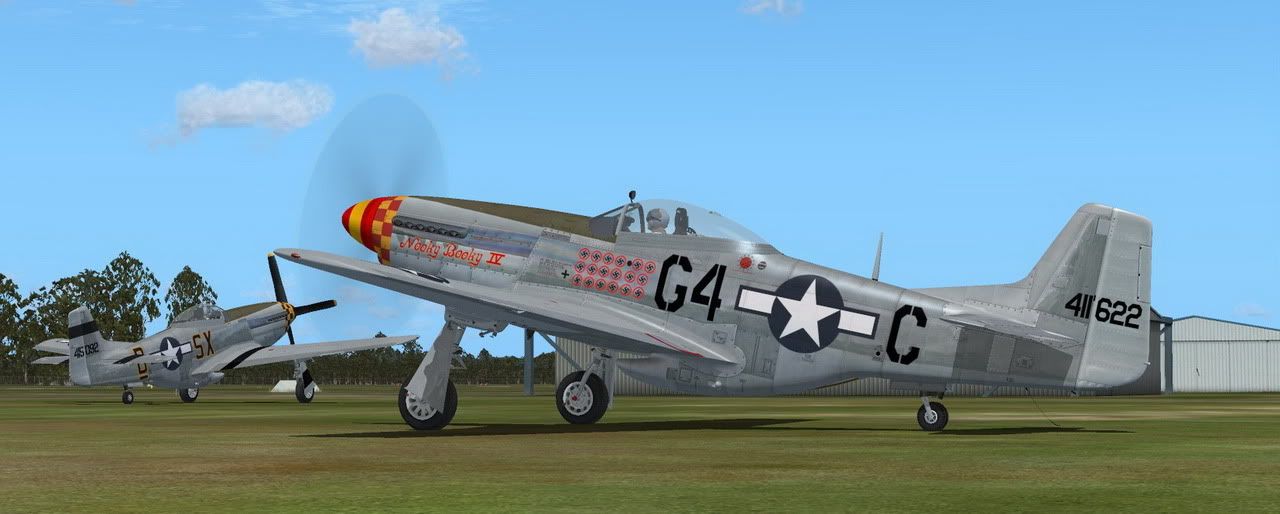
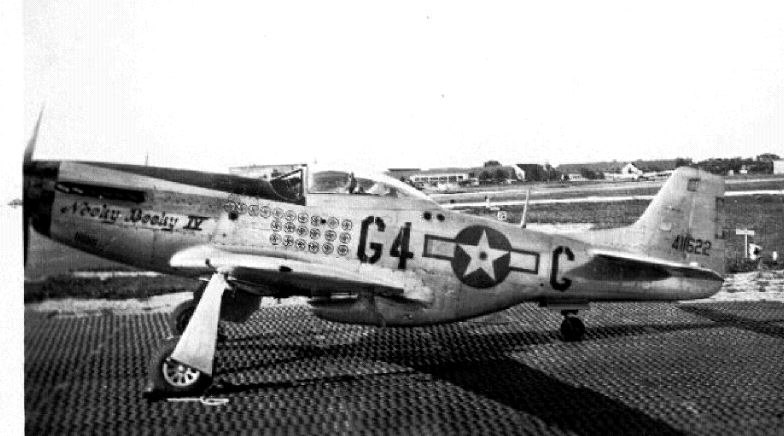
The closeness of the numbers in the serial on the tail, is a pure sign that it is a Dallas-built Mustang - Inglewood-built Mustangs, had the serial numbers spaced further apart - and this can very easily be used to recognize one from the other. Of course everyone knows that Nooky Booky, 44-11622, was a P-51K, which were only ever manufactured at the Dallas plant anyway. As can be seen in this photo, the aircraft was modified, in the field, with the addition of two formation lights on each side of the fuselage, which were actually recognition lights of the same type as used under the right wing tip, usually always orange. This was a field-mod done for formation leader's aircraft, and not practiced by all groups (Off the top of my head, I can only think of examples from the 357th FG and possibly the 4th FG that did this).
 I'm sure my email addy was correct and I don't use a spam filter, so...............
Bomber_12th
SOH-CM-2025
Steve, if that is the case, please send an e-mail to Warbirdsim support, and it shall be taken care of as soon as possible, with a new e-mail sent to you.
As covered earlier in this thread:
As covered earlier in this thread:
Sorry for the issues a couple of you are having with emails not coming back.
<?xml:namespace prefix = o ns = "urn:schemas-microsoft-com
It is due to a combination of high security email settings and your provider blocking out the Warbirdsim return mails. If you ask them to unblock info@warbirdsim.com, sales@warbirdsim.com and support@warbirdsim.com, then it should work. The alternative is to use a different email address for the order.<o
<o
The whole system is automated and so this is why it is not evident straight away at our end that an order has not worked.<o
<o
We are discussing with our main provider to try and find a way to solve this issue.

jankees
SOH-CM-2026
I have no plans to release any paints for this aircraft in the foreseeable future, I just like to splash paint around. I'll quit teasing you guys, OK? I Blame John for making such a great looking bird...can't help myself.
John, you just paint all the birds you like, can't wait to see what you'll come up with. I'll delete Nooky Booky for you. Any chance of telling us which ones you're considering?
I may or may not do a few when the paintkit comes around, we'll see.
About the serials, yes, the font is way off, I have been thinking of making a master set myself on several occasions, but never got round to it (yet).
John, you just paint all the birds you like, can't wait to see what you'll come up with. I'll delete Nooky Booky for you. Any chance of telling us which ones you're considering?
I may or may not do a few when the paintkit comes around, we'll see.
About the serials, yes, the font is way off, I have been thinking of making a master set myself on several occasions, but never got round to it (yet).
Steve, if that is the case, please send an e-mail to Warbirdsim support, and it shall be taken care of as soon as possible, with a new e-mail sent to you.
As covered earlier in this thread:
OK, I'll try my Google account and if that doesn't work I'll shoot you guys an email.
Thanks
Steve
Bomber_12th
SOH-CM-2025
I have no plans to release any paints for this aircraft in the foreseeable future, I just like to splash paint around. I'll quit teasing you guys, OK? I Blame John for making such a great looking bird...can't help myself.
John, you just paint all the birds you like, can't wait to see what you'll come up with. I'll delete Nooky Booky for you. Any chance of telling us which ones you're considering?
I may or may not do a few when the paintkit comes around, we'll see.
About the serials, yes, the font is way off, I have been thinking of making a master set myself on several occasions, but never got round to it (yet).
Jan Kees, no deleting anything, and I'm very glad you're enjoying repainting the aircraft - hopefully a sign on many great things to come!! I'll definitely have to get in communication with you in the coming weeks!<?xml:namespace prefix = o ns = "urn:schemas-microsoft-com
fficeffice" /><o></o><o
></o>I too have thought about finally getting around to making a font that will suit my needs for the serials. It was also a challenge in the cockpit, because for the life of me, I never found a font that worked perfectly for any of the gauge numbers (which there are several variations), or many of the stencils or other select text-work, all of which required hand-drawing the letters, straight from photos. Coming fresh off of typography and other design classes, and what have you, it was an interesting study, looking at the letter-types used throughout all of the different aspects of the aircraft. The most common letter-type I found, true to the original and restorations, is very close to Lithos! But then again not exact.
Now I'm starting to get somewhat angry. I re-register with a different email and buy thru a validated PayPal account and when I'm returned to your site I get this:
Thank you for your order. It will be processed and despatched within 2-7 working days.
If you have any queries, please contact us quoting your order reference number: 1310
Why does it take this long and now what am I supposed to do?
Steve
Thank you for your order. It will be processed and despatched within 2-7 working days.
If you have any queries, please contact us quoting your order reference number: 1310
Why does it take this long and now what am I supposed to do?
Steve

Why does it take this long and now what am I supposed to do?
Steve, look at the posts #77 and #78 from this thread, hopefully it will take as much time as it took for them. I can assure you the models are definitely worth the wait. And I'm not even a 'pony man'.
Cheers,
Huub
Well, just checked my email and the D\L link is there so looks like I got excited for no reason:redf:.
I was a little upset because I have some free time this weekend and that's why I ordered it today and the 2 to 7 day thing didn't sit to well......just having a bad day but it looks like it's about to get MUCH better .
.
Thanks guys,
Steve
I was a little upset because I have some free time this weekend and that's why I ordered it today and the 2 to 7 day thing didn't sit to well......just having a bad day but it looks like it's about to get MUCH better
.Thanks guys,
Steve
Bomber_12th
SOH-CM-2025
Spilot, those are some good ones!<?xml:namespace prefix = o ns = "urn:schemas-microsoft-comfficeffice" /><o></o>
<o></o>
Steve, I'm glad you'll be able to enjoy the aircraft this weekend! As I understand it, the 2 to 7 day statement, is more/less referring to the potential amount of time that may accrue if something in the ordering process goes haywire, and must be fixed. Otherwise, as all orders are automatically processed, order links are sent out very shortly after the order is placed.
fficeffice" /><o></o><o
></o>Steve, I'm glad you'll be able to enjoy the aircraft this weekend! As I understand it, the 2 to 7 day statement, is more/less referring to the potential amount of time that may accrue if something in the ordering process goes haywire, and must be fixed. Otherwise, as all orders are automatically processed, order links are sent out very shortly after the order is placed.
<?xml:namespace prefix = o ns = "urn:schemas-microsoft-com
Steve, I'm glad you'll be able to enjoy the aircraft this weekend! As I understand it, the 2 to 7 day statement, is more/less referring to the potential amount of time that may accrue if something in the ordering process goes haywire, and must be fixed. Otherwise, as all orders are automatically processed, order links are sent out very shortly after the order is placed.
Thanks, looking forward to some quality time with Miss "UPUPA EPOPS" and all the other ladies
 .
.That 2 to 7 day statement needs to be either eliminated or re-written to at least direct you to check your email to see if the D/L link has been sent. Could save some frustration on both ends.
Steve

skyhawka4m
Charter Member
Did you check your SPAM folder? I found mine there for some reason.