-
Please see the most recent updates in the "Where did the .com name go?" thread. Posts number 16 and 17.
-
IMPORTANT DOWNLOADING INFORMATION - ALL MEMBERS PLEASE READ
Please see this thread for updates. Update Thread
SOH ADMINISTRATION
You are using an out of date browser. It may not display this or other websites correctly.
You should upgrade or use an alternative browser.
You should upgrade or use an alternative browser.
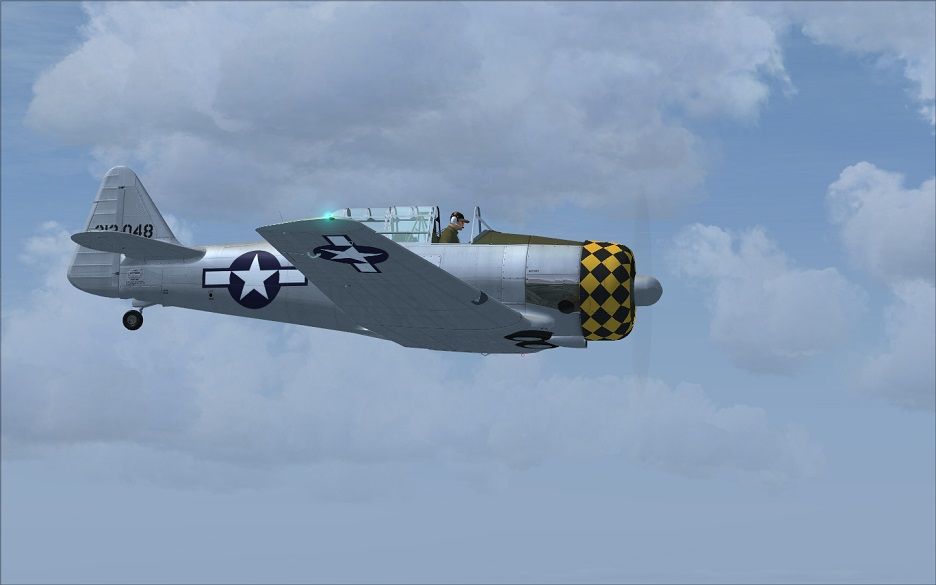
More Wozza T-6 Repaint WIP
- Thread starter Bomber_12th
- Start date


FentiFlier1
Charter Member
John, how kind of you to produce these top-notch repaints for the FS community.
They look absolutely fantastic, and I will use your paintkit if you release it to remake the few I made, plus probably a few more!

Owen.
They look absolutely fantastic, and I will use your paintkit if you release it to remake the few I made, plus probably a few more!
Owen.

Marvin Carter
Charter Member 2015
WOW!!!!

Bomber_12th
SOH-CM-2025
Thanks guys! I do hope you'll enjoy them. It is a great feeling to do something like this that is truely 'freeware' all the way through, and quite the sense of accomplishment after going through this aircraft. In the end, it's no longer the repainting challenge I once thought of it as, but getting to that point certainly was. : )
A little personal info - the SNJ-4 N7083C, bare metal with the red nose, is probably my favorite 'Texan' that exists today, simply as it has been the one I've been around the most ever since I can remember, it being hangared at what has always been my 'local airport'. This is actually the third time I have made a repaint of that aircraft.
A little personal info - the SNJ-4 N7083C, bare metal with the red nose, is probably my favorite 'Texan' that exists today, simply as it has been the one I've been around the most ever since I can remember, it being hangared at what has always been my 'local airport'. This is actually the third time I have made a repaint of that aircraft.


skyhawka4m
Charter Member
Once again....I say.....the textures make the planes for me. I loved this plane before but now with these paints....its tops on my list with my mustangs. Can't wait to see the offerings from others and more from john.
thank you john for taking the time to do these...I know your schedule is busy in development......:salute:
thank you john for taking the time to do these...I know your schedule is busy in development......:salute:

SpaceWeevil
SOH-CM-2026
This was always a good looking model, but you've made it come alive - just amazing, thank you.


John,
Installed the paints fine but for some very odd reason, all your new repaint's cowlings are not displaying their colors but rather a base bare metal color. Any ideas?
Have you installed the updates t6texmod.zip and fsds_t-6update.zip? Wozza updated the texture lay-out after the original release to fix the cowl mapping. From what you describe, I think you are missing the last file.
Cheers,
Huub
Great work John. I really love them!
Wozza's T6 was already a great model. But the textures from guys like Marcel, Tom, Daniel, Marvin and you (and all those I forget) really make this model special! When I look at the download numbers I think most like the polished one. However I prefer to look at your perfect rendering from aluminium dope.
Cheers,
Huub
Wozza's T6 was already a great model. But the textures from guys like Marcel, Tom, Daniel, Marvin and you (and all those I forget) really make this model special! When I look at the download numbers I think most like the polished one. However I prefer to look at your perfect rendering from aluminium dope.
Cheers,
Huub


gaucho_59
Charter Member
Where can you download these two files?
Thanks for the advise... I am having another problem.... the mdl file... it seems the ones with the model... conflict.. or what... (T-6 and T-6_inside)
Your help would be most appreciated.... :isadizzy:
Have you installed the updates t6texmod.zip and fsds_t-6update.zip? Wozza updated the texture lay-out after the original release to fix the cowl mapping. From what you describe, I think you are missing the last file.
Cheers,
Huub
Thanks for the advise... I am having another problem.... the mdl file... it seems the ones with the model... conflict.. or what... (T-6 and T-6_inside)
Your help would be most appreciated....
:isadizzy:
Obie311
Charter Member
Excellent repaints! I have mothballed some previous liveries to fly these.
With the flight mods it's quite a docile flyer. Basic question is this... Is the t-6 now too friendly or does this represent the RW aircraft?
I didn't fly Wozza's FDE much so I can't compare. Flying this T-6 it's hard to believe that prospective pilots were able to transition to the Mustang from the T-6. I'm still trying to get a handle on take-off with the Little Friends II Mustang. I use the rudder trim and a bootful of right rudder but it's quite a handful to say the least. The power delivery from 40" to 55" is amazing.
FWIW I've flown backseat in a T-6 and P-51 but no stick time and I have RW time in the usual Pipers, Cessnas, Citabria and Decathlon.
Obie
With the flight mods it's quite a docile flyer. Basic question is this... Is the t-6 now too friendly or does this represent the RW aircraft?
I didn't fly Wozza's FDE much so I can't compare. Flying this T-6 it's hard to believe that prospective pilots were able to transition to the Mustang from the T-6. I'm still trying to get a handle on take-off with the Little Friends II Mustang. I use the rudder trim and a bootful of right rudder but it's quite a handful to say the least. The power delivery from 40" to 55" is amazing.
FWIW I've flown backseat in a T-6 and P-51 but no stick time and I have RW time in the usual Pipers, Cessnas, Citabria and Decathlon.
Obie
Bomber_12th
SOH-CM-2025
Thank you everyone again for the comments and compliments, I appreciate it!
With the FDE modification (the same one I post to this forum a few weeks ago) the only significant change I made was to the engine and prop data, and I don't recall noticing any difference in torque on take-off after these changes, though there may have been (I'll investigate further). The Texan itself doesn't sound like it has much p-factor or torque effect on take-off - it has a rather small prop (especially compared to the size of the aircraft), and with less than half the take-off power as something like a P-51. It was a big step-up from the Stearman, going from 220 hp and cruising at about 80-90 mph, up to 600 hp and cruising at about 150-170 mph. There are many reports of wartime pilots flying something like the P-40 for the first time, following completion of training in the Texan, and very nearly going off the runway before tackling the aircraft's tendancy to swing (of course after that first take-off, they would get the hang of it straight away).
The Texan is often said and shown to be an easy aircraft to fly. There are only two items that contribute to a 'reputation' for the aircraft:
1. Poor ground handling - with a narrow track landing gear, the aircraft is very prone to ground looping on the landing roll-out, and is the biggest area where a new Texan pilot can get into trouble - upon landing, you need to have feet that move. It can also be a challenge to taxi. (I don't know if something like that can be fully simulated in FSX via the flight dynamics)
2. Can snap on a dime - especially at low speeds, because of the slight sweep in the wings, the aircraft can snap very quickly when cross-controlled.
With the FDE modification (the same one I post to this forum a few weeks ago) the only significant change I made was to the engine and prop data, and I don't recall noticing any difference in torque on take-off after these changes, though there may have been (I'll investigate further). The Texan itself doesn't sound like it has much p-factor or torque effect on take-off - it has a rather small prop (especially compared to the size of the aircraft), and with less than half the take-off power as something like a P-51. It was a big step-up from the Stearman, going from 220 hp and cruising at about 80-90 mph, up to 600 hp and cruising at about 150-170 mph. There are many reports of wartime pilots flying something like the P-40 for the first time, following completion of training in the Texan, and very nearly going off the runway before tackling the aircraft's tendancy to swing (of course after that first take-off, they would get the hang of it straight away).
The Texan is often said and shown to be an easy aircraft to fly. There are only two items that contribute to a 'reputation' for the aircraft:
1. Poor ground handling - with a narrow track landing gear, the aircraft is very prone to ground looping on the landing roll-out, and is the biggest area where a new Texan pilot can get into trouble - upon landing, you need to have feet that move. It can also be a challenge to taxi. (I don't know if something like that can be fully simulated in FSX via the flight dynamics)
2. Can snap on a dime - especially at low speeds, because of the slight sweep in the wings, the aircraft can snap very quickly when cross-controlled.

 eye for detail!