
-
Please see the most recent updates in the "Where did the .com name go?" thread. Posts number 16 and 17.
You are using an out of date browser. It may not display this or other websites correctly.
You should upgrade or use an alternative browser.
You should upgrade or use an alternative browser.
DC-4 Skymaster
- Thread starter lagaffe
- Start date


gray eagle
SOH-CM-2026
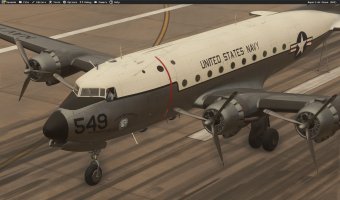
Thanks for the update. I noticed that upon initial startup of the engines, the propellers appear in a feathered state. Unless I unfeather the propsLink for this Beta v0.70 : warning the archive is a 7z and not a zip file !
the blades will spin in a feathered state and I think that is why the plane would not take off. I experimented with the blade controls
and the blades moved to a unfeathered state thus the plane would gain take off speed. Was this the desired result from you?
I wanted to add that when I start the engines, the blade will spin in a feather mode.
I did a CTRL E to start engines and in cockpit view, I see that the prop levers move back to feather as each engine starts and pops spin in feather mode.
Last edited:

lagaffe
SOH-CM-2026
Hello,
The purpose of a Beta version is precisely to discover the small hidden parts that have been forgotten, that we had to repair and that were not.
When the engines were stopped, I thought the propellers were in a feather state to avoid any issues, which explains this condition.
Still in my logic, I thought that the propellers were put in position only when the engines had started and that the oil pressure was sufficient to supply the devices allowing to change the pitch of the propellers. Now if I was wrong, I can try to correct it ...
I think there are people more competent than me: if they could settle this issue, did I actually make a mistake?
Thank you for your feedback, I take this opportunity to share with you some of the progress made over the past two weeks.
Following Thomas’s comment, I tried to modify the VCs and it was not very conclusive. Not that I couldn’t create the instruments, but even though they were modeled (some were Canso instruments), I had a few digital instruments that didn’t want to display the "red segments" of the usual display. I insisted for a few days and despite some partial successes, there were still some lefts who remained silent.
Since I am stubborn, I insisted for several days and at the beginning of this week, I thought I had wasted my time and I was ready to give up ...
Two days ago, I thought about the GPS that I wanted to integrate in 2023 into the Canso PBY, a vintage GPS like the KLN-90B. In 2023, I had a conversation with Falcon71 and KAI31:
who had started working on this GPS and I decided to go back over my old work about this GPS to see if I could find a solution.
While studying these files closely, I finally went on the Discord of falcon71 and found an interesting discussion about radio displays that didn’t want to light up. While trying to apply the bypass, I managed to get my digital radios working and even integrated the latest version of the GPS KLN-90B this afternoon.
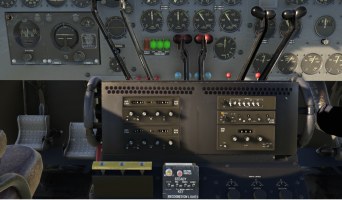
With analogic radios for th DC-4 SAAF (some problems yet on the ADF ... ) :
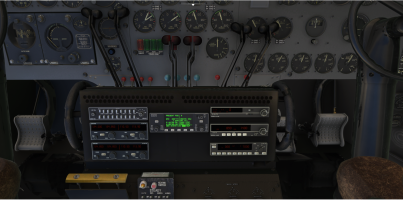
With digital radios and a KLN-90B working for the DC-4 L-1009 (I had yet to find a potentiometer to increase the red segments) :
The GPS addon KLN-90B is quite unusual because Falcon71 dissociates the code from the 3D, let me explain.
- The 3D model is integrated into the DC-4, as well as part of the logic managing the buttons.
- For FS20, you need to download and install the the KLN-90B 1.6x version in the Community
- for FS24, you need to download and install the KLN-90B 2.x version in the Community
This way, KLN-90B updates can be downloaded and installed in your simulator version without requiring a modification of the DC4.
I will give you more explanation in the next update v0.75 of the DC-4/C-54 (next week perhaps).
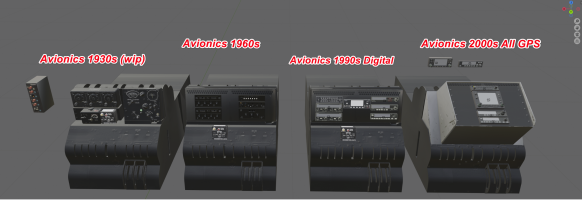
Currently, all the VC that can be included in this addon:
- 1930s will be the next work but I will pause some times before this,
- 1960s is working (ADF ...) on the the DC-4 SAAF variation
- 1990s is for the DC-4 L-1009
- 2000s is for the C-54 variations.
I still have a few minor issues but I think I can solve them in the coming days.
To answer in advance the questions some might have about letting the user choose their VC components : it’s technically possible but it’s really too much work and I won’t do it this year... maybe next year ... perhaps
For the 1930 avionic, as these are the type of radios that are in the Douglas A-26, I would take advantage of this next project to study what it is possible to do and if it works I would make an update on the DC-4/C-54.
The purpose of a Beta version is precisely to discover the small hidden parts that have been forgotten, that we had to repair and that were not.
When the engines were stopped, I thought the propellers were in a feather state to avoid any issues, which explains this condition.
Still in my logic, I thought that the propellers were put in position only when the engines had started and that the oil pressure was sufficient to supply the devices allowing to change the pitch of the propellers. Now if I was wrong, I can try to correct it ...
I think there are people more competent than me: if they could settle this issue, did I actually make a mistake?
Thank you for your feedback, I take this opportunity to share with you some of the progress made over the past two weeks.
Following Thomas’s comment, I tried to modify the VCs and it was not very conclusive. Not that I couldn’t create the instruments, but even though they were modeled (some were Canso instruments), I had a few digital instruments that didn’t want to display the "red segments" of the usual display. I insisted for a few days and despite some partial successes, there were still some lefts who remained silent.
Since I am stubborn, I insisted for several days and at the beginning of this week, I thought I had wasted my time and I was ready to give up ...
Two days ago, I thought about the GPS that I wanted to integrate in 2023 into the Canso PBY, a vintage GPS like the KLN-90B. In 2023, I had a conversation with Falcon71 and KAI31:
who had started working on this GPS and I decided to go back over my old work about this GPS to see if I could find a solution.
While studying these files closely, I finally went on the Discord of falcon71 and found an interesting discussion about radio displays that didn’t want to light up. While trying to apply the bypass, I managed to get my digital radios working and even integrated the latest version of the GPS KLN-90B this afternoon.
With analogic radios for th DC-4 SAAF (some problems yet on the ADF ... ) :
With digital radios and a KLN-90B working for the DC-4 L-1009 (I had yet to find a potentiometer to increase the red segments) :
The GPS addon KLN-90B is quite unusual because Falcon71 dissociates the code from the 3D, let me explain.
- The 3D model is integrated into the DC-4, as well as part of the logic managing the buttons.
- For FS20, you need to download and install the the KLN-90B 1.6x version in the Community
- for FS24, you need to download and install the KLN-90B 2.x version in the Community
This way, KLN-90B updates can be downloaded and installed in your simulator version without requiring a modification of the DC4.
I will give you more explanation in the next update v0.75 of the DC-4/C-54 (next week perhaps).
Currently, all the VC that can be included in this addon:
- 1930s will be the next work but I will pause some times before this,
- 1960s is working (ADF ...) on the the DC-4 SAAF variation
- 1990s is for the DC-4 L-1009
- 2000s is for the C-54 variations.
I still have a few minor issues but I think I can solve them in the coming days.
To answer in advance the questions some might have about letting the user choose their VC components : it’s technically possible but it’s really too much work and I won’t do it this year... maybe next year ... perhaps
For the 1930 avionic, as these are the type of radios that are in the Douglas A-26, I would take advantage of this next project to study what it is possible to do and if it works I would make an update on the DC-4/C-54.
Last edited:
gray eagle
SOH-CM-2026
So I understand that my discovery is valid and that you might be able to correct the reverse prop startup?Hello,
The purpose of a Beta version is precisely to discover the small hidden parts that have been forgotten, that we had to repair and that were not.
When the engines were stopped, I thought the propellers were in a feather state to avoid any issues, which explains this condition.
Still in my logic, I thought that the propellers were put in position only when the engines had started and that the oil pressure was sufficient to supply the devices allowing to change the pitch of the propellers. Now if I was wrong, I can try to correct it ...
I think there are people more competent than me: if they could settle this issue, did I actually make a mistake?
Thank you for your feedback, I take this opportunity to share with you some of the progress made over the past two weeks.
Again, when I unfeather the props and start turning them, when they are fully started, the blades will reverse and in cockpit view, I observe
the prop blade levers move back to reverse mode.
Last edited:
lagaffe
SOH-CM-2026
@gray eagle
Nobody has answered to my questions:
- "When the engines were stopped, I thought the propellers were in a feather state to avoid any issues ... ?" yes/no ?
- "When the engines had started and that the oil pressure was sufficient to supply the devices allowing to change the pitch of the propellers ?" yes/no
For your last observation: yes, I have see that and I am finding the reason.
gray eagle
SOH-CM-2026
Okay, I understand now. Thanks.@gray eagle
Nobody has answered to my questions:
- "When the engines were stopped, I thought the propellers were in a feather state to avoid any issues ... ?" yes/no ?
- "When the engines had started and that the oil pressure was sufficient to supply the devices allowing to change the pitch of the propellers ?" yes/no
For your last observation: yes, I have see that and I am finding the reason.
lagaffe
SOH-CM-2026
Jankees, Ferondoe and other developers hves provided Buffalo Airways liveries for the DC-4/C-54 addon released in September 2025.
This(my) addon is a new version with a fuselage modificated so the old liveries are not completely compliant: the fuselage UVs have been modified to bring more details on the upper and lower part of it.
I mentioned in the post #345 of this topic the modifications that I had brought on the fuselage texture (you can download this image and save it in 8K before working on it) and in the next version (v0.75) I will add ONLY the PSD file related to this new fuselage: it will be find in the folder "Documentations\Paintkit Enhanced".
All the others textures (engines, wings, etc) are not changed so you can use the others parts of the Flight Replicas paintkit: https://www.flight-replicas.com/downloads.html or use the ones of the old liveries provided en September-October 2025.
gray eagle
SOH-CM-2026
lagaffe
SOH-CM-2026
Thank you for your article on the Hamilton system, I think I must have read similar things while reading the various manuals when I was creating the PBY-5. Although I read technical English quite well (I am French), I admit having a bit of trouble with these large documents, but by taking a little time we manage to understand them.
To be able to understand this Hamilton system, I have used a lot various IA and that I have learned is (but I could be wrong) :
As a "wink", here is a fairly complete article on the Hamilton Hydromaticc system, but in French, the advantage is that it is interactive with close-up images. : Lockheed Constellation - Hélice Hamilton
if someone has flown DC-3/DC-4 (Hollister may be) and if they have any memory of this technical point, they can contribute their expertise .
To be able to understand this Hamilton system, I have used a lot various IA and that I have learned is (but I could be wrong) :
Question to Qwant:
What were the recommendations for aircraft with propellers managed by a hydromatic Hamilton solution regarding the value of the pitch to be adopted after landing on the parking?
As the AI takes a lot of precautions and asks each time to refer to the Checklist of aircraft in question, I tried to read what I could find on the DC-4 but I didn’t find much information so I kept the answer from this AI, which seemed like common sense to me: I found many images of Canso PBY that were completely returned after storms, so this precaution seems interesting to take into account.Answer from Qwant:
For the Hamilton Standard Hydromatic propellers, the general recommendation after landing was to place the blades at a high pitch - HIGH RPM / high pitch - that is, at a high angle, close to feathering, and not at a low pitch. This reduced the risk that the wind would turn the propeller when the aircraft was stationary.
However, the exact position depends on the model of aircraft and its flight manual: the procedure specific to the aircraft must be followed. The results viewed here do not provide a source confirming this recommendation for a specific model.
As a "wink", here is a fairly complete article on the Hamilton Hydromaticc system, but in French, the advantage is that it is interactive with close-up images. : Lockheed Constellation - Hélice Hamilton
if someone has flown DC-3/DC-4 (Hollister may be) and if they have any memory of this technical point, they can contribute their expertise .
Last edited:
gray eagle
SOH-CM-2026
I clicked on your link and it offered to translate from French to English which was helpful and it looks like pretty much same info onThank you for your article on the Hamilton system, I think I must have read similar things while reading the various manuals when I was creating the PBY-5. Although I read technical English quite well (I am French), I admit having a bit of trouble with these large documents, but by taking a little time we manage to understand them.
To be able to understand this Hamilton system, I have used a lot various IA and that I have learned is (but I could be wrong) :
As the AI takes a lot of precautions and asks each time to refer to the Checklist of aircraft in question, I tried to read what I could find on the DC-4 but I didn’t find much information so I kept the answer from this AI, which seemed like common sense to me: I found many images of Canso PBY that were completely returned after storms, so this precaution seems interesting to take into account.
As a "wink", here is a fairly complete article on the Hamilton Hydromaticc system, but in French, the advantage is that it is interactive with close-up images. : Lockheed Constellation - Hélice Hamilton
if someone has flown DC-3/DC-4 (Hollister may be) and if they have any memory of this technical point, they can contribute their expertise .
the principles of the variable pitch propeller and operation. In my situation, when one of your DC-4 or C54's are ready to fly in FS2024,
all the engines are running (no cold start) and when I am ready to fly, I apply full throttle and the plane will not move (the parking brake is released)
and I have to push each engines prop controls full forward, then and only then will the plane move forward and gain takeoff speed.
Ah ok thank you. Forgive my ignorance, is this how I need to convert it or is it not possible? I’m not clued up on all this stuff!Jankees, Ferondoe and other developers hves provided Buffalo Airways liveries for the DC-4/C-54 addon released in September 2025.
This(my) addon is a new version with a fuselage modificated so the old liveries are not completely compliant: the fuselage UVs have been modified to bring more details on the upper and lower part of it.
I mentioned in the post #345 of this topic the modifications that I had brought on the fuselage texture (you can download this image and save it in 8K before working on it) and in the next version (v0.75) I will add ONLY the PSD file related to this new fuselage: it will be find in the folder "Documentations\Paintkit Enhanced".
All the others textures (engines, wings, etc) are not changed so you can use the others parts of the Flight Replicas paintkit: https://www.flight-replicas.com/downloads.html or use the ones of the old liveries provided en September-October 2025.