
Lavochkin La-7
Unit: 176 GIAP February 1945 Germany
Pilot: Major Aleksandr S. Kumanichkin 35 total victories
Development of what became the La-7 began in mid-1943 as the La-5FN "Standard" project, an initiative to identify and incorporate every possible aerodynamic improvement into the existing airframe. Poorly optimized cowl flaps, air intake geometry, and surface gaps. These seemingly minor imperfections were collectively costing the aircraft nearly 25 mph in top speed.
The key change was moving the oil cooler and supercharger air intakes from the cowling top to the wing roots, dramatically cleaning up the engine cowling's aerodynamic profile. The cowl flap mechanism was redesigned for smoother operation, wing-to-fuselage fairings were improved, and every access panel and gap was sealed or faired over. The wing structure itself was refined, with the main spar redesigned for both lighter weight and greater strength using metal rather than wood.
The first La-7 prototype flew in November 1943 and demonstrated the results immediately: maximum speed reached 411 mph at 20,500 feet, a substantial improvement over the La-5FN's 402 mph. Rate of climb improved by nearly 100 feet per minute. Handling qualities were refined, with lighter control forces and more precise response throughout the flight envelope. State acceptance trials confirmed the La-7 as the best Soviet fighter yet tested.
Production began in March 1944 at Factory No. 21 in Gorky (modern Nizhny Novgorod), with combat units receiving their first La-7s in June.
The La-7 entered combat in June 1944 during the opening phase of Operation Bagration, the massive Soviet offensive that destroyed Army Group Center. Equipped with the new fighter, elite Guards regiments immediately established air superiority over the battlefield, allowing Il-2 Shturmoviks and Pe-2 dive-bombers to operate with increasing freedom. Luftwaffe pilots who had been accustomed to qualitative superiority over Soviet fighters found the La-7 an unsettling opponent, faster, with better climb, and flown by increasingly experienced Soviet pilots. The kill-to-loss ratios achieved by Soviet Guards regiments in the war's final months were the best of the entire Eastern Front war, a stark reversal from the catastrophic ratios of 1941.
The La-7 also saw limited postwar combat service. North Korean Air Force La-7s were used in the opening stages of the Korean War in June-July 1950, though they were quickly swept aside by USAF F-80 Shooting Star jets and even by propeller-driven F-51 Mustangs whose pilots had greater experience and training.
Credits
Captain Kurt: Aircraft model, VC, 2D panel. paint textures, and .dp
aircraft flight files: Thicko
Kelticheart: Prop blurred texture
Gauges: Most are by Morton for the Br Yak-9U others by authors unknown
Bombs, rockets, and racks are from Ivan Hsu's I-16 series
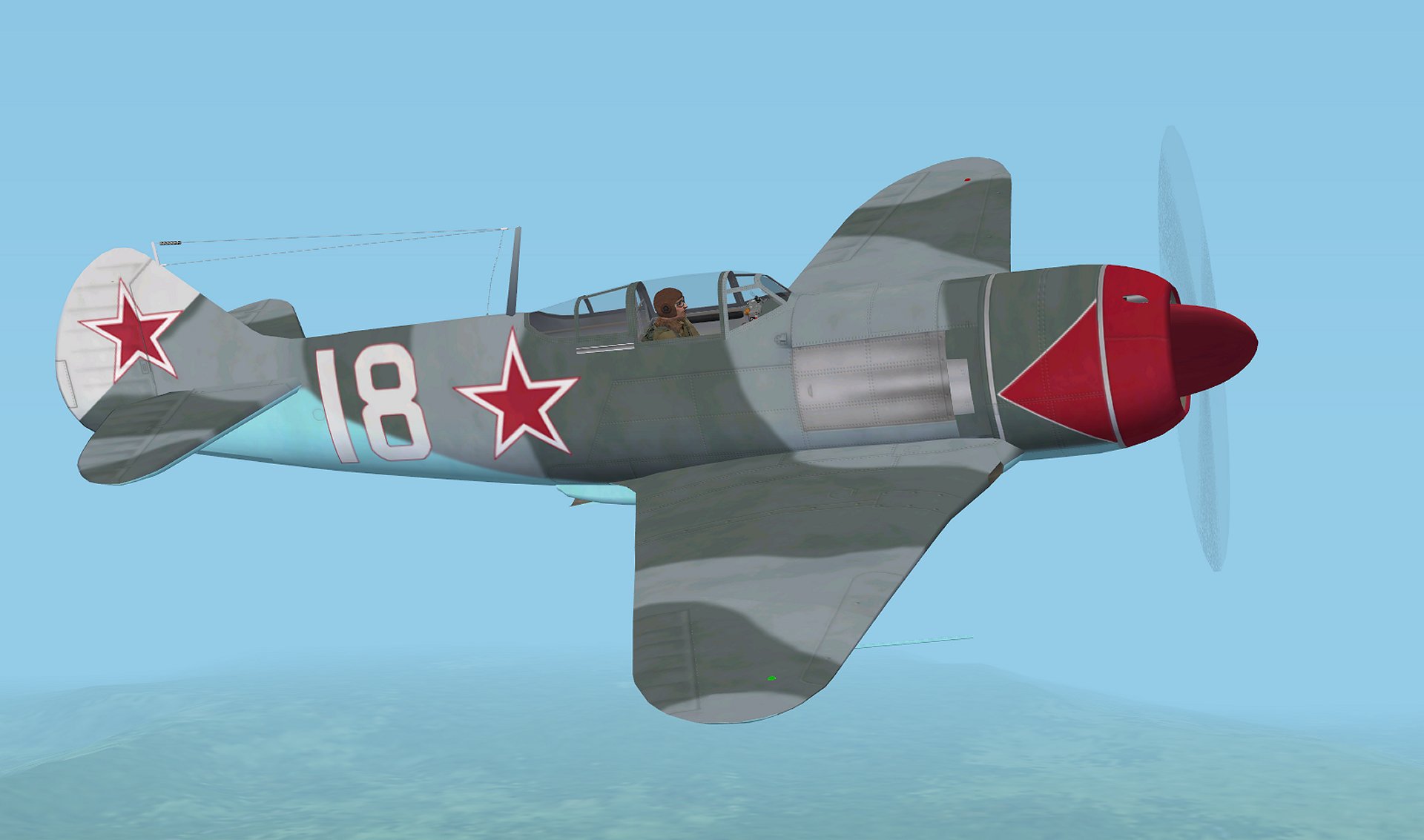
Unit: 176 GIAP February 1945 Germany
Pilot: Major Aleksandr S. Kumanichkin 35 total victories
Development of what became the La-7 began in mid-1943 as the La-5FN "Standard" project, an initiative to identify and incorporate every possible aerodynamic improvement into the existing airframe. Poorly optimized cowl flaps, air intake geometry, and surface gaps. These seemingly minor imperfections were collectively costing the aircraft nearly 25 mph in top speed.
The key change was moving the oil cooler and supercharger air intakes from the cowling top to the wing roots, dramatically cleaning up the engine cowling's aerodynamic profile. The cowl flap mechanism was redesigned for smoother operation, wing-to-fuselage fairings were improved, and every access panel and gap was sealed or faired over. The wing structure itself was refined, with the main spar redesigned for both lighter weight and greater strength using metal rather than wood.
The first La-7 prototype flew in November 1943 and demonstrated the results immediately: maximum speed reached 411 mph at 20,500 feet, a substantial improvement over the La-5FN's 402 mph. Rate of climb improved by nearly 100 feet per minute. Handling qualities were refined, with lighter control forces and more precise response throughout the flight envelope. State acceptance trials confirmed the La-7 as the best Soviet fighter yet tested.
Production began in March 1944 at Factory No. 21 in Gorky (modern Nizhny Novgorod), with combat units receiving their first La-7s in June.
The La-7 entered combat in June 1944 during the opening phase of Operation Bagration, the massive Soviet offensive that destroyed Army Group Center. Equipped with the new fighter, elite Guards regiments immediately established air superiority over the battlefield, allowing Il-2 Shturmoviks and Pe-2 dive-bombers to operate with increasing freedom. Luftwaffe pilots who had been accustomed to qualitative superiority over Soviet fighters found the La-7 an unsettling opponent, faster, with better climb, and flown by increasingly experienced Soviet pilots. The kill-to-loss ratios achieved by Soviet Guards regiments in the war's final months were the best of the entire Eastern Front war, a stark reversal from the catastrophic ratios of 1941.
The La-7 also saw limited postwar combat service. North Korean Air Force La-7s were used in the opening stages of the Korean War in June-July 1950, though they were quickly swept aside by USAF F-80 Shooting Star jets and even by propeller-driven F-51 Mustangs whose pilots had greater experience and training.
Credits
Captain Kurt: Aircraft model, VC, 2D panel. paint textures, and .dp
aircraft flight files: Thicko
Kelticheart: Prop blurred texture
Gauges: Most are by Morton for the Br Yak-9U others by authors unknown
Bombs, rockets, and racks are from Ivan Hsu's I-16 series


