Hello,
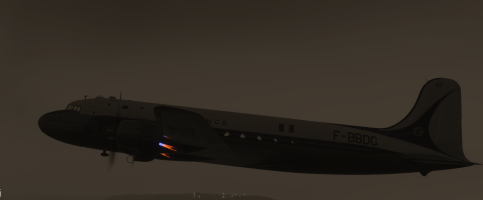
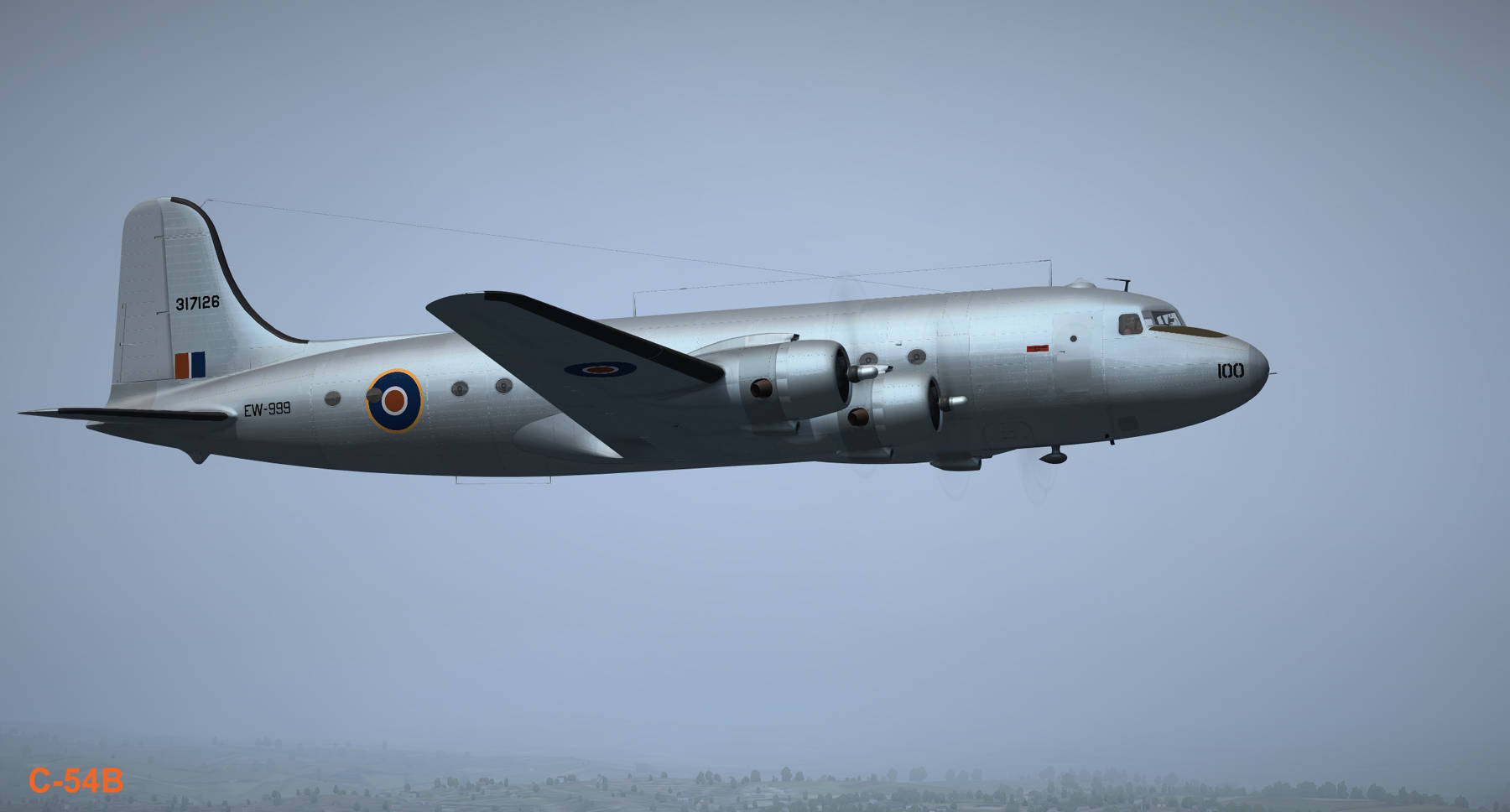
For the Connie, here is the most accurate image I found but the Connie’s engines (4 x Wright R-3350 Duplex Cyclone - 18 cyl - 2200 cv) are much more powerful than those of the DC-4 (4 x Pratt & Whitney R2000 Twin Wasp - 14 cyl - 1450 cv) so this must be taken into account to define the exact scale of these effects!
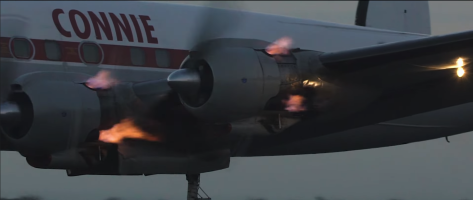
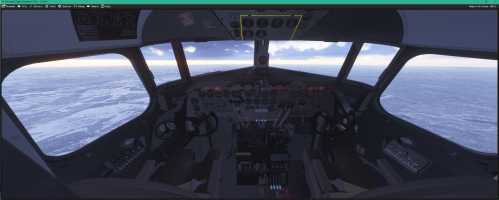
Well, with a 1.8 factor on each empty which manage flames effects (screen under MSFS 2024 - Gibraltar at night)
========================================================================
Following a remark made on the official FS forum, I would like to return to the subject:
improved mode ... that one user used.
When one wants to carry an existing aircraft on FS9 or FSX/P3D with the agreement of its initial creator, a method consists in using MCX (Model Converter X by Arnon Gerretssen) to load the MDL file and export it in glTF/bin which also generates an XML file which is a translation of the modeldef.xml used to create the initial aircraft.
This process works rather well but has a number of disadvantages if we stop the work at this stage:
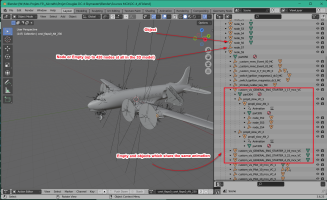
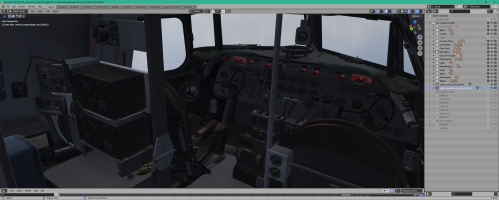
- all the objects are transcribed in a tree structure based on nodes/empty related to each other and which contains the elements/objects of the aircraft and the animations, the names of these nodes, objects and animations are generated automatically and it is very very difficult to recognize an object or an animation just by reading the name assigned to it
- the generated XML file includes these complicated names and is essentially based on <Partinfo> and some very simplified ModelBehavior
- all the animated objects are broken down and if an object contains several elements, each element is assigned the same animation; for example a throttle that consists of a lever, a knob and bolds will be broken down into three elements: the lever then the knob and the bolds and each of them will be assigned the same animation which amounts to duplicating at least this one.
If we take the entire plane, we arrive at a result that works but is not optimal:
- it is very difficult to navigate in this tree structure
- there is a multitude of node/empty that are useless (420 nodes or empties in the initial blender file), some of them have a function of pivot or attachment for an object but most are generated only for the needs of the tree structure and because of the generation process which is recursive,
- this multiplication at the level of animations can be a brake on the rendering engine because it will be required for each animation to perform additional work, which degrades the performance of the aircraft,
- the 3D objects are triangulated and vertex merging is not optimal which produces too complex objects compared to what is strictly necessary from a 3D point of view; indeed the rule commonly applied in 3D is to use as many quadrilateral polygons (4 sides) as possible and to avoid n-gones or triangles if possible.
If I refer to the numerous posts I have read for 20 years, the graphics engines of FS9 and FSX/P3D imposed limits on the number of nodes/empty that the creator used in an airplane because it overloaded the processes.
That’s why in my addons,
I try to limit these empty as much as possible except when it is absolutely necessary.
Having 2 or more animations attributed to a complex object is counterproductive you will easily understand, in this case it is preferable to keep the animation on the main element (
in my example the throttle lever) and to link to this main element the subaltern elements (
knobs and bolts for example). In the end, the graphics engine runs faster and the workload is reduced, which allows for more FPS or adding more animations and details: the render engine compute ONE animations and the others components are attach to the animated one.
Breaking down the different complex objects seems to be a waste of time but it allows for isolating the basic elements from reworking them to eliminate excess vertices and make the object’s topology look like quadrilateral polygons when possible.
The gain in terms of saved vertex sometimes reaches more than 30% and so I prefer to use these 30% to add details or animations rather than unnecessarily overloading the graphics engine.
Some will tell me that the graphics engines of MSFS have evolved (multi-threading, parallelism) and that they allow more polygons and vertices, nevertheless a simple object is rendered faster and more efficiently regardless of the graphics engine that will use it.
On a plane like the DC-4, the cleaning task:
- breaking unnecessary composed objects,
- removing unnecessary empty,
- renaming objects and animations,
- re-associating basic objects into a coherent whole,
- etc ...
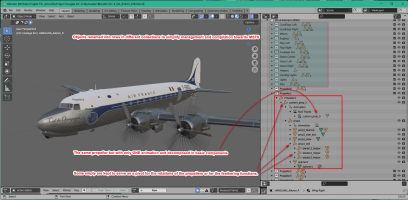
takes me between 15 days to count 5 hours of daily work but in the end, I obtain a source file that is very close to the one that the initial author may have created with another software (FSDS for the DC-4 of Mike), which is readable and optimized.
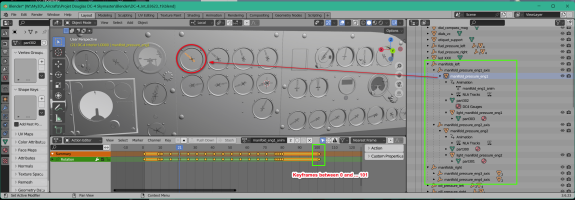
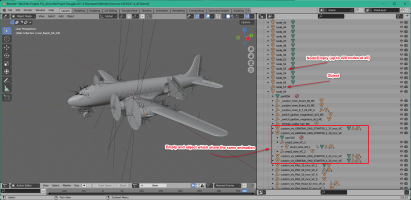
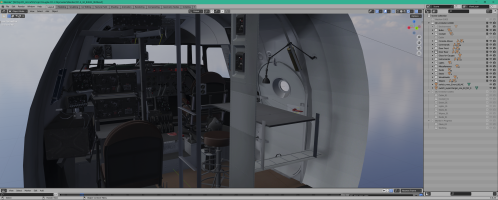
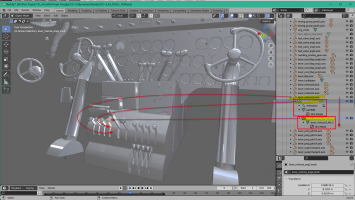
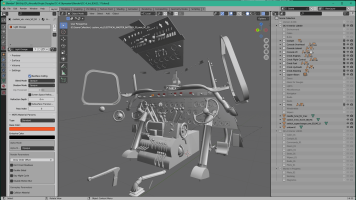
Initially after MCX step :
After cleaning operations :
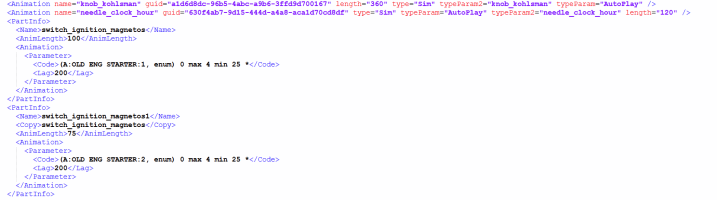
As for the XML code automatically generated by MCX, it is in <PartInfo> format for 80%, the rest can be very
simplistic ModelBehaviors that are automatically generated. Indeed, this code is usable by MSFS 2020 and 2024 but for how long?
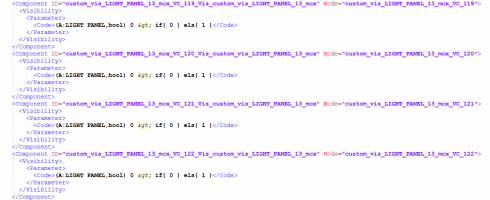
The MSFS engine is built to comply with an SDK and it gives its maximum if it is allowed to load an aircraft that complies with this SDK and especially the most recent functions and not those that date back 20 years ...
Finally, an aircraft whose 3D is optimal, well broken down into coherent objects and with an XML code based on the latest principles of the SDK
allows very easily to be subsequently used under another SDK to be compiled into a native FS24 aircraft !
It is for all this work and all these technical details that I consider that it is not an "improved mod" but a native creation based on a 3D model created by another person, whose consistent work I commend he has done with FSDS. (
software that I have never been able to master by the way 
)
Need. More. Axes!





 www.justflight.com