DC-4 Skymaster

Hello Didier,

Thank you for the update and you're cerainly right about the amount of work you would be facing to every version of the C-54 and DC-4. Just two examples is a good choice, a DC-4 and a C-54E. These will be a great addition to your growing fleet of airplanes. Here is information about the C-54E fuel system and is this the one you will be modeling in your C-54E? This tank figuration was also used in the DC-6 as modeled by PMDG, with slight differences in the cockpit controls.

Ed

  • Capacity: The C-54E featured a total fuel capacity of approximately 3,540 US gallons.
  • Integral Wing Tanks: Unlike early C-54 models that used soft-walled tanks in the cabin, the C-54E (following the B-model design) used integral fuel tanks built into the outer wings.
  • Tank Layout: The C-54E typically featured an 8-tank system (main and auxiliary tanks). The design changes from the C-54D to the E-model finalized the removal of soft-walled cabin tanks, replacing them with more efficient wing-located storage.
  • Components: The fuel system includes engine-driven fuel pumps, booster pumps, selector valves, crossfeed valves, and shut-off valves for each tank.
  • Fuel Management Strategy: Standard operating procedure for the C-54 (8-tank system) involved taking off on main tanks, cruising on auxiliary tanks, and switching back to main tanks for landing.
  • Selector Positions: The fuel selector valve positions for the 8-tank system were: REAR—OFF; CENTER—MAIN TANKS; FORWARD—AUXILIARY TANKS.

    Key Changes in the E-Model
  • Convertible Cabin: The move to wing-based, soft-walled tanks (or integral tanks) allowed for a convertible cabin, allowing the C-54E to function as either a troop transport or cargo hauler without the restrictions of large fuel tanks in the main fuselage.
  • Production Location: The C-54E-15-DO was produced at the Douglas Santa Monica plant, with the C-54E version overall aimed at increasing fuel capacity and efficiency over the C-54D.
Operational Considerations
The fuel system enabled the C-54 to achieve a range of around 3,000 miles. Proper fuel management (using varying power settings) was key to maximizing this range, a technique crucial for the type's extensive use by Air Transport Command.
 
Currently, I have no precise idea on the tanks number that I will modelized:
- 4 ("one" for each engine) or
- 8 (main+ aux for each engine)
As I said previously, I would add an advanced management system (written for the GAS Stearman) which can manage fuel and oil system. The XML code is written and tested, the only think is to multiply 4 times the code for the four engines.

If I looked closely at the video about the N500EJ that I posted yesterday, it seems that the 4 large fuselage tanks have been removed and replaced by smaller flat tanks (with a few extra jerrycans just in case), placed at the front of the plane. (on the video we see the sky blue curtain right in front of these tanks and the cockpit as an extension). The plane has been significantly lightened: there are only 8 seats left on the wings. It would be tempting for me to do it again identically.

For now, I tried to understand how superchargers were managed in MSFS. I don’t like simulating a supercharger using the turbocharger parameter: it's as this I have modelized the Stearman IB75 but it's not te reality.

Since MSFS, there is two parameters for this function :
- supercharger = 1 (it's the Legacy FSX implementation - see below for technical notes provided by the SDK)
- new_supercharger = 1 or 2

The "new_supercharger = 2" parameter that allows you to simulate an overload with several steps (5 at most).

; --------------------NOTES ON SUPERCHARGER--------------------
; In Legacy FSX, the supercharger - activated using the supercharged parameter - used a calculation that was actually lacking an essential parameter:
; boost = ( supercharger_boost_high_end - supercharger_boost_low_end ) * Throttle_position
; In this formula, the supercharger_boost_low_end parameter is not used at all.
; In Microsoft Flight Simulator this has been rectified and you can enable the use of the correct formula by enabling the new_supercharged parameter in the engines.cfg file, using one of the following values:
; 1: This will make the simulation use a fixed formula to calculate the supercharger boost using the existing legacy supercharger parameters supercharger_boost_high_end and supercharger_boost_low_end.
; Boost will then be calculated using the following formula:
; boost = ( supercharger_boost_high_end - supercharger_boost_low_end ) * Throttle_position + supercharger_boost_low_end
; 2: This will permit the simulation to have multi speed support for the supercharger using the following parameters: supercharger_altitude_gear.N, supercharger_boost_high_end_gear.N, supercharger_boost_low_end_gear.N.
; This system will allow for a maximum of 5 gears. As an example, if a two speed supercharger is needed then the CFG parameters would have this structure:
; supercharger_altitude_gear.1 = [VALUE]
; supercharger_boost_high_end_gear.1 = [VALUE]
; supercharger_boost_low_end_gear.1 = [VALUE]
; supercharger_altitude_gear.2 = [VALUE]
; supercharger_boost_high_end_gear.2 = [VALUE]
; supercharger_boost_low_end_gear.2 = [VALUE]
;
; When using the multispeed supercharger you can monitor which gear is engaged by monitoring the SimVar RECIP_ENG_SUPERCHARGER_ACTIVE_GEAR.
; The supercharger system will continuously check if the current Pressure Altitude is superior or equal to the altitude at which each gear should engage in order to automatically switch between the gears.
; If an altitude is set as -1.0 the gear is considered inactive and the engaging altitude for this gear will not be checked thus preventing the switch to this particular gear (which is why default altitude
; value is -1.0). When a gear is engaged the boost values corresponding to this gear will be used in the following calculation of boost:
; boost = ( supercharger_current_gear_boost_high_end - supercharger_current_gear_boost_low_end ) * Throttle_position + supercharger_current_gear_boost_low_end
;
; IMPORTANT! When using the "new_supercharged" param, the legacy "supercharged" parameter must be either set to 0 or removed from the CFG file.

By reading how VIRTAVIA made the Grumman F7F-3 Tigercat, I think I can adapt it to the DC-4/C-54 and test it.
According to what I read two years ago, one of these two parameters "supercharger" was buggy, I hope Asobo has fixed it since.

The animations and codes used to manage the selection levers (and crossfeeds) of the tanks are very simple, and by tomorrow this should be done (I think that this answer to yours questions ;-) )

Ah ... I was going to forget: the Cold & Dark start is also planned, but once the overhead and the last gauges are animated and coded.
 
Last edited:
Thank you Didier,

A consideration to choose the 8 tank version is we can fly maximum range flights with the airplane.

Looking forward to your beta release.

Ed
 
Here is some very interesting reading about KORD, and it was first known as Orchard or Douglas Field. ORD was the three letter identifier for Orchard, and it was built for the production of the C-54 during WW2.

The only building remaining is the old Administration Building, now the city of Chicago Department of Aviation building.

I didn't know the history of that actual airport area and this is just something I discovered this morning. I was doing some reading about the C-54 and they mentioned they were built in the Douglas facility in Chicago. I didn't know Douglas built C-54's in Chicago! Or that the ORD airport was actually constructed for the building of the C-54's.

So KORD exsists today because of the C-54. Now how cool is that?

And Didier is putting in countless hours to bring us this historic airplane to MSFS!

Thank you Didier!!!

Ed


Here is some more interesting reading about the Douglas Chicago airport and the C-54 and some history about the first C-54 built at that plant. It had a sad ending indeed, and to think this was only one of countless facilities built during WW2 in America.

The bottom link is another Chicago project that is truly amazing, the manufacturing of the Wright R-3350 for the B-29. I have watch this a couple time and I am just amazed at what they were doing back then. The machines and manpower and womenpower, can't not forget the part women played in the manufacturing aspect of the WW2 years! Another interesting subject is the WASP pilots of that time.


Here is an interesting article about the construction of Douglas Field and the C-54.


More interesting reading about the WASP pilots and flying the C-54.


Last edited:
Hello,

After a few days of rest, with the aim of modeling fuel management as best as possible, I reread several times the 3 flight manuals available to me on the C-54 A& B, C-54E, and R5D, and it seems that the best compromise is to model the C-54E but compared to what "Flight Replicas" had achieved, there are several changes to be made on the MSFS native aircraft.

Pros and cons :
+ The DC-64 L1009 is directly derived from the C-54E ( good point for the commercial liners as Air France, South Africa and TWA models)
+ The N500EJ is a modified C-54E model (this for the DC-4/C-54 modernized panel)
+ The number of tanks is 8, which offers great autonomy (not the largest but it is interesting)

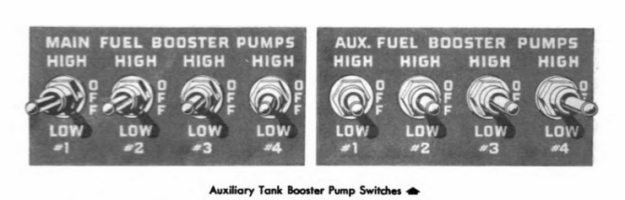
- There are 8 boost pumps (one for each tank) on this model, not 7 as on the A & B models, so the overhead panel needs to be reviewed.
1776341845177.png
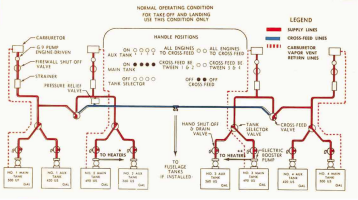
Nota : each switch has 3 positions: Low - Off - High for better fuel management (economy)

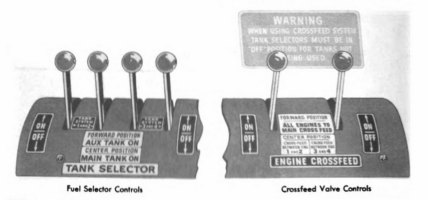
- Fuel selectors now have 3 positions : OFF - Main tanks - Aux tanks
- The crossfeed levers have also 3 positions: OFF - Cross-feed between 1 & 2 or 3 & 4 - All engines are cross-feed ... and only 2 crossfeed levers are needed as we can see on the picture published in post #111 (two red levers only on the right of the pedestal)
1776341935587.png

I extracted theses pages that detailed the fuel system on the C-54E to make a dedicated PDF and I did the same thing for managing engine oil tanks.
 
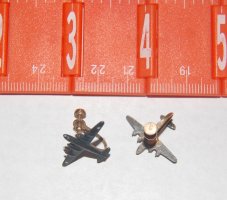
I loved all that about ORD (Orchard Place). My great grandparents owned one of the farms adjacent to Orchard Place from 1890's. My Dad's father and his two brothers worked for their Dad on the farm and brought produce to "Farmers' Market" in Chicago on Elston Avenue by horse and wagon. Up until about 50 years ago, my then wife-to-be and her mother and sister lived in a third floor walkup right behind it on Monticello Avenue in Chicago. After the farm was sold, and great-grandpa and the oldest son died in the flu epidemic, grandma sold the farm and the two boys took their mother and moved into Chicago. My grandfather worked for Chicago Surface Lines as a motorman on one of the Elston Avenue streetcars every day traveling past that farmers' market during the Depression. My father recited all this family history to me. Then during World War II, my best friend who was almost as old as my dad, and like an uncle's mother worked at the Douglas Aircraft Company as a "Rosie The Riveter" on C-54's. He'd tell me about riding around the plant with his mom on a Cushman golfcart because it was so large. He left me among the inherited things, a pair of sterling silver "C-54" earings his mom was awarded for something but he couldn't remember what. Our family always talked about fate that if they had held onto the farm until Douglas came, they might have gotten some real money for it. Our family's motto has always been: "A day late or a dollar short" LOL.
 
Last edited:
That’s really what I like about exchanges during discussions about our hobby : stories about "slices of life", getting to know other people ... more than 6000 kms or even more, etc.

During discussions about the Canso PBY, I got to know Bô Bonbohom, a Quebecer from Montreal with whom I fraternized for more than 10 years, through our forum (2010 - 2024).
We talked on Skype at least 4 times a month and he had become a true friend. Recently, during a trip to Quebec with my daughter, I was able to meet him and share a meal and an afternoon with him at the "Trois-Rivières" airport: it was very moving to be able to make such an encounter with him, whom I had been exchanging with for so long.
Unfortunately, he passed away two years ago and never saw the final version of the PBY. But I still remember a very good friend with an inimitable accent that I sometimes had a lot of trouble understanding: no matter how much we both spoke French, sometimes it was very funny and we often repeated ourselves.
 
I understand what you mean about France/French and Quebec?French.
Being a "displaced Northerner" to the deep South here in the USA, I still after 15 years have trouble understanding people and their expressions, too. We all speak American English, right? NOT!!! LOL! And thank YOU for your past help through FSDevelopers.
 
Thank you for sharing that story about your family and sorry to hear that your great grandfather and one of your uncles were lost during the flu pandenic of 1918. That must have been devastating to your family, especially your poor great grandmother.

I found the story of the construction of Douglas Field in 1942 very interesting and that is why I posted it here, as it, and the C-54 share a page in history together.

Also, a note, is that it was mentioned that one day they showed up to work, it may have been August 17, 1945 and the facility was locked down and everyone was told to go home, the war is over! Think of the number of people that lost their jobs that week across America, but that being said, they did not lose their lives to the conflict, just a job.

Which led to the baby boom!

Now everyone was getting married and making babies!

The internet is a great resourse for history that just keeps getting better and better.

If you can, post a picture of those C-54 earrings. I would like to see what they look like.

Thanks again for sharing your story with the rest of us,

Ed
 
Haven't thought about that in so many years. Here is a shot of the earrings. I used to take a lot of miniature photography so I had my closeup lens set to do these justice. They ARE tiny as you can see from the ruler. I forgot they had the 1941 insignia on the wings. And they are sterling silver AND gold. I think it would be fair to say like so many heirlooms in so many jewelry boxes and trunks in attics, they are a part of history. I was collecting military and navy insignia 20 years ago. Does anyone younger than me know what a "sweetheart pin" is? The first one to answer wins a Kewpie doll. (And all those under 30 say...WHAT? LOL) Ooops, sorry lagaffe, I didn't mean to hijack the thread.
C-54 Earrings.jpg
 
Last edited:
Thanks for posting that picture.
You are welcome. No answers, so I guess I'll enlighten ya'all: "Sweetheart" pins were miniatures of either hat emblems or wings of USAAF and USN members shipping out to their loved ones to remember them while they were away for a long time. When I collected I would bid on lots not just one item and many came with sweetheart pins of all kinds, some even with a miniature photo in a cameo. Like those earrings, these to me are priceless pieces of WWII history. I imagine that almost if not all of those who bestowed them are now gone on and just a distant memory to the grand kids or great-grand kids who put all of their "stuff" on eBay. Now, that's all from me so that lagaffe can back to the purpose of this thread. Thank you for letting me share a memory or two.
 
The new [FUEL_SYSTEM] is almost done with:
- 4 main tanks,
- 4 aux tanks,
- 4 driven pumps for the engines
- 8 electric pumps (4 for the main tanks and 4 for the aux tanks)
- 8 valves to open or close the fuel flow
- 4 junctions to rely one main and one aux tanks
- 16 lines to rely al this stuff.

1776538024321.png
The [ELECTRICAL] system has been also reviewed to take in account the new electrical circuits necessary for this devices.
All this makes it possible to manage the fuel supply to the engines either by using the main tanks, or the auxiliaries, or by mixing the two types.

On the other hand, the management of the cross-feed will be carried out in a future step as soon as possible.

Currently the aircraft can start with "CTRL+E" but ... after one or two minutes ... it stop ! :banghead:
I probably forgot something and I think it might take me a day or two to find the mistake that I have in front of my nose but can’t see.
 
Back
Top