
-
Please see the most recent updates in the "Where did the .com name go?" thread. Posts number 16 and 17.
-
Special Server Maintenance
Just when you think you have everything running some what better...
You get a message from the Hosting company. Short story they need to move us to a new server. I have been working with them to plan a good date for all concerned. Here is what we have come up with as a schedule.
- November 4th 17:00 -5UTC shut off the forums and start backup proceedures. During this time there will be no access to the forums or the Resource Section.
- November 5th Continue with Backups and download same until complete.
- November 6th 7:00 turn over server to hosting company to move system to new server
- November 7th - 8th restore backups and upgrade forum software.
If all goes well we should be back online on November 8th.
To keep you updated we will post updates on AVSIM forums.
Thank you for your support.
You are using an out of date browser. It may not display this or other websites correctly.
You should upgrade or use an alternative browser.
You should upgrade or use an alternative browser.
Screenshots!
- Thread starter Bravo/4
- Start date
Effing hell MM!!
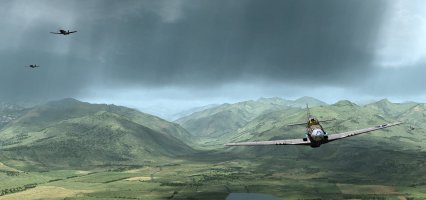
What a beautiful pic....autumn over Korea...just superb.
(I'm keeping that as a background slideshow pic. )
And G, those Spit pics, so good, so evocative of a dawn patrol over the WCoD. I love the pics you do from the inside the cockpit with hood reflection etc, again so realistic. (And I'm using that one as well..ha ha!)
Thank you gents.
Cheers
Shessi
What a beautiful pic....autumn over Korea...just superb.
(I'm keeping that as a background slideshow pic.
)And G, those Spit pics, so good, so evocative of a dawn patrol over the WCoD. I love the pics you do from the inside the cockpit with hood reflection etc, again so realistic. (And I'm using that one as well..ha ha!)
Thank you gents.
Cheers
Shessi

MajorMagee
SOH-CM-2022
She's not dead yet.

Frosty
SOH-CM-2026

What did you do to get those extremely densely wooded hills? A Cray supercomputer? Is it a heavily modded version of DPC Korea? Probably too many things to share with us? It looks so fantastic!! I agree with Shessi; I might save this as background piccie (which I would normally never do!)

mongoose
SOH-CM-2026
Also I would have to update my graphics card.Ah, so!
But that is ... blasphemy!! Pitchforks, tar and feathers! What is he trying to do? Lure us to the dark side?
(Still a VERY nice piccie, though - and the wrong forum

Pat Pattle
SOH-CM-2026
I'd like to see those trees from down low. In the original IL2 series the tree canopy was just flat textures that looked great from above but iffy if you flew close. Would love to be proved wrong but I can't afford it at the moment.
MajorMagee
SOH-CM-2022
The trees look good in Korea even close up. I dare not post another example for fear of being burned at the stake.
BTW, you can see AnKor over there in a professional capacity.
BTW, you can see AnKor over there in a professional capacity.

Now that is MSFS 2020 quality to say the least!!!Here's a state of the art DX12 example for comparison. I'd say our old girl is still doing just fine!
View attachment 199757
Frosty
SOH-CM-2026
... I dare not post another example for fear of being burned at the stake. ...
Aw, come on, Andy, it was just in jest! If you are discouraged that easily, it's only good that you didn't choose to become a travelling evangelical preacher
. Come now, tempt us to join the dark horde!
MajorMagee
SOH-CM-2022
Well, as it turns out, I've done that. Back in 2006 I preached Paul's sermon about the Unknown God in a Taoist Temple on Laoshan Mountain looking out over the sea on a Sunday morning to a couple of Buddhists. So here you go...
Last edited:
Frosty
SOH-CM-2026
Well, as it turns out, I've done that. Back in 2006 I preached Paul's sermon about the Unknown God in a Taoist Temple on Laoshan Mountain looking out over the sea on a Sunday morning to a couple of Buddhists. So here you go...
Who would have guessed....?
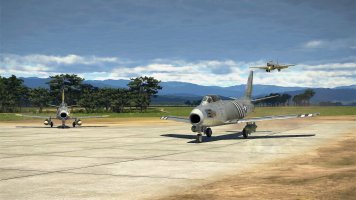
Again, wonderful screenie!! (Look at the weather!! )Reminds me of when I first started visiting this site. The IL2-CFS3 flame wars were erupting. That too would pass but it drove the CFS3 developers to greatly improve the appearance of CFS3. So posting pictures from any IL2 game is helpful
Of course I am poking fun at those days!
Personally, I don't give a rat's ass about who's flying what, as long as they're all having fun. And I certainly don't mind the occasional teaser of what another sim is like - I have done it myself. Admittedly, I was fooled in believing it was some souped-up version of CFS3, as that sharkmouth F-51D is in CFS3 Korea (though a different A/C number, I noticed later). Good stuff, this all is!!

gecko
Charter Member
A few short minutes ago I was up among those cirrus clouds at 30,000ft.
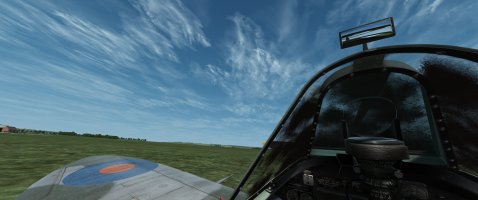
I began a shallow dive, but realized too late that the extreme cold and the moisture that had condensed on the way up had caused my propeller pitch change mechanism to ice up. These first generation De Havilland constant speed units are prone to that if you don't exercise the engine speed control periodically at high altitude. I hadn't. The engine rapidly over-sped, and so did the aircraft, with each of these two factors only worsening the other. Both engine RPM and airspeed were soon off the scale. I entered compressibility about the same time my engine began a rapid unscheduled self-disassembly, which brought my propeller to a sudden and complete stop with a screech and a loud bang and sprayed oil all over the windshield. Compressibility was causing the dive to steepen uncontrollably, and I was still accelerating. Too fast to get the canopy open (this wasn't one of the improved design that can be jettisoned) and even if I did, I'd be pinned to the canopy frame by the screaming 500 mph+ blast of air. No choice but to stay with her and hope the denser air at low altitude would slow me down and make my elevator effective in time. Slowly, the compressibility effects began to diminish, but not quickly enough. As a last resort, I deployed the flaps, knowing full well they'd quickly be ripped from my wings at this speed, but hoping they would at least help me decelerate for a moment, and the drag from whatever wreckage was left behind might help further. It worked, and I was able to pull my much-abused airplane out of the dive, with a couple thousand feet to spare. I put the flap switch back up to prevent the now torn-open pneumatic lines to the flaps from draining all of what remained of my pneumatic pressure. With no engine to drive the compressor, I would only have what was in the reservoir, and if I was lucky enough to be able to make a wheels-down landing, I'd need that for the brakes.
Now slowed down, I was able to open the canopy to see around the oil, and see what my options were. I soon found West Malling within easy gliding distance, so I opted not to bail. Now to get the undercarriage down. My engine-driven hydraulic pump was obviously not going to do me any good, so I followed the emergency procedure: set the undercarriage lever to the DOWN position, and then (and only then) push the red emergency undercarriage extension lever forward and down. I could hear the hiss of the compressed air pushing the undercarriage down, and soon saw the green DOWN indicator illuminate, and there was a red indicator pin sticking out of each wing. I was home free now. Time to secure the aircraft for a potential crash landing if something didn't go to plan - fuel cocks off, ignition off, cockpit door to the half-cocked position to keep the canopy from slamming shut and jamming in the event of a rapid deceleration. The glide was progressing beautifully, my landing run was now aligned with the windsock, and I had a nice light touchdown and a slow roll to a stop in the middle of the grass of the airfield, using the last gasps of my pneumatic pressure on the brakes.
Who says non-combat flights are always boring!
I began a shallow dive, but realized too late that the extreme cold and the moisture that had condensed on the way up had caused my propeller pitch change mechanism to ice up. These first generation De Havilland constant speed units are prone to that if you don't exercise the engine speed control periodically at high altitude. I hadn't. The engine rapidly over-sped, and so did the aircraft, with each of these two factors only worsening the other. Both engine RPM and airspeed were soon off the scale. I entered compressibility about the same time my engine began a rapid unscheduled self-disassembly, which brought my propeller to a sudden and complete stop with a screech and a loud bang and sprayed oil all over the windshield. Compressibility was causing the dive to steepen uncontrollably, and I was still accelerating. Too fast to get the canopy open (this wasn't one of the improved design that can be jettisoned) and even if I did, I'd be pinned to the canopy frame by the screaming 500 mph+ blast of air. No choice but to stay with her and hope the denser air at low altitude would slow me down and make my elevator effective in time. Slowly, the compressibility effects began to diminish, but not quickly enough. As a last resort, I deployed the flaps, knowing full well they'd quickly be ripped from my wings at this speed, but hoping they would at least help me decelerate for a moment, and the drag from whatever wreckage was left behind might help further. It worked, and I was able to pull my much-abused airplane out of the dive, with a couple thousand feet to spare. I put the flap switch back up to prevent the now torn-open pneumatic lines to the flaps from draining all of what remained of my pneumatic pressure. With no engine to drive the compressor, I would only have what was in the reservoir, and if I was lucky enough to be able to make a wheels-down landing, I'd need that for the brakes.
Now slowed down, I was able to open the canopy to see around the oil, and see what my options were. I soon found West Malling within easy gliding distance, so I opted not to bail. Now to get the undercarriage down. My engine-driven hydraulic pump was obviously not going to do me any good, so I followed the emergency procedure: set the undercarriage lever to the DOWN position, and then (and only then) push the red emergency undercarriage extension lever forward and down. I could hear the hiss of the compressed air pushing the undercarriage down, and soon saw the green DOWN indicator illuminate, and there was a red indicator pin sticking out of each wing. I was home free now. Time to secure the aircraft for a potential crash landing if something didn't go to plan - fuel cocks off, ignition off, cockpit door to the half-cocked position to keep the canopy from slamming shut and jamming in the event of a rapid deceleration. The glide was progressing beautifully, my landing run was now aligned with the windsock, and I had a nice light touchdown and a slow roll to a stop in the middle of the grass of the airfield, using the last gasps of my pneumatic pressure on the brakes.
Who says non-combat flights are always boring!
Last edited: