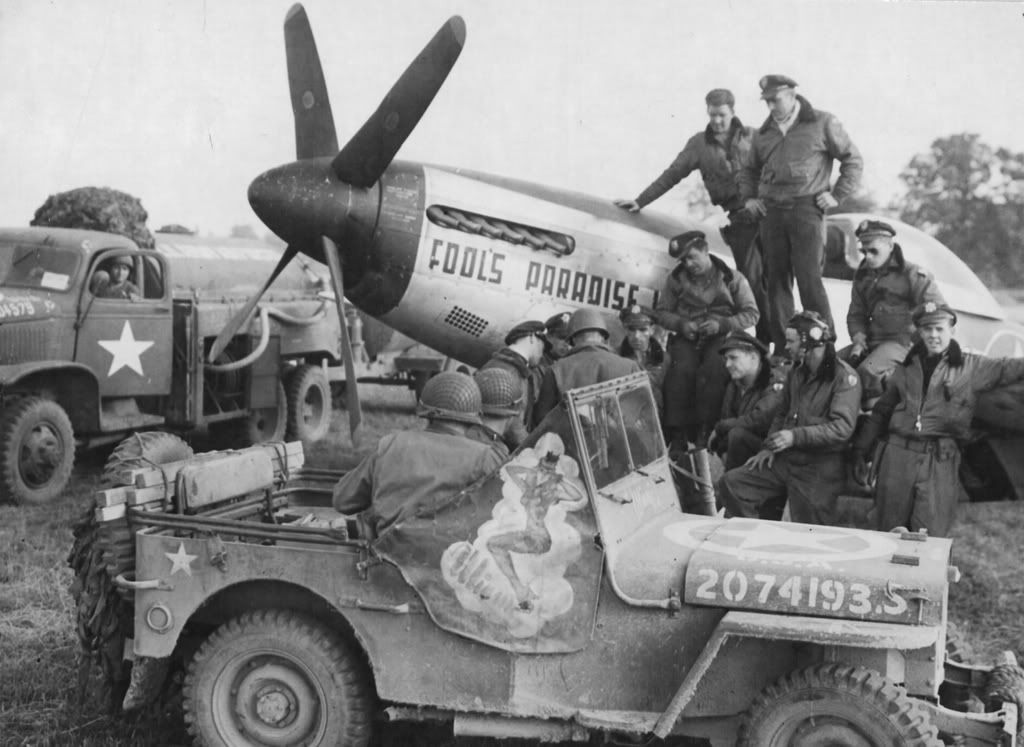
"Fool's Paradise IV"
I had plans at one time to reproduce this scheme, so I have done a bit of research on it already. The nose color and color of the nose art typography, was
very likely to have simply been flat black. The reason being, is that at the time, the noses of all Mustangs were painted black (at the same time the black bands were added to the wings and tails - which was at depot level, where the aircraft received their final servicing and checks before being flown to their assigned units), for quick identification purposes. Once assigned to and stationed with a group, the nose was over-painted with the color(s) of the individual group, by the group itself. When the black paint was applied to the nose (at depot-level, before individual assignment), there was also a strict procedure that was adhered to, in which the stencils that were over-painted, were re-applied in white (and differing in wording from the original factory stencils). Once the individual group colors were applied, these stencils too were over-painted/lost. This other photo of "Fool's Paradise IV" that exists, clearly shows those very stencils, applied at depot level, still remaining, clearly illustrating that the paint on the nose still remains the same black-identification paint applied from depot-level. Depictions of other aircraft within the 363rd FG, from the same time period, also show the noses simply remaining black.
The 20th FG ("Glengary Guy" for example) utilized the black-painted nose from the depot for the basis of the nose-markings/paint on their aircraft as well, with those white stencils, applied at depot level, remaining too (as can be seen on the depiction of "Glengary Guy" within Little Friends II).
Regarding invasions stripes - you have to understand that just a few weeks after June 6th, there was actually an order (thus it had to be adhered to), that
required the invasion stripes to be removed from the top surfaces of all aircraft that had them fully applied. There were only to be stripes as seen if looking up at the aircraft from the ground (these no longer being 'invasion stripes'). Some worked with paint-remover to get rid of the stripes from the upper-surfaces, but this didn't bode well for the finish on the wings (which had layers of putty and paint already, from the factory - there was actually a very stringent outline for how to properly repair the finish of the wings, if paint-remover was used on the wings, as provided by North American Aviation). The easiest thing was just to paint over them, with whatever paint could be found, which was usually either USAAF Olive Drab, or RAF Dark Green (the thinking being, that these were still considered to be the typical upper-surface colors of the time, despite all Mustangs coming off the assembly line in silver/bare-finish). Based on the best photo-view of the aircraft, it clearly had a coat of some form of "camouflage green" carefully applied over the invasion stripes on the fuselage. With the tonal-differences as seen on the wing fillets and flap, I would also venture to say that the same paint was used to paint over the invasion stripes on the tops of the wings, from just in-board of the out-board side of the flaps (furthest edge of the invasion stripes) all the way to, and onto, the wing-to-fuselage fillets. There was likely only one quick coating applied, as the invasion stripes can still be seen through the OD/Green paint.